I have a serious question for people who insist there’s nothing to worry about when it comes to political Islam.
Why are so many governments, intelligence agencies, research institutes, and investigative organizations spending millions of dollars and countless hours examining Islamist ideology, political influence, financial networks, recruitment, and expansion?
We don’t see the same international counterterrorism apparatus devoted to tracking Judaism or Catholicism as religions. So why does political Islam attract this level of scrutiny? Why have countries banned the Muslim Brotherhood, investigated its affiliated institutions, and spent decades trying to understand how its networks operate?
And at what point do we stop dismissing the concerns of people asking these questions?
I’m not asking anyone to take my word for it. I’m asking why these investigations exist in the first place, what governments have discovered, and why so much of the public seems uninterested in finding out.
Those are questions worth answering. And they’re the questions behind this investigation.
In June 2022, German lawmakers wanted answers about a British charity with ties to the Muslim Brotherhood that owned property in Germany. One of its holdings was in Berlin’s Wedding district, on the grounds of an old AEG-Telefunken factory. The site covered about 1.4 acres and included a five-story office building. German security authorities had identified organizations operating there with connections to what they call legalistic Islamism, an approach to advancing Islamist political goals through lawful institutions.
The charity was Europe Trust. It had been founded by the Council of European Muslims, formerly the Federation of Islamic Organisations in Europe, or FIOE. German authorities associated that organization with the Muslim Brotherhood’s European network. Ibrahim El-Zayat, a German businessman with longstanding Brotherhood connections, had served on Europe Trust’s board until 2014.
The lawmakers wanted to know what Europe Trust had bought, how much it had paid, and where the money came from. Germany’s federal government confirmed that the trust owned properties in Berlin and Lüdenscheid in 2019. It identified the organizations involved but couldn’t provide a complete account of the purchases.
Europe Trust was registered as a British charity, and its financial statements provided more information. In 2019, the trust reported approximately $6.5 million in property investments. The buildings supported mosques, Islamic community centers, and educational institutions. Some tenants paid reduced rent, while others paid nothing. Properties valued at approximately $1.7 million produced no investment income.
The trustees explained that the buildings helped the charity carry out its work. They also gave it assets that could remain under the trust’s control for years. A mosque could use one building, a school another, and a community organization a third. Directors and tenants might change, but the property could stay with the same owner.
In December 2015, Britain published the findings of a government investigation into the Muslim Brotherhood. The review identified organizations that had operated in the country for decades, some established by Brotherhood members and others influenced by its teachings. In June 2016, Parliament questioned Ibrahim Mounir, the Brotherhood’s deputy supreme guide, about the movement’s international leadership. Mounir was living in Britain and held a senior position in its international organization.
France was investigating an Islamic educational institute that had trained imams and teachers since 1990. Authorities examined its teaching materials, leadership, and connections to Brotherhood-associated organizations. In September 2025, the French government dissolved the institute, citing material that officials said encouraged hatred, discrimination, and violence.
The United States was examining financial connections. In January 2026, Washington designated the Egyptian and Jordanian branches of the Muslim Brotherhood under counterterrorism sanctions. In July, Treasury sanctioned Mahmoud al-Abyari, a senior Brotherhood official based in Britain, and identified financial operations in Türkiye, Indonesia, and Gaza that it accused of supporting Hamas.
On October 2, American and French authorities announced arrests involving people accused of collecting money for Hamas through humanitarian appeals. Prosecutors said the operation had raised more than $1.7 million since January 2020. Defendants included residents of Louisiana and Florida, along with people arrested in France.
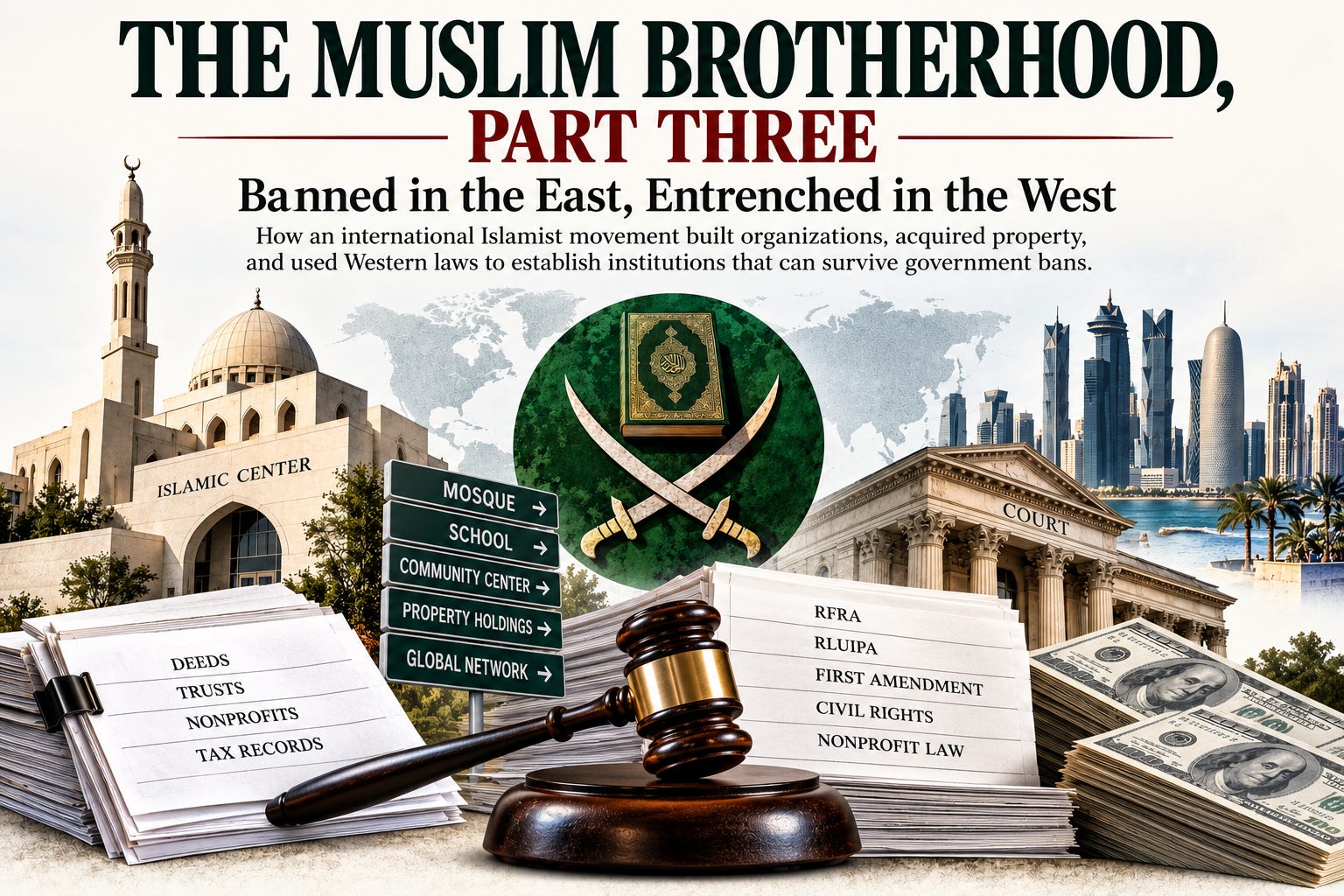
The Brotherhood had been outlawed in Egypt and faced restrictions in other Middle Eastern countries, but organizations and individuals influenced by the movement had spent decades establishing institutions in Western countries. Some maintained direct organizational connections to Brotherhood leadership. Others shared its ideology or had been founded by former members. They operated under different names, with separate boards, charities, schools, and property holdings.
Governments could close particular organizations or prosecute their leaders. Other institutions, buildings, and supporters could remain.
Previously in this investigation
A note about the paywall: I’ve kept these investigations behind a paywall from the beginning because I’m concerned about being targeted by certain entities. I’ve heard enough to take that possibility seriously. I know that sounds paranoid, but I see what they’ve done to Amy Mekelberg of RAIR and others who dare say something. So a paywall offers limited protection, and maybe even a false sense of security, but it’s one precaution I can take while continuing this work. Thank you to everyone who understands and supports these investigations.