Innovation is moving at unprecedented speed. Over the last few days, the signal worth paying attention to was not another model leaderboard jump by itself. The stronger signal was how much of the serious conversation shifted toward inference budgets, workflow cost, and the systems that decide when expensive reasoning should run at all.
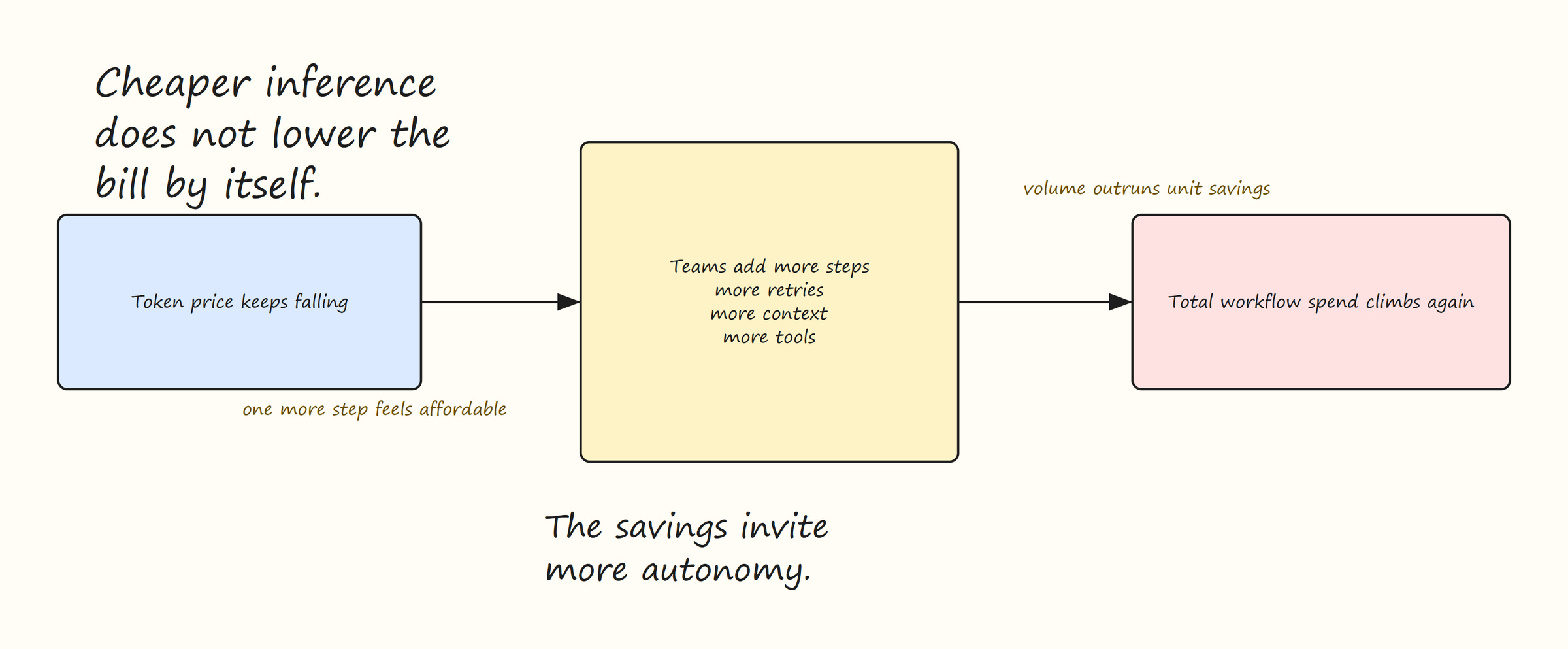
That shift matters because cheap tokens did not make AI cheap. They made it easier to ask for more work. Once teams can afford one more agent step, they ask for ten. Once they can afford ten, they add tools, memory, verification, retries, longer context, and background runs. The unit that looked cheap in isolation becomes expensive again once it sits inside a real workflow.
This is what looked worth paying attention to over the last few days. The free section makes one claim: the next durable moat in AI is workflow economics. The paid section, Going Deeper, turns that claim into an operating memo and weekly checklist you can use right now.
Figure 1 shows the shift at a glance. Token prices can fall while total workflow appetite rises even faster, which means the total bill keeps climbing unless somebody governs what work deserves expensive reasoning in the first place.
Figure 1: Cheap tokens increase workflow appetite faster than they cut spend
The first trap in this market is confusing lower unit cost with lower total cost.
That logic worked in simpler software markets because usage often stayed bounded. If a storage price fell, many teams banked part of the savings. If bandwidth got cheaper, many teams still kept the same product shape. AI does not behave that way. Every drop in model cost invites a product manager, engineer, or operator to ask for one more step of reasoning that felt too expensive last quarter.
That extra step rarely arrives alone. It brings tool calls, intermediate checks, retries, and longer prompts with it. The same team that used to buy one answer now buys a sequence: gather context, plan, act, verify, repair, summarize, and explain. Each individual step can look affordable. The workflow total can still outrun the budget very quickly.
This is why I think the cheap-token story confuses people. It frames AI like a commodity input when the real product has become managed autonomy. Once you buy autonomy, you are not only buying model output. You are buying duration, retries, coordination, and cleanup.
Figure 2 illustrates how the bill changes shape. A cheap single response becomes a multi-step workflow bill once you add planning, tools, checks, and human recovery around it.
Figure 2: One answer becomes a many-step workflow bill
That new bill matters because most teams still measure the wrong thing.
They ask what a prompt costs. They ask what a model call costs. They ask whether one vendor charges less than another. Those questions still matter, but they no longer describe where most of the money goes. The real cost now lives in the workflow around the model: context assembly, orchestration, waiting, verification, human review, repair, and the mistakes that spill into downstream systems.
You can see that shift in the products getting attention right now. The market no longer talks only about smarter models. It talks about routing, governance, auditability, data layers, and inference budgets. That is not a side conversation. It is the market admitting that the expensive part now sits in the surrounding system.
Once the surrounding system becomes the expensive part, margin stops depending on access to intelligence alone. Margin depends on how often you send the right job to the right lane, how rarely you let a workflow thrash, and how quickly you detect work that should never have reached a costly path in the first place.
Figure 3 makes that operational choice visible. The winner is not the team that sends every job to the smartest model. The winner is the team that routes cheap work cheaply, escalates only when needed, and keeps expensive reasoning scarce.
Figure 3: Routing decides where margin survives
Routing sounds tactical until you watch what happens without it.
Without routing, every workflow drifts toward the frontier. Teams keep the premium model in the loop because it feels safer, because nobody wants to miss quality, or because the product path never got redesigned after the first prototype worked. That habit quietly destroys margin. It also hides the real architecture problem, which is not model quality alone. The real problem is job placement.
Good job placement starts with a blunt question: what work actually deserves premium reasoning? Some jobs need deep synthesis. Some jobs need fast extraction. Some jobs need structured verification. Some jobs only need a hard rule and a cheap model. If you run those jobs through the same lane, the expensive lane becomes your default lane, and your default lane becomes your business model.
This is why workflow economics has become a moat. Strong teams now treat model choice like a portfolio decision, not a brand preference. They design lanes, promotion rules, fallbacks, and caps. They do not assume every task deserves the same cognition budget.
Figure 4 shows why this cannot live inside model selection alone. A workflow economics stack needs budgets, policy, trusted data, execution limits, and observation around the reasoning engine or the expensive lane expands on its own.
Figure 4: A workflow economics stack keeps reasoning inside budget
That surrounding system now does more strategic work than many teams admit.
The model still matters. I would not argue otherwise. But the budget outcome now depends just as much on context shaping, caching, permissions, semantic definitions, approval boundaries, and stop rules. Those controls decide how often a workflow escalates, how much context it drags into the run, and how many steps it burns before a human sees the result.
This is why the data platform and policy layer have become economically important. If the system can reuse trusted definitions instead of forcing the model to infer meaning from raw tables, it wastes less reasoning. If the workflow can call a cheap validator before it calls an expensive planner, it preserves margin. If the runtime can stop a looping repair path early, it prevents a cheap request from turning into an expensive incident.
People often describe these controls as governance overhead. I think that framing misses the point. In the agent era, governance is cost control. The same boundary that reduces risk often reduces waste because it keeps the workflow from spending premium cognition on avoidable work.
Figure 5 shows where most margin leaks actually appear. The model bill is only one leak. The larger leaks often come from fan-out, oversized context, repeated retries, and cleanup after the system kept working longer than the job was worth.
Figure 5: Most margin leaks happen outside the model call
Once you see the leak points, a better KPI becomes obvious.
The question is no longer "what does this model cost?" The better question is "what did a successful workflow cost us after the full run finished?" That metric forces the team to count the entire path: prompt volume, tool usage, validation passes, retries, wait time, human intervention, and recovery.
That shift changes which workflows deserve investment. A task with a high model bill can still be attractive if it closes quickly, lands accurately, and avoids human cleanup. A task with a low per-call price can still be a bad business if it sprawls across many steps, triggers review queues, and fails often enough that a human has to rebuild the output anyway.
This is where I think a lot of AI strategy will break over the next year. Teams that budget by prompt or by vendor rate card will keep underpricing autonomy. Teams that budget by successful outcome will see much earlier which workflows deserve more freedom and which ones need a cheaper lane or a harder boundary.
Figure 6 shows what the winning operating rhythm looks like. The moat does not come from one clever routing rule. It comes from a weekly loop that reviews outcomes, tightens lanes, and keeps autonomy aligned with actual value.
Figure 6: A weekly workflow economics loop compounds advantage
That weekly loop is the final market shift I would underline.
The teams that win from here will not treat AI as one giant budget bucket. They will manage it like a portfolio of workflows with different value density, different failure costs, and different reasoning needs. They will accept that some work deserves premium cognition, some deserves a cheap deterministic path, and some should never run autonomously at all.
That portfolio view creates compounding advantage. It improves gross margin because the team stops overspending on cheap work. It improves trust because operators can explain why one lane receives more authority than another. It improves product speed because routing rules become reusable instead of being reinvented inside each new feature.
Most of all, it gives the organization a way to keep scaling autonomy without pretending that cheaper models solved the economics. They did not. They simply moved the fight. The hard part now is deciding which jobs deserve expensive intelligence, which jobs deserve a cheaper path, and which jobs deserve no agent at all.
For paid subscribers: the workflow memo continues below.
The paid section turns the thesis into a practical operating memo with routing lanes, escalation rules, measurement targets, and a weekly checklist you can apply to your own AI budget. Subscribe here: https://kenhuangus.substack.com/subscribe?coupon=302342d9.