Do you think I’m human? Over the last two years, the American government has made me truly concerned that 77 million Americans voted because they believed I was not human. I’m not self-centered to imply they actually thought of me, Seema, at all. But looking at the Nobel Peace Prize winner and the current rejecter in the American government, I cannot help but feel that global society is at a crossroads, fighting to define who is human.
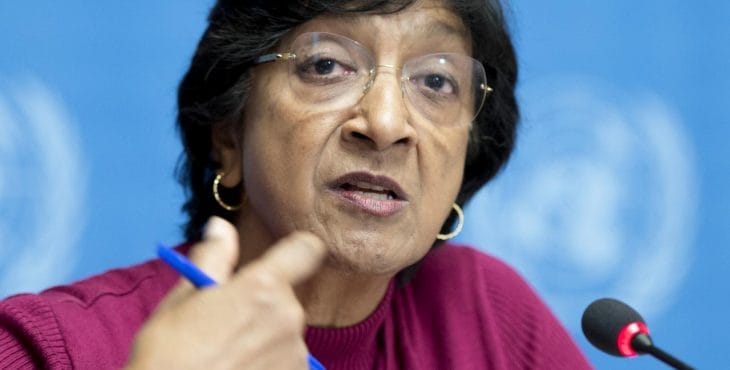
Navi Pillay is a jurist who has spent her career fighting on the international stage for basic human rights for all people. The same day that her prize was announced, the United States government announced they would be televising a death by firing squad to the whole world. These two stories encapsulate where we are in the world today.
Currently, the Trump administration is aiming to be the worst ever. As a historian, I’m sorry to say they have some room. But they’ve surpassed ineptitude and are moving quickly into cruelty and the inhumane. Many of the ghouls in Trump’s orbit want to squash the idea that anybody but white men deserve rights. Their idea of government works only for the few and, even then, happily shifts with the government’s whims. The kleptocracy they have installed under the guise of patriotism and democracy has largely stalled our economy and lost us a war. The only success they can boast of is making the United States a pariah on the world stage.
Recently, a Danish politician commissioned an artist to create a work about Donald Trump. The honest, if unflattering, depiction shows a nude Trump being carried by a slim golf caddy. (You can download a version to 3D print) The sculpture recalls 19th-century political cartoons in which the working class must hold up the Gilded Age. Its prominent place in Strasbourg, at an official EU building, reminds us that freedom of speech still exists elsewhere. After all, for all of Trump’s lip service about the First Amendment, he meant he should be able to say what he wanted.
Herein lies the challenge for all the Trump supporters, though I suspect, if you’re still gung-ho MAGA, nothing will sway you. Trump supporters wanted a man who would give them what they wanted. Their ideal was to keep getting government handouts without understanding how the government worked. They wanted to remain as racist as they could, though, and ideally get rid of any program that helps people who don’t look like them. Their ignorance was not constant when Trump was ineffective. Now that Trump is a puppet for Project 2025, MAGA is being made to suffer for their choice. So when, in the first term, they believed I, as a brown woman, was not a human, they didn’t suffer for their choice. Now, they might take pleasure in ICE terrorizing Brown people, but they won’t be able to feast in this economy on their rewards.
In governments that use bloodsport to maintain the existing order, people are expendable. Celebrating an enemy’s death can easily turn into watching your own future. The man who will be shot was a Brown American who did kill service members and other Americans. He served in the military as a psychiatrist. But this government’s love of cruelty will return the kind of hate this assailant had 1 million fold. Cruelty begets cruelty. Just as voting to take away my rights resulted in a government that happily negated benefits for anyone, a government that celebrates the death of one can arbitrarily turn that violence on anyone.
Which takes me to the work of Navi Pillay. Her grandparents were indentured servants from India, who were taken to South Africa. Raised under Apartheid, she enjoyed more rights than black South Africans, but fewer rights than white ones. This disparity, along with her upbringing as a Hindu who believed all people are equal and that human life is sacred, moved her to fight injustice. She eventually earned a scholarship to study law at Harvard. As the Trump administration demonstrates, Harvard has certainly educated some of the worst, but Navi used her degree to improve basic human rights for all. Her work impacted her own nation, including helping to dismantle apartheid. But she strove for human rights at the international level.
I can’t help but believe the Nobel Prize committee understood that by honoring a Brown woman who worked within an international body for every human’s right to exist, they were refuting the conservatism of men trying to go backward. As an American, this seems like an affront to Trump, which I adore. But the Hindutva movement in India is also about hierarchical human rights, and Brexit was about white people wanting special dispensation. These movements are all reactionary to the change of the late 20th century, change that can be characterized as just rectifying the dehumanization of some citizens.
That, in 2026, we remain unconvinced that all people deserve equal rights highlights how deeply some people are broken. That’s what we’re seeing in politics around the world. In the Enlightenment, the idea of human rights came to fruition, but only for privileged white men. 300 years later, as a society, we still can’t admit that every living human being is equal. Think of the sacrifices those hateful people will endure; for example, in the United States, universal healthcare, to hold on to their belief that some people don’t matter. Society bears the cost of their hate, and they only notice when they feel the harm. To me, the Nobel Peace Prize should remind us all that basic human rights remain hard-won. But also, the inequity of the world is a choice hateful people make, and not an immutable fact.