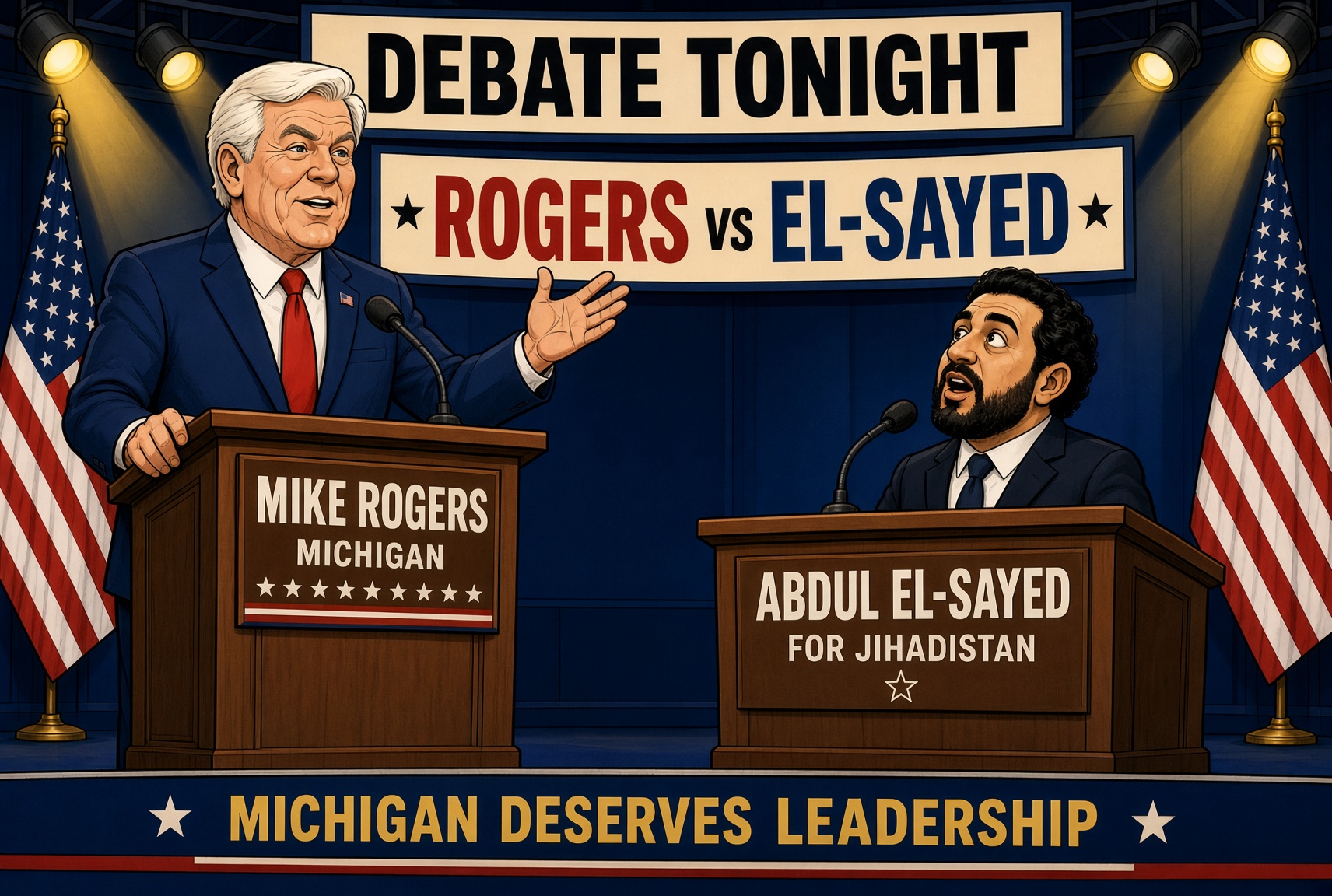
First, the soundbite heard round the world last night. From Michigan, this was Mike Rogers in the Senate debate.
That’s gonna leave a mark.
So will this about the house in the UAE.
And then this from Susan Collins in Maine.
Now, on to the other stuff some of you won’t like.
The Pentagon says the execution of Nidal Hassan will be livestreamed for the public to witness. Hassan is a paraplegic, confined to a wheelchair. The public imagery of a firing squad killing a man sitting in a chair because he cannot stand is going to undermine support for the death penalty. A society that increasingly finds ways to sympathize with the villains will do so here. This also gives Nidal Hassan the platform for martyrdom he wants. They’ll be passing out the livestream video in the Middle East to inspire more terrorists to shoot up Americans to celebrate the glory of the martyrdom of Nidal Hassan.
This is also a continuation of soul-twisting moral decline the country keeps going through as we leave authentic Christendom behind.
I support the death penalty. God himself told Noah that those who willfully take the life of another should be executed. My reading of the Bible, as a Reformed Christian, is that this pre-law command to Noah to take the life of those who willfully take the lives of others is binding on us now. I do not think it is a coincidence that societies that have abandoned the death penalty have fully embraced the cult of death. They no longer kill the murderers, but they relish killing babies, the elderly, and the infirm. It is not a coincidence.
But that doesn't mean we should be livestreaming an execution.
The United States Army prohibits public executions, though, of course, the Secretary of Defense can overrule those guidelines.
The pagan Roman Empire relished the public spectacle of executions. Growing up overseas in an Islamic country, some executions were public. Most brutal dictatorships publicly execute those who run afoul of the state. Christendom, over time, recognized that justice is not to entertain or titillate. Justice is not meant to be a spectacle.
In Ezekiel 33:11, scripture reads, “As surely as I live, declares the Sovereign Lord, I take no pleasure in the death of the wicked, but rather that they turn from their ways and live.” Proverbs 24:17 echoes that for us. “Do not gloat when your enemy falls; when they stumble, do not let your heart rejoice.”
In Chapter 19 of De Spectaculis, Tertullian, one of the early post-apostolic church fathers, wrote about the public spectacle of executions in Rome. “It is good, no doubt, to have the guilty punished. Who but the criminal himself will deny that? And yet the innocent can find no pleasure in another's sufferings: he rather mourns that a brother has sinned so heinously as to need a punishment so dreadful,” he wrote.
In Confessions, Augustine wrote of his friend Alypius, who, dragged into the Coliseum to see gladiatorial fights, shut his eyes, though not his ears. Upon the cheers of slaughter, he opened his eyes to the blood, and the bloodlust corrupted him. Augustine’s writing has long taught Christians not to be entertained by the spectacle of violence, as watching it can damage you.
We have come to increasingly recognize the coarsening of culture through pornography and the sexualization of culture. Embracing public executions — the sensationalism and spectacle of them — will do the same.
Pete Hegseth wants the spectacle of an Army firing squad gunning down a wheelchair bound paraplegic. If the Pentagon does go forward with this, it is actually soul-twisting to turn the execution of a criminal into reality television for the entertainment of Americans.
I expect a whole lot of pastors demanding you get into politics right now will be silent or defend this. They should not. Ironically, as Hegseth and others in the Trump Administration want to advance Christendom, it was American Christians in the early 1800’s who pressured local governments to stop public executions because of what the spectacle did to those who watched them.
Over to you, random internet dude who claims to be a committed Christian in the Presbyterian Church in America:
It turns out much of what you have bought over the past year should actually have cost less than it did.
According to new research from economists at the New York Federal Reserve, reported yesterday by CNBC, tariffs had pushed up prices on 67 categories of everyday consumer goods by 2.9 percentage points as of February. Without the tariffs, prices on those same goods would have fallen by almost 1 percent. For most of 2024, before the tariffs, goods prices were flat to slightly falling, just as they had been for years before COVID. The tariffs reversed that. In the words of CNBC’s headline, inflation on many everyday items was entirely due to tariffs.
The New York Fed is not a cable news panel or a partisan think tank. Wall Street and Washington both pay attention to it because its researchers are very good at this. The authors, Mary Amiti, Sebastian Heise, and David Weinstein, traced the tariffs through every link in the supply chain: the border, the American factory, and the store in which you bought it. Their work is the clearest evidence yet of what the tariffs have done to your family, and it confirms what major economists across the political spectrum predicted before the tariffs took effect.
The tariff crowd told us foreigners would pay. At first, they did. But then, after they absorbed as much of the cost as they could, they stopped paying and passed on the costs. The researchers found that roughly 90 percent of the tariffs passed straight through into the prices American importers paid at the border. From there, the cost moved down the line. About two-thirds of the price increases you experienced came directly from tariffed imports. The other third of the price increase you experienced came from American-made goods, because domestic manufacturers paid more for imported parts and materials, and because they raised their own prices once their foreign competition got more expensive. That second round of price increases takes 9 to 12 months to reach consumers.
Steel shows how the second round of price increases works. A fifty percent tariff on imported steel allowed domestic steel producers to charge more. The tariff set a higher ceiling on what the foreign competition could charge, so domestic producers could raise prices and still stay beneath the import price.
According to Reason, American steel rose thirty percent between May 2025 and September 2026, from $993 to $1,293 a metric ton, while comparable Western European steel rose seventeen percent. American steel now costs about fifty-four percent more than European steel. In August, Nucor raised its hot-rolled coil price three weeks in a row, even as the price of the scrap it melts down was falling. Every builder, automaker, appliance maker, and farm equipment manufacturer in the country buys that steel, and they pass the cost along to their customers. The Peterson Institute estimates that each steel job protected this way costs steel users about $650,000. Since the steel tariffs took effect, metal manufacturing has added jobs, but manufacturing as a whole has lost them.
The cost shows up in paychecks, too.