A very specific kind of silence falls over the financial world during a Bitcoin bear market.
Six months earlier, your barber asked you about hardware wallets, cable news anchors breathlessly tracked daily green candles, and every third person on the internet suddenly became a macroeconomist. Then the music slows down. The price chops sideways, bleeds lower, rallies just enough to trap the optimists, and bleeds lower again. The tourists pack up their bags and leave. The group chats go quiet.
And right on cue, out from the woodwork come the obituary writers.
You know the script by now because it has been performed with theatrical precision every few years for over a decade and a half. A laundry list of reasons why this time is different—why the ceiling is permanently in, why the narrative is exhausted, why Bitcoin is finally, mercifully dead and will never see a new all-time high again. Maybe it’s high interest rates. Maybe it’s regulatory fatigue. Maybe it’s miner capitulation, retail apathy, a shiny new tech distraction, or a macro liquidity crunch. The excuses change costumes every cycle, but the underlying chorus remains identical: It’s over.
Whenever the sentiment gets this heavy, I find it helpful to step away from the fifteen-minute price charts, mute the pundits, and ask a much simpler, much harder question.
What would it actually take to break Bitcoin?
Not what it takes to cause a thirty percent drawdown. Not what it takes to bore speculators into selling their bags at a loss. If you have spent more than five minutes studying financial history, you already know that volatility is the price of admission for any monetizing asset. No, I mean what would it actually take to fundamentally invalidate the thesis?
What are the true existential events that would either send Bitcoin to zero or permanently strip it of its purpose?
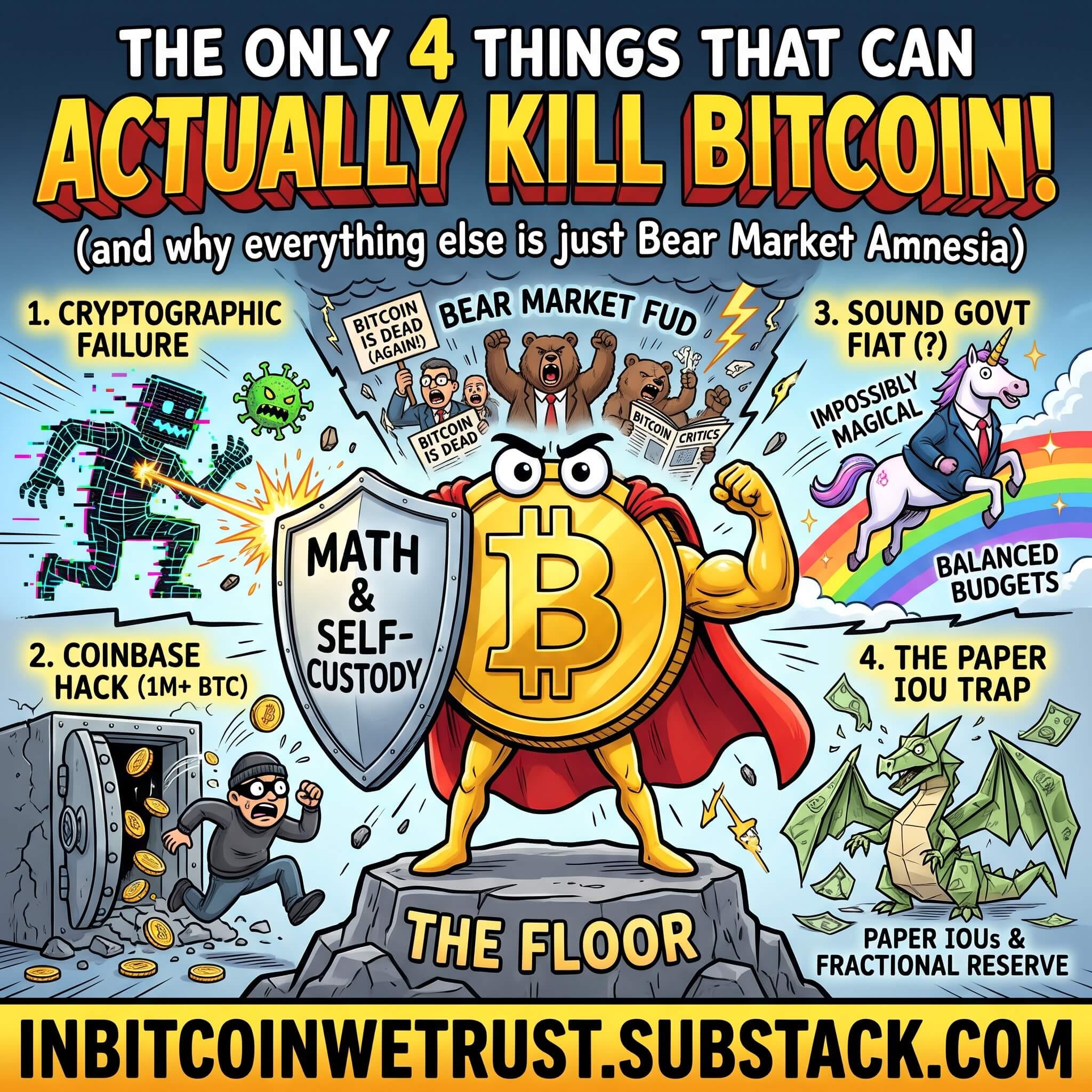
If you strip away the noise, the media hysteria, and the short-term macro anxieties, there are really only four things that would be truly catastrophic for Bitcoin.
Some of them would kill the network outright in an afternoon. Others would leave the price intact while quietly hollowing out its soul. Together, they form the only checklist a rational observer ever needs to look at. And when you examine all four of them in the cold light of day, you realize something startling about the current market panic.
Let’s start with the only scenario on this list that sends Bitcoin to literal zero before you can even log into your exchange account to hit the sell button.
People talk about Bitcoin as if it were a stock, a tech startup, or a shiny digital coin sitting inside an app. In reality, Bitcoin is none of those things. It has no headquarters, no board of directors, no marketing department, and no customer service line. At its core, Bitcoin is simply a set of mathematical rules agreed upon by millions of participants around the world, enforced by two foundational pillars of modern computer science: cryptographic hashing and public-key cryptography.
When you “own” Bitcoin, you don’t actually hold a file on your phone. What you hold is a private key—a secret, astronomically large number—that gives you the mathematical authority to sign transactions associated with a public key on a shared global ledger.
The entire security model of the Bitcoin network rests on a simple, non-negotiable mathematical asymmetry: it must be trivially easy for the network to verify that your signature came from your private key, and it must be computationally impossible for anyone else to reverse-engineer your private key from your public key.
That asymmetry is the bedrock of digital property rights. It is the invisible wall standing between your life savings and every hacker, intelligence agency, and supercomputer on earth.
Now imagine waking up on a Tuesday morning to learn that the wall just vanished.
Imagine a breakthrough in mathematics—or a catastrophic, previously undetected flaw in elliptic curve cryptography—that allows anyone to derive a private key directly from a public key. Or imagine a zero-day protocol bug in Bitcoin Core so severe that it allows an attacker to forge signatures, bypass consensus rules, and spend coins they do not own without anyone being able to tell which transactions are legitimate and which are counterfeit.
If private keys can be derived from public keys, the entire concept of holding Bitcoin evaporates on the spot.
Think about what happens in the first sixty seconds after that discovery goes public. The oldest, wealthiest wallets on the network—including the roughly 1.1 million Bitcoin mined in the earliest days by Satoshi Nakamoto, whose public keys have been exposed on the blockchain for over fifteen years—are drained instantly. Automated bots begin sweeping every address that has ever reused a public key. Exchanges freeze withdrawals globally, not out of malice, but because their own cold storage vaults are suddenly standing wide open on a public street corner.
In that scenario, there is no “buying the dip.” There is no psychological support level on a chart. If you cannot secure a bearer asset, it ceases to be an asset at all. A vault with no lock in a world full of thieves has a market value of zero.
Critics often bring up quantum computing here, pointing to the theoretical day when a sufficiently powerful quantum machine running Shor’s algorithm could crack Bitcoin’s current ECDSA and Schnorr signatures. That is a real technical challenge, and treating it with complacency would be foolish. Yet there is a world of difference between a slow-moving, visible technological horizon and a sudden, unfixable technical collapse.
Quantum hardware does not materialize in a garage overnight; its progress is measured in incremental leaps of logical qubits across decades. Long before a quantum computer is strong enough to crack a single Bitcoin key in real time, the network has the ability to upgrade its signature schemes to quantum-resistant cryptography—just as the rest of the world’s banking, military, and nuclear command infrastructure will have to do. It would be messy, contentious, and require users to migrate their funds to new address formats, potentially forcing a painful community debate over what to do with lost or abandoned coins.
But a sudden, unannounced mathematical or protocol failure where ownership itself becomes impossible to prove? That is the kill shot.
Look around today. Look at the blockchain explorer right now. Every ten minutes, like a metronome that does not care about recessions, elections, or panic on social media, a new block is found. The cryptographic signatures hold. The hashing power securing the ledger sits at levels that would have seemed like science fiction five years ago. No private key has ever been derived from a public key. The math remains undefeated.
How a suspected espionage scandal and a $490 billion market wipeout exposed the fatal flaw of “Founder Mode” and triggered a global national security crisis.
If the first threat is a failure of math, the second threat is a failure of human architecture.