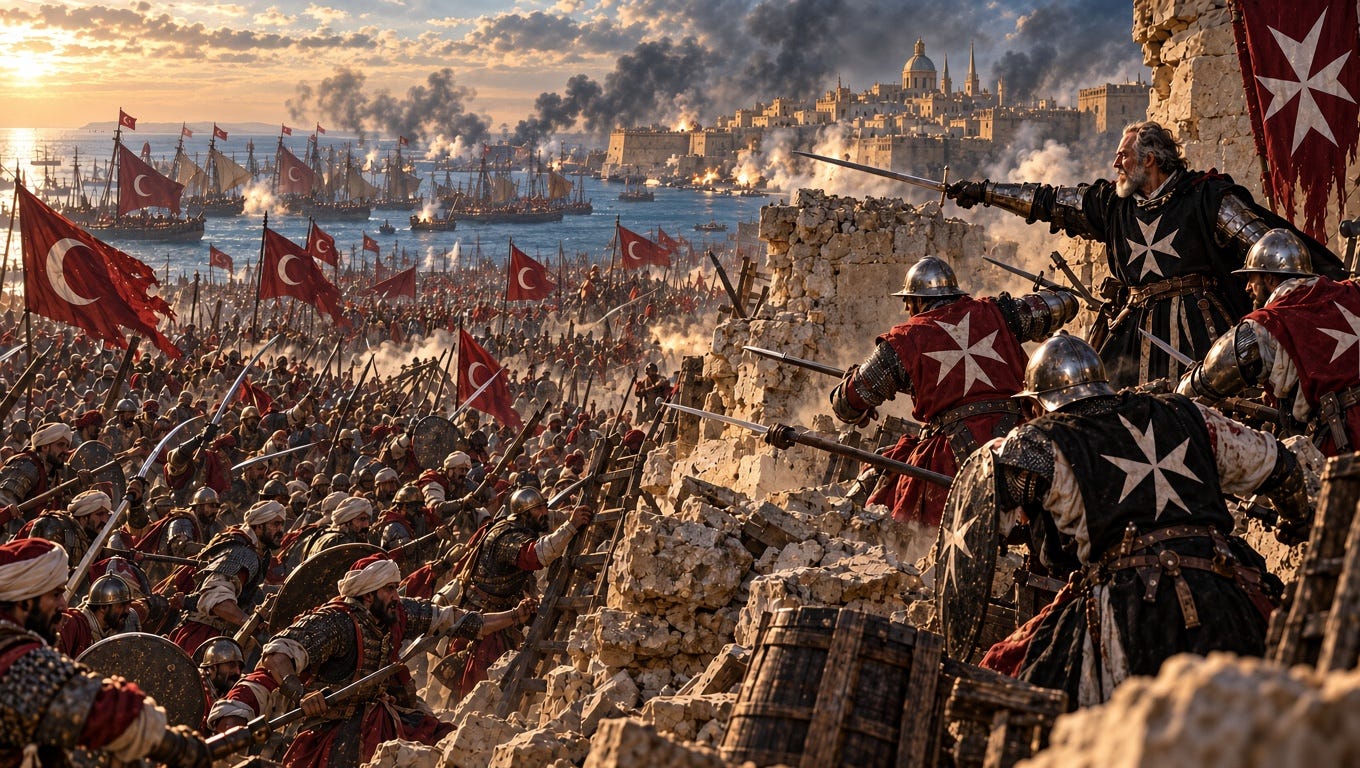
Although today’s date will forever be associated with the massacre of some 3,000 Americans, for centuries earlier, September 11 was celebrated as the day when a small band of Christian knights defeated a massive Muslim horde. Far from a day of defeat and mourning, it was a day of victory and celebration. That story is worth recounting.
Around the start of the sixteenth century, Muslim pirates from Algiers began to terrorize the Christian Mediterranean. Like their terrestrial counterparts, they too were indoctrinated in and emboldened by Muhammad’s promises: “A campaign by sea is like ten campaigns by land,” the prophet said in a hadith, “and he who loses his bearings at sea is like one who sheds his blood in the path of Allah”—that is, he is rewarded either in the here or hereafter. The piratical lust for booty was, accordingly, heightened by dreams of “martyrdom.”
When Suleiman “the Magnificent”—better known among Muslims as Suleiman “the Ghazi” (jihadi/raider)—became Ottoman sultan in 1520, he instantly took the most notorious of these Barbary pirates, Khair al-Din Barbarossa, into his service and helped him prosecute the sea jihad on Europe.
The ensuing reign of terror forced Europeans along the Mediterranean coast to relive the days of their ancestors in the centuries before the Crusades, when the Middle Sea was first inundated with jihad and slave raiding. Over the following two decades, hundreds of thousands of Europeans were enslaved, so that, by 1541, “Algiers teemed with Christian captives, and it became a common saying that a Christian slave was scarce a fair barter for an onion.”
Despite the seaborne jihad’s successes, “You will do no good,” a seasoned corsair counseled Suleiman, “until you have smoked out this nest of vipers.” He was referring to the Knights of the Hospital of St. John—aka the “Hospitallers”—who came into being soon after the First Crusade (c.1099) but were now headquartered in Malta.
Suleiman had evicted them from Rhodes in 1522—whence for two centuries they had frustrated all Ottoman naval attempts—and Holy Roman Emperor Charles V had bequeathed the island of Malta to them in 1530. They were the emperor’s response to the sultan’s pirates—and, for more than three decades, a thorn in Suleiman’s side.
In March 1565, after having finally decided to eliminate this “headquarters of infidels,” as it was known among Muslims, Suleiman dispatched one of the largest fleets ever assembled—carrying some forty thousand Ottomans—to take the tiny island, which had a total fighting population of eight thousand.
Pius IV implored the kings of Europe to come to Malta’s aid, to no avail: the king of Spain “has withdrawn into the woods,” complained the pope, “and France, England and Scotland [are] ruled by women and boys.” Only the viceroy of neighboring Sicily responded, but he needed time to raise recruits.
Jean Parisot de Valette, the Master of the Knights—“his disposition is rather sad,” but “for his age [seventy-one], he is very robust” and “very devout”—made preparations for the forthcoming siege, including by explaining to his men what was at stake: “A formidable army composed of audacious barbarians is descending on this island,” he warned; “these persons, my brothers, are the enemies of Jesus Christ. Today it is a question of the defense of our Faith as to whether the book of the Evangelist [the Gospel] is to be superseded by that of the Koran? God on this occasion demands of us our lives, already vowed to His service. Happy will those be who first consummate this sacrifice.”
On May 18, the Ottomans commenced nonstop bombardment, first targeting St. Elmo, one of Malta’s key forts. “With the roar of the artillery and the arquebuses, the hair-raising screams, the smoke and fire and flame,” a contemporary wrote, “it seemed that the whole world was at the point of exploding.” The vastly outnumbered and soon wearied defenders, who were ordered to “fight bravely and sell their lives to the barbarians as dearly as possible,” did just that; and for every Christian killed defending the fort, numerous Muslim besiegers fell.
After withstanding all that the Ottomans could throw against it for more than a month, on June 23, St. Elmo, by now a heap of rubble, was finally stormed and captured.
Virtually all 1,500 defenders were slaughtered. The same grisly fate Salah al-Din (Saladin) had centuries earlier consigned to Islam’s staunchest enemies—the Knights of the Hospital and Temple at the disastrous Battle of Hattin (1187)—was again meted out to them. The Knights “were hung upside down from iron rings . . . and had their heads split, their chests open, and their hearts torn out.” Ottoman commander Mustafa ordered their mutilated corpses (along with one Maltese priest) nailed to wooden crosses and set adrift in the Grand Harbor in order to deride and demoralize the onlooking defenders.
Continue reading below.
If you value unflinching, historically grounded analysis that mainstream outlets soften or ignore, consider upgrading. Paid subscribers get:
**Several new, full-length articles every week.**Carefully researched pieces you won’t find elsewhere.
Full access to the complete premium archiveArchive of in-depth writing, research, and commentary — all in one place.
Entry into the subscriber chatA private space for serious readers and thoughtful discussion.