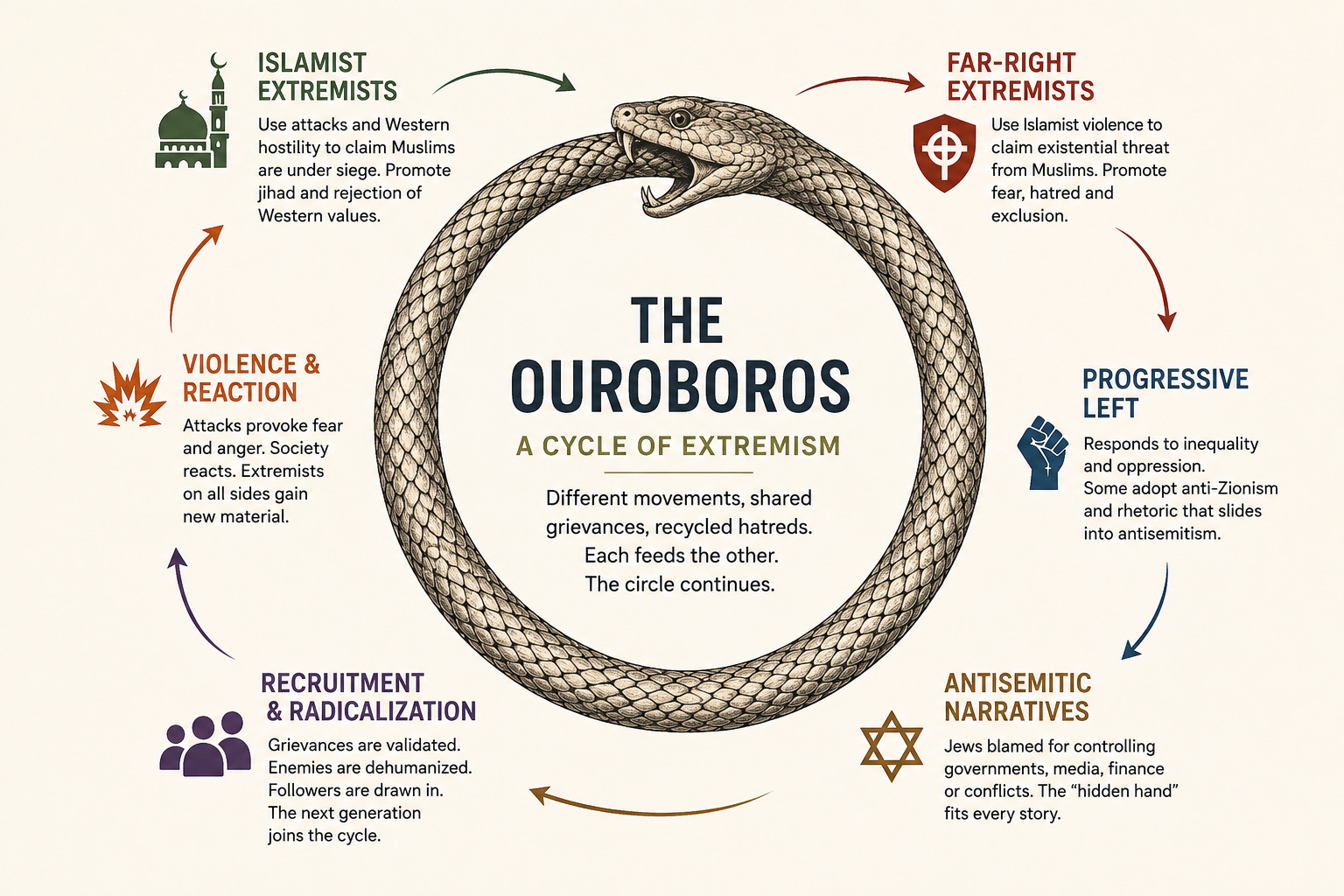
Back in June, I wrote about the Ouroboros, the ancient symbol of a snake eating its own tail. I was looking at political movements consuming themselves, chewing through their language, principles, and credibility while becoming less capable of recognizing the extremism growing inside their own ranks.
I keep thinking about that article because I see the circle differently now.
Lately, more people have been warning about the rise of the alt-right, sometimes while arguing that Islam is no longer what Americans should be worrying about. The greater danger, they say, is growing on the right.
I’m watching the right too. I’m also still watching Islamism, the progressive left, campus activism, political organizing, funding networks and the strange alliances forming between people whose actual beliefs should put them on opposite sides of almost everything.
I’m not choosing one and looking away from the others.
The latest numbers give us plenty of reason to watch it all. FBI data released in August show that 1,528 anti-Jewish hate-crime incidents were reported in the United States in 2025. Jews were the targets of 63 percent of all reported religion-based hate crimes and 14 percent of all reported hate crimes despite making up roughly 2 percent of the American population.
ADL tracks a broader range of antisemitic harassment, vandalism and assault. Its 2025 audit counted 6,274 incidents, an average of 17 every day. The total fell sharply from the 2024 spike, but physical assaults reached a record 203. Thirty-two involved a deadly weapon, and three people were murdered in antisemitic attacks.
The numbers differ because the FBI and ADL track different metrics, but both point in the same direction.
Something is very wrong.
And the Ouroboros I wrote about in June was bigger than I realized.
Political scientists and extremism researchers have been studying this for years.
In 2006, political scientist Roger Eatwell used the phrase “cumulative extremism” while studying tensions in Britain. Researchers who followed looked at what happens when opposing extremist movements react to one another, feed each other’s anger and hand one another fresh propaganda.
The cycle is easy to see.
Islamist extremists point to anti-Muslim extremists and tell Muslims that the West hates them, integration is a lie and coexistence will eventually become impossible. Far-right extremists point to Islamist terrorism and tell Western audiences that Muslims collectively pose an existential threat and that the political establishment refuses to admit it.
Each side gets new material for the next recruitment pitch.
Researchers have also studied why this back-and-forth grew between Islamists and anti-Islam movements in Britain while developing differently elsewhere. The Ouroboros grows where political anger, major events, media coverage and organized movements give it something to feed on.
More recent research found something even stranger.
People themselves aren’t always staying inside ideological boxes.
George Washington University’s Program on Extremism uses the phrase “fringe fluidity” to describe extremists who move between belief systems or build a worldview out of pieces that shouldn’t logically fit together. Former FBI Director Christopher Wray once described these mixed beliefs as an ideological “salad bar.”
GWU researchers examined thousands of memes and videos and found white nationalists borrowing jihadist language, ideas and tactics while some jihadists borrowed neo-Nazi language and imagery.
The movements can hate each other while borrowing from each other.
George Washington University’s Program on Extremism also compared white supremacist extremism with Salafi-jihadism.
Salafi-jihadism is the violent Sunni Islamist current associated with groups such as al-Qaeda and ISIS. Salafi-jihadists seek to replace existing governments with rule based on their interpretation of Islamic law and see violent jihad as a legitimate way to pursue that goal. Salafism is broader than jihadism, so this refers to the violent movement, not everyone who identifies as Salafi.
White supremacist extremists and Salafi-jihadists want very different societies. Their religions, political goals and ideas about who should rule are completely different.
The stories they tell followers can sound very familiar.
Both can describe their people as victims of an enormous conspiracy. Jihadists speak of a global war against Islam. White supremacist extremists speak of “white genocide” or the “Great Replacement.” Both portray the surrounding society as hostile, corrupted and controlled by forces determined to destroy the people they claim to defend.
Then the Jew appears.
GWU researchers found virulent antisemitism beneath both sets of conspiracy theories. Jews become part of the hidden force supposedly manipulating governments, culture, finance, immigration or war.
Another GWU study focused specifically on antisemitism in American far-right and Islamist extremism found antisemitic ideas woven into the larger story extremists tell about how the world works.
Complicated failures suddenly have an architect.
Someone did this to you. Someone is hiding behind it. Someone controls the system.
Give that someone a Jewish last name.