Women and poor people were the first AI.
As numerous AI pundits and CEOs soft-pedal the challenges of the industry, their calls for oversight are largely a classic of the long history of work within patriarchal systems. Reframing their purported about-face within the history of labor helps demystify why they’ve seemed to find a conscience.
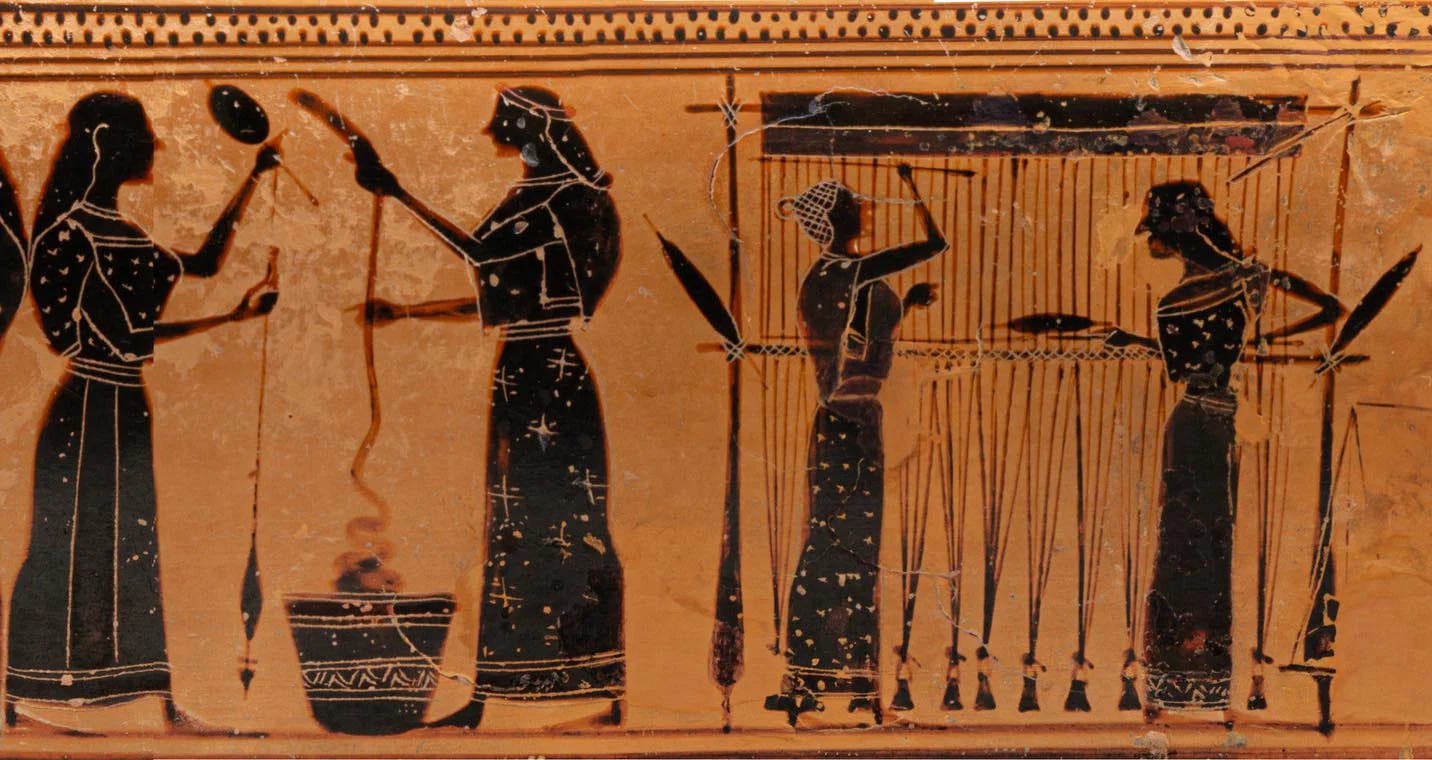
Women have always worked. In patriarchy, their labor was a naturalized element of family membership. Men led farms and workshops; women did the family's labor. Of course, women also had the labor of children, which men did not often participate in. How do we know? The hard work women did can be found written in their bodies. A study of women’s bones from prehistoric times, during the rise of agriculture, shows incredible strength in women’s upper bodies. In other words, women 5,500 years ago did work equal to men's to start our agricultural Revolution. Similarly, even earlier, many of the hunters of our hunter-gatherer roots were women; they employed tools like spears and atlatls.
If you thought early hunters and farmers were only men, that reflects a bias in our society and inaccuracies in past writing. Starting in the 17th century, with the Enlightenment, men began systematically writing down all knowledge; this is the era of the rise of the encyclopedia. In their hubris, they believed all societies were like theirs. They rewrote history through their narrow understanding of the world. In doing so, they codified many lies about the past. In reclaiming the work history of women, many men in the 21st century become defensive rather than face the emotional toll of their cognitive dissonance.
This intellectual circuit—what actually happened, how we understand history incorrectly, and how emotions diminish corrections—explains the AI bubble. Much of the work people have done employed diverse workforces; in understanding that history, a narrow group of people misrepresented what happened; the narrow group codified the system imperfectly. Many of the tech Bros involved in AI did not come from diverse humanities training, so they have no idea of their natural blind spot. They planned the systems around their frameworks, which are impaired by their narrow frame of understanding, and validate these systems with each other, also largely men from the same backgrounds. Rather than seeing their systems' failures earlier, they now have success metrics they won’t meet. This is like a factory worker in the Industrial Revolution who doesn’t understand the media but pushed for efficiency without understanding effectiveness in relation to time spent. Those old factory workers got floated by money. AI bros today are looking for a lifeline, too.
Even the idea of men needing a lifeline for their lack of planning has deep historical roots. Women’s work was regularly attributed to men. In historic tomb sculptures in Japan, for example, whole families would set up camp, build haniwa so the dead had all the necessities for a perfect afterlife, and then move on. The women weren’t just cooking and cleaning; they were also building. In ancient Babylon, a story highlights the kind of work real women were doing: “You are perpetually pressing oil, grinding barley, baking big breads. Laborer, child of misery, offspring of paupers.” In both of these ancient systems, the men received remuneration and credit for the work done by their family unit. Why? Because with the rise of civilization, the family unit became a business unit.
Historically, family was not just the nuclear family we use today, but a collective of related people. Women became objectified for their ability to create more members of this family unit. Basically, in marriage, women provided both labor and the production of literal offspring; she was an employee who could create more employees. Offering her freedom of movement or autonomy would be detrimental to this working system. As such, for patriarchal work systems to function, women had to be controlled. But the opposite part of controlling women is that men always had this ready system of production. They could hire men, but those men could leave; they could marry women, and those women were legally bound to them. Patriarchal societies have kept ready forced labor from women for millennia. It has been a lifeline for men.
If you think I’m pulling isolated stories of women working, There are plenty of historical records. Administrative records show that over 4,000 women were employed in the weaving industry in the village of Guabba, in the city-state of Lagash in southern Iraq in c. 2112–2004 BCE. In Hammurabi’s Code, women’s labor is often mentioned, such as: “The house where there is beer, it is her place. The house where there is food, she is the great cook.” Chinese tradition credits Leizu (or Xi Lingshi), wife of the Yellow Emperor, with discovering silk around 2640 B.C. after a cocoon fell into her tea. As such, sericulture was largely women’s work in Chinese history. The bible mentions women working in finance, trade, as artisans, and as leaders. Women always worked.
Connecting labor to the good of the family also ensured that women largely allowed these systems to continue. History has many women who did the work that men got credit for. Much of Einstein’s early theoretical work came from his first wife, Mileva Marić. Many wives of famous male authors—such as Sophia Tolstoy or Anna Dostoevsky—served as primary editors, researchers, and stenographers for works published solely under their husbands’ names, though these arrangements were rarely viewed as stolen credit at the time. The phenomenon is so common in science history that it has a name: the Matilda effect. In 1870, Matilda Jocelyn Gage wrote a treatise called The Woman Inventor, in which she described many instances of men getting credit for women’s work, including Eli Whitney being credited with inventing the cotton gin instead of Catherine Green, whose device was invented earlier. Her theory languished in the footnotes of History until science historian Margaret Rossiter discussed how men rewrite history to hide women, pointing to the phrase "Matilda effect" in 1993.
Art history also has numerous women who worked in their fathers' and then husbands’ workshops. While their names are lost, we can infer their existence from the names that survive. Artemisia Gentileschi is probably the best known for the legal case in which she had to testify about one of her father’s employees raping her. But artists like Catharina van Hemessen, credited with the first self-portrait, and Lavinia Terrilinc, who worked in the court of Henry VIII, are two of my favorites. In all of these artists, we should also see that their names are known to us because the men in their lives encouraged them to be known. We should see agency in both the women and the men in these situations, and in their purposeful choices against the prevailing system. Patriarchy is a system that hurts everybody, but it does not imply that everybody in the system hurts other people. Knowing those women’s names also means the men in their lives valued those names.
Valuing other people is at the heart of the real challenges in a work system that needs labor and doesn’t value workers. Historically, there was at least a reciprocal relationship between the worker and the proprietor in the family situations I’ve discussed: while the woman was legally bound to the man, the man also had responsibilities to her. Similarly, these families were within a society in which the ruler had responsibilities to the family; these networks offered a social safety net so workers were not exploited by a structural system that left them in penury.
Is that the source of the massive differences in our AI industry? It is not surprising that men employ AI at a higher rate than women. Our first era of mechanization, the Industrial Revolution, also saw men quickly become factory owners while often largely employing women and/ or children. In parallel, AI uses the labor of many people, only for the prompt user to take credit.
What’s interesting is that the system of AI currently didn’t need to exist this way. Machine learning has held long-standing promise for the next level of mechanization. I served on panels discussing machine learning 10 years ago, talking about how big data, when employed carefully, can empower smaller companies through cooperative data-sharing practices. The fact that machine learning has morphed into a free-for-all where intellectual property is stolen is really just the next step in millennia of work history. It replicates the history of work. A few powerful men, a minority of men, profit off the labor of a majority of people while taking credit. The underlying hierarchy ensures that the men at the top of this pyramid get the support they need to prevent it from toppling over. But herein is the massive difference today. Even in the 19th century, factory owners feared hell. While they didn’t have the social construct of the aristocracy over their serfs, they had some emotional safeguards.
This is the biggest takeaway for someone reading the news: these men are raising a flag about regulation for their benefit. Just as robber barons acquiesced to regulation when the workforce demanded it, these men are using the good of society as a ploy for self-protection. While rich men are like a long history of men who have happily profited off others' labor, the technocrats have been proudly and vociferously unconscionable. The likelihood they all woke up with a belief in cultural good on a random weekend in September is as low as being visited by the ghost of the civilization future.
Unlike those fathers who wanted their daughter’s names on historical artwork who cared about someone selse, these AI CEOS are scared, and they know the patriarchal system will bail them out.