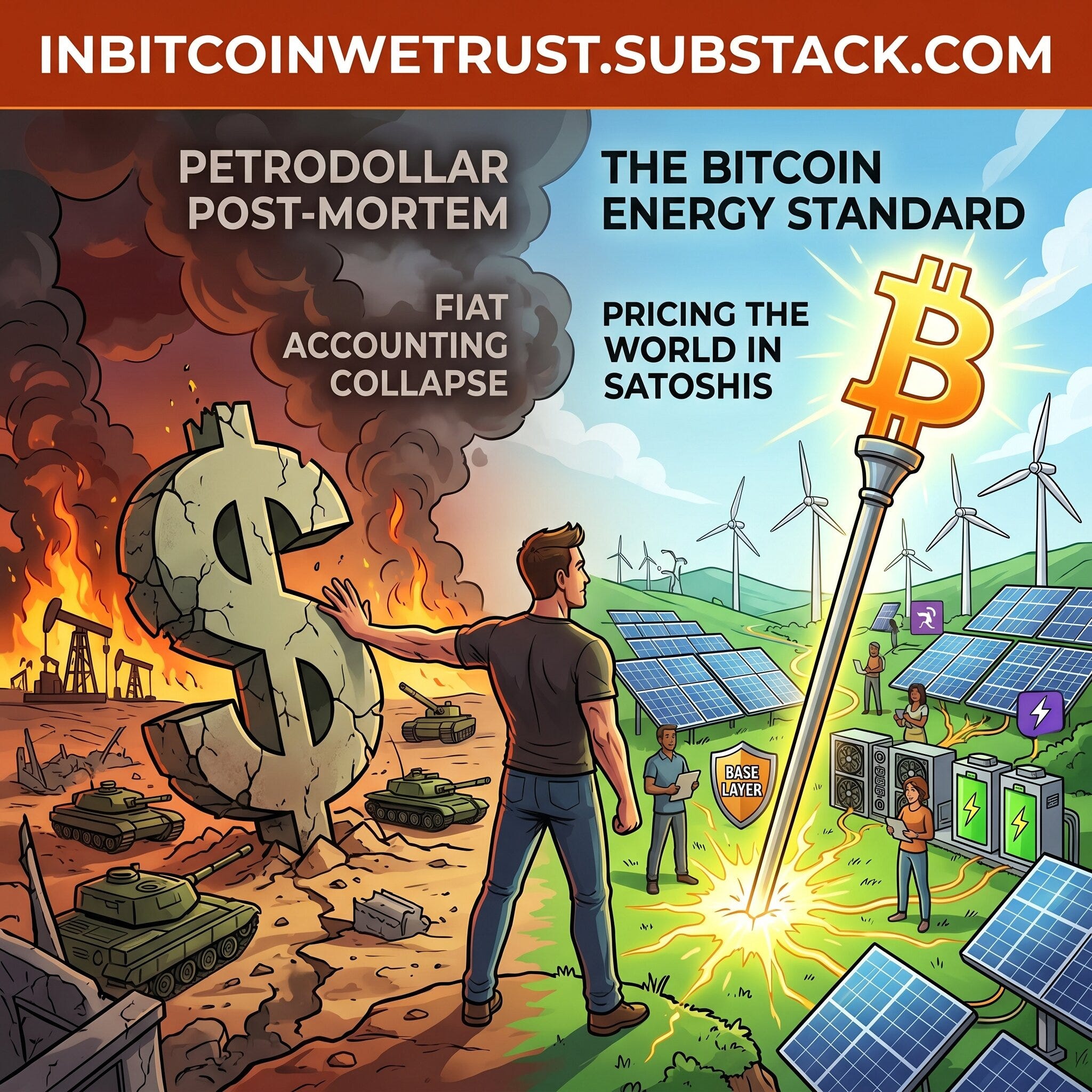
For exactly fifty years, the world operated under a singular, unbreakable geopolitical hallucination: the Petrodollar.
The agreement was simple. The United States provided military protection to the Middle East, and in exchange, the world’s critical energy supplier agreed to price and sell all of its crude oil exclusively in US Dollars. It was the masterstroke that allowed the Western fiat system to endlessly print money without immediate hyperinflation, because every nation on earth was forced to hold dollars simply to keep their lights on and their trucks running.
But hallucinations, no matter how deeply entrenched, cannot survive a collision with raw kinetic reality.
When the Trump administration escalated the standoff with Iran from aggressive economic sanctions into direct kinetic strikes on Iranian energy infrastructure in early 2026, the geopolitical chessboard flipped. The retaliatory closure of the Strait of Hormuz—the vital maritime artery that handles a massive percentage of the world’s liquid energy—did not just trigger a localized conflict. It triggered the final, catastrophic uncoupling of the fiat dollar from the physical world.
The BRICS bloc, already building alternative settlement rails, seized the moment. They officially refused to use the SWIFT system or the US Dollar for energy trade. The Petrodollar did not die with a diplomatic treaty in a Swiss boardroom; it died in the burning waters of the Persian Gulf.
Today, we are living through the economic whiplash. Crude oil swings by $40 a barrel in a single afternoon based on rumors of drone strikes or blockades. In the West, fiat inflation is being driven not just by money printing, but by an absolute energy supply shock.
For the sovereign individual, this presents an existential crisis in accounting. How do you run an off-grid farm, manage a localized supply chain, or plan a generational homestead when the fiat currency you use to measure the cost of electricity, fuel, and raw materials is violently detaching from reality?
You stop using it.
Today, we are examining the thermodynamic pivot. We are going to explore how the parallel economy has completely abandoned the US Dollar as a unit of account, shifting instead to the only objective, immutable, and thermodynamically anchored metric on earth: Bitcoin.
To understand why we must price the world in Satoshis, we first have to recognize why pricing the world in dollars has become mathematically impossible.
Money is supposed to be an information system. It is supposed to act as a ruler, measuring the time, human labor, and raw energy required to produce a good or service. But what happens when the ruler is made of rubber?
Let us say you run a localized manufacturing DAO (Decentralized Autonomous Organization) that 3D-prints essential water desalination parts for your physical citadel. You need to buy raw polymers, and you need electricity to run the printers.
In 2023, you could accurately forecast your costs in USD for the next twelve months. In 2026, amid the fallout of the Iran conflict, forecasting is a joke.
On Monday, a US carrier strike group repositions in the Mediterranean. The fiat markets panic. The cost of energy spikes 15%. Your fiat cost to print one part jumps from $10 to $11.50.
On Wednesday, the Federal Reserve announces an emergency liquidity injection to prop up failing domestic banks. The dollar drops in purchasing power. The cost to import your raw polymers spikes 20%.
By Friday, the fiat price of your desalination part is $14.00.
Nothing in physical reality changed. You are using the same amount of raw material. The 3D printer is drawing the same amount of electricity. Your labor time is identical. Yet the fiat price is completely unmoored, wildly oscillating based on the whims of central bankers and military generals operating thousands of miles away.
When the ruler stretches and shrinks every 24 hours, trade grinds to a halt. You cannot sign long-term contracts. You cannot accurately price your labor. The fiat pricing mechanism has become a source of noise, completely obscuring the true cost of production.
The parallel economy needed a new ruler. We needed a metric that was completely immune to geopolitical blockades, unbothered by central bank liquidity injections, and tied directly to the fundamental laws of physics.
We found it in the base layer of the Bitcoin protocol.
The legacy world looks at Bitcoin and sees a volatile speculative asset. They measure Bitcoin in dollars, and because the dollar is collapsing, they see Bitcoin’s price swinging wildly. This is like looking out the window of a crashing airplane and claiming that the ground is rushing up to meet you.
The sovereign individual looks at Bitcoin and sees base reality. 1 BTC = 1 BTC.
Bitcoin is the first engineered monetary network in human history that is directly tethered to thermodynamics. To create a new Bitcoin (or to earn one via mining), you must expend raw physical energy. You must harness electricity, feed it into an ASIC (Application-Specific Integrated Circuit), and perform quadrillions of SHA-256 cryptographic hashes to prove that work was done.
Bitcoin is, quite literally, a digital representation of expended energy. It is a thermodynamic battery.
Furthermore, the Bitcoin network possesses something the global oil market does not: the Difficulty Adjustment. If half the world’s oil refineries are blown up in a war, the supply of oil drops, and the price skyrockets. There is no automatic correction mechanism.
If half the world’s Bitcoin miners are taken offline, the protocol automatically adjusts. The mathematical puzzle becomes exactly 50% easier to solve. The block time remains 10 minutes. The issuance remains entirely predictable. It is the ultimate macroeconomic shock absorber.
How does this theoretical philosophy translate into the physical survival of a Bitcoiner in 2026? It starts at the power meter.
Sovereign homesteads are no longer tying themselves to the municipal power grid. The state uses grid access as a weapon of compliance, and the fiat cost of electricity is skyrocketing due to the geopolitical energy wars. Instead, individuals are building localized micro-grids: solar arrays, micro-hydro turbines, and deep-cycle battery walls.
But a microgrid produces a problem: stranded energy. In the middle of the day, your solar panels generate far more electricity than your homestead can consume. You cannot store all of it in batteries. In the legacy world, you would sell that excess power back to the state grid for pennies on the dollar.
In the parallel economy, you plug an ASIC miner directly into your solar inverter.
You take your excess physical energy, and you convert it directly into digital energy (Bitcoin) without ever asking for the state’s permission.
This creates a localized, closed-loop economy. You now know exactly how much physical energy it takes to generate 10,000 Satoshis. You have established a localized exchange rate between sunlight, electricity, and cryptography.
Once you establish this baseline, you stop thinking in dollars entirely.
The Old Mindset:“This solar panel cost me $400. It produces $2 of electricity a day. It will take me 200 days to pay it off.” (A calculation that breaks the moment inflation alters the value of the dollar).The Sovereign Mindset:“This solar panel costs me 500,000 Sats. Hooked up to my miner, it generates 2,000 Sats of pure thermodynamic value per day. It pays for itself in 250 days, regardless of what the Federal Reserve or the US Military does.”
This mindset is rapidly expanding beyond localized energy grids and into physical trade networks.
Nostr-based marketplaces and decentralized local exchanges are beginning to strip fiat prices from their listings entirely. They are moving to the Satoshi Standard.
Imagine you are a homesteader who raises cattle, and you want to buy lumber from a local sawmill to build a barn.
The sawmill operator’s primary cost is the energy required to run the massive industrial saws. The legacy diesel supply chain is shattered because of the Strait of Hormuz blockade. Therefore, the sawmill has transitioned to running on an off-grid solar and battery setup, subsidized by Bitcoin mining.
The sawmill operator knows exactly how much Hash Rate he has to turn off to run the saws to cut your lumber. He is calculating his opportunity cost in Bitcoin.
**He does not quote you a price in fiat. He quotes you the energetic cost of his labor and machinery: **“The lumber for this barn will cost you 2.5 million Sats.”
You, the rancher, know exactly how much energy and labor went into raising the beef you are trading. You value a quarter-cow at 1.25 million Sats.
You send him 2.5 million Sats over the Lightning Network. He delivers the lumber.
At no point in this transaction did either of you check the USD exchange rate on a centralized exchange. At no point did you care about the Federal Reserve’s interest rates or the fallout of the Trump administration’s foreign policy.
You traded physical energy for physical energy, using a cryptographically perfect ledger to settle the difference.
The war in the Middle East did not break the global fiat system; it merely exposed a mathematical inevitability. You cannot build a civilization on a unit of account that can be manipulated, printed, or weaponized by politicians.
The Petrodollar era was an era of profound illusion. We pretended that paper printed in Washington had intrinsic value because we forced the world to use it to buy physical energy.
When the bombs dropped and the geopolitical fault lines shattered, the illusion evaporated. We were violently reminded that the universe only respects thermodynamics. You cannot print a barrel of oil. You cannot print a kilowatt-hour of electricity. And you cannot print a Satoshi.
The sovereign individual of 2026 does not care who controls the Strait of Hormuz. They do not care about the latest round of sanctions or the frantic maneuverings of legacy central banks.
They have unplugged from the hallucination. They are building their own localized energy grids, running their own immutable ledgers, and pricing the physical world in pure, uncompromising math.
The Petrodollar is dead. Long live the base layer.
How Infinite Money Printing Saved Wall Street, Sacrificed the Dollar, and Sent the Bill to the Working Class.