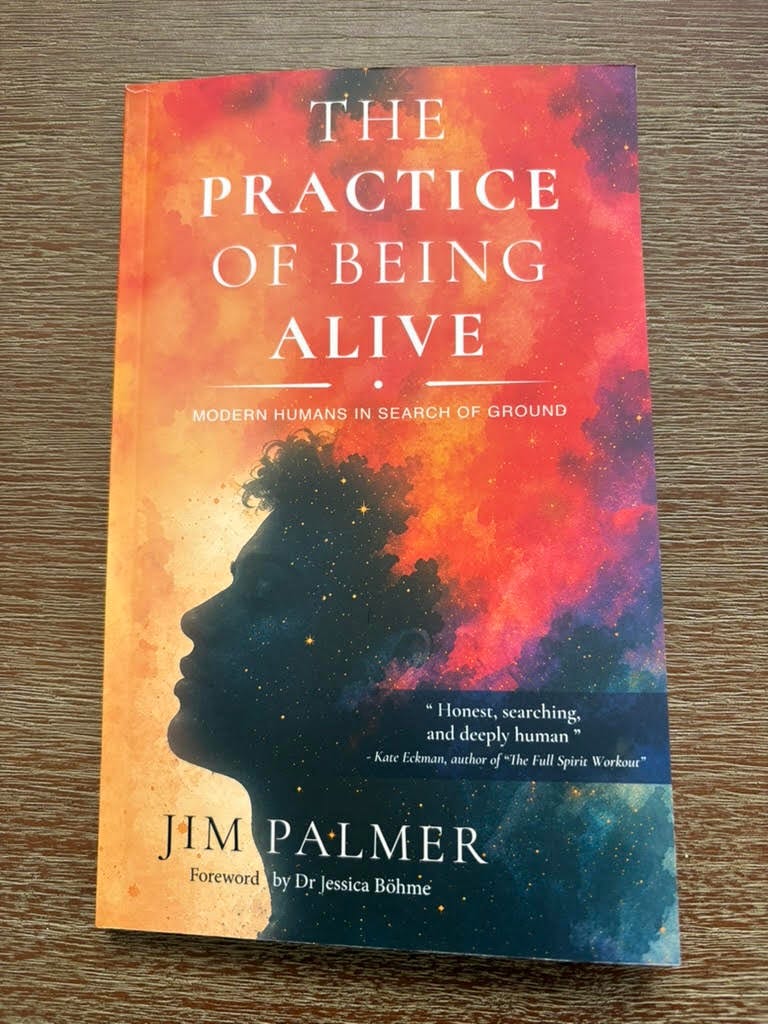
There is a strange difference between finishing a manuscript and holding the first physical proof of a book in your hands.
For years, ** The Practice of Being Alive** existed mostly inside my head and on a screen. It was a growing collection of questions, fragments, chapters, discarded pages, conversations, revisions, and ideas I kept returning to because I knew I had not yet taken them far enough. There were periods when I thought I understood what the book was about, only to discover that I was still writing my way toward the deeper question underneath it.
Then this arrived.
For the first time, I held The Practice of Being Alive: Modern Humans in Search of Ground in my hands. It was a proof, not yet the finished book that readers will eventually receive, but that distinction did little to diminish the experience. I saw the title on an actual cover, turned pages that were no longer Word documents, and encountered something that had occupied so much of my interior life as an object separate from me. It was surprisingly emotional.
The manuscript is finished now, and the book is moving through the final stages of production. I will share release and ordering details as they are finalized. But the long period of writing, revising, discarding, reconsidering, and trying to discover what this book needed to become has come to an end.
And the book I ended up writing is not quite the book I thought I was writing when I began.
Many of you have been ** part of this project** from its earliest stages. I shared portions of the book here while they were still being developed, and some of you participated in reader groups and discussion circles. You questioned things, challenged things, noticed gaps, identified passages that resonated, and helped me recognize where an idea had not yet gone far enough. I am deeply grateful for the intelligence and generosity you brought to that process.
The book that is now going into publication is not simply a polished version of those early drafts. The project itself changed as I wrote it. I initially thought I was writing primarily about the modern crisis of meaning. That remains part of the book, but over time I became convinced that the problem runs deeper. The crisis is not simply that people are struggling to find meaning. Something is changing in our relationship to the structures that once provided human beings with orientation, coherence, belonging, and a place to stand.
Religion no longer carries the authority it once did for millions of people. Traditional institutions have weakened. Communities have fragmented. Identity has become increasingly contested and unstable. Digital systems mediate more of our experience, while artificial intelligence is accelerating questions about human uniqueness, work, knowledge, creativity, and agency. We possess extraordinary technological capability while often lacking the human capacity to metabolize the world those capabilities are creating.
Beneath these developments is an ancient human question that has become newly urgent: What gives us ground? I became interested in what allows us to live without certainty about what the universe means, belong without surrendering ourselves to the group, face mortality without organizing our lives around its denial, and remain open to mystery without turning it into dogma. How do we participate meaningfully in existence when no institution, ideology, technology, or metaphysical system can finally tell us what our lives must mean?
Those became the questions underneath the book.
The title eventually became more important to me than I initially understood. The Practice of Being Alive is not about developing the correct theory or explanation of life. The emphasis is on practice because a human life is something we participate in before it is something we understand. Much of modern life trains us into observation. We watch, evaluate, compare, interpret, document, consume, and explain. Increasingly, we can spend our lives standing slightly outside our own experience, trying to understand ourselves while the life we are attempting to understand continues happening.
A human life cannot finally be lived from the position of an observer. We have to love people without knowing how long we will have them, make decisions without guarantees, create things that might fail, and allow ourselves to belong without disappearing. We have to accept that our identities will continue changing, encounter suffering that cannot always be transformed into a lesson, live inside bodies that age, and face futures we cannot control. Eventually, we have to confront the fact that the life we have spent so much time trying to understand will end.
Being alive requires capacities that information alone cannot give us. Capability concerns what we are able to do; capacity concerns what we are able to hold. I have become increasingly convinced that one of the defining questions of our time is whether our human capacity can develop quickly enough to meet the world our capabilities are creating. The Practice of Being Alive became my attempt to explore what that development might require.
The subtitle of the book is Modern Humans in Search of Ground. I chose those words because I think they describe something many people are experiencing, whether or not they would use this language themselves. Beneath much of our cultural anxiety is a search for something sturdy enough to stand upon, something capable of telling us who we are, where we belong, what matters, and how we should live.
We search for that ground in many places. Religion has historically been one of them, but we also seek it through politics, identity, ideology, achievement, relationships, therapy, wellness, technology, nationalism, spirituality, and belonging to the right communities. These things can contain genuine value. The difficulty begins when we ask them to provide something no external structure can permanently provide: an unquestionable foundation for our existence.
The deeper movement of the book is not toward finding another system that will finally make us secure. It is toward developing a different relationship with the uncertainty, contingency, and vulnerability that are inseparable from being human. Uncertainty does not make participation impossible, and mortality does not make life meaningless. The absence of cosmic guarantees does not make love less real, and changing identities do not mean there is no continuity to a human life. The loss of inherited certainty does not require the loss of depth, spirituality, wonder, responsibility, or belonging.
Perhaps one of the most important realizations behind the book is that we may not need another world to make this one matter. What we need is a greater capacity to inhabit this one.
The writing is finished, but bringing the book into the world is not. In the weeks ahead, I’ll share release and ordering details, along with the conversations and events that will surround the book. For now, I mostly wanted to mark this particular crossing.
It also means that the developmental phase of the book is ending. For some time, I shared draft material through Thinking in Draft, allowing readers to look over my shoulder while the thinking was still happening. Those pieces belonged to a particular stage of the creative process. They were experiments, provisional formulations, fragments of chapters, and ideas that sometimes changed significantly before finding their final place.
Now that the manuscript has a final form, I am beginning to draw a boundary between that developmental material and the finished book. I am grateful that I was able to write parts of this book in conversation with readers rather than entirely behind a closed door. But the next time much of this material appears, I want it to be encountered as part of the larger work it eventually became.
Books have authors, but they rarely come into existence alone. This one emerged from years of conversations with people navigating life after religion, questions arising from my work in existential health, discussions within the Center for Non-Religious Spirituality, exchanges with practitioners and scholars, reader groups, friendships, disagreements, and thousands of responses from people who have trusted me with pieces of their own lives. Those encounters changed the questions I was asking and, ultimately, changed the book.
During the years I was writing this book, another part of the work was taking shape alongside it: the ** emerging field of existential health**. That work has now begun moving beyond my own writing into
I am especially grateful to** **, founder of the Institute for Practical ekoPhilosophy, who wrote the foreword to The Practice of Being Alive. Jessica brings a depth of thought and perspective that does more than introduce the book; her foreword is a significant contribution to the work itself. She places its questions within a larger conversation about what it means to be human, how we participate in the living world, and what our moment asks of us. I hope her foreword also invites readers into Jessica’s own body of work and inspires them to explore her thinking further.
I am also deeply grateful to ** **for her generous endorsement, which now appears on the cover. Kate is an author, media host, speaker, and cultural commentator whose work explores what it takes to remain fully human in a culture increasingly shaped by performance, disconnection, and emotional exhaustion. She has a rare ability to give language to experiences people deeply feel but struggle to name, especially around identity, belonging, loneliness, and the ways our lives become performances. Her conviction that “Staying Human Is the Edge” shares important ground with The Practice of Being Alive, which makes having her words on the cover especially meaningful to me.
Somewhere along the way, The Practice of Being Alive stopped feeling like something I was simply trying to say. It became an attempt to name something I believe many of us are living through together. We are inheriting a world in which many of the old grounds of meaning and identity no longer hold as they once did, while many of the new authorities competing to replace them ask us to surrender ourselves in different ways.
The possibility I wanted to explore is that there is another way of standing in the world. We can learn to live without absolute certainty while still making commitments, belong without disappearing, and change without treating every previous version of ourselves as a mistake. We can face mortality without making this life a consolation prize, encounter mystery without needing to possess it, and develop a relationship with reality that does not depend upon reality conforming to our preferred explanations.
For me, this is what the practice of being alive means. It is the difficult, beautiful, unfinished work of becoming capable of participating fully in a life we cannot secure in advance, explain completely, or keep forever.
After all the drafts, conversations, revisions, discarded pages, and mornings spent searching for the words, this is the book that emerged. Soon, the book I have carried for so long will become something you can hold in your own hands.
I am looking forward to that.