Before we start, a Black Friday special. With Black Friday coming up, you can get 20% off the full subscription for the first year - which is $120 for the year, or $10/month. Paid subscribers get access to full deepdives, The Pulse on Thursdays, to resources for engineering managers and software engineers, and to the full archive.
The offer is available until Tuesday, 1 December. You can also gift this offer.
To mark The Pragmatic Engineer’s fifth birthday in September, I launched an essay competition on the theme of how things have changed in building software since the emergence of AI models that are better than ever at coding. Engineers shared their experiences and observations, and a $10,000 grand cash prize for our favorite entry went to ‘How software engineering changed: a tale of two eras’ by Neil Kakkar.
There were also six category winners who each won $2,500 in prizes, and in this article we’re happy to share excerpts from the winners and runners-up in three of those categories, also linking to 40 more articles. These essays by hands-on engineers and engineering leaders impressed us with their details of hard-earned experience, and are refreshingly honest and raw.* Thanks to everyone who entered the competition and congratulations to the winners.*
Today, we check out essays on three different areas:
**What happens when AI writes all the code?**How engineering practices have dramatically changed at startups and mid-sized tech companies in the twelve months since Opus 4.5 was released.The winner is ‘An engineering manager’s crazy year’ by Anton Zaides.**Stories from solo builders.**How one-person businesses and side projects that turn “AI-native” are building more, faster, and with higher quality.The winning essay is ‘I’m a 100x engineer now!’ by David Veszelovszki.**Reflections on AI.**What does this change mean for us human engineers? Thoughtful reflections which conclude that while agents can (and do!) write the code, engineers need to understand it to stay in control of systems and shape them.The winning piece is ‘The new core skills: agentic engineering at Granola’ by Jacob Bartlett.
At the end of 2025, many of us in tech saw AI’s coding capability dramatically improve with Opus 4.5 and GPT-5.2, and the models suddenly become good enough to reliably write most of the code – and soon, almost all of it. In January, I asked: when AI writes almost all the code, what happens to software engineering?
All the entries in this category covered the new challenges of AI generating the code, and how practices at many tech companies have adapted. Many writers compare a “before” and “after” with data on PR rates, revert rates, build times, and more.
*Edited excerpt from the essay by *
“It’s June 2026; a nice, sunny day outside when I sit at my computer, looking at a 10k-line PR opened by my team’s great designer, and I want to die inside.
It’s not a mock or a prototype; it’s code he wants to merge into production. Not only is it full of hacky solutions (not even talking about criminal useEffect abuses), it also has dummy data where backend calls were supposed to be. How the hell did I get here? Let’s back up a bit.
I joined HoneyBook as an Engineering Manager in October 2025. It’s a 13-year-old startup (raised ~$500M), a management platform for business owners (think CRM+contracts+admin, etc.). I joined to lead an existing team of seven experienced engineers responsible for the financial products like managing business expenses, loans, etc.
This past year has been a crazy ride, going in just a few months from classic engineering to pure vibe coding, ending with the launch of a real zero-to-one initiative at an established company.
We split our work into three repositories: the shared ai-workflows codebase, our own backend repo, and a thin frontend layer called atlas-vibe. Each had a different code review approach:
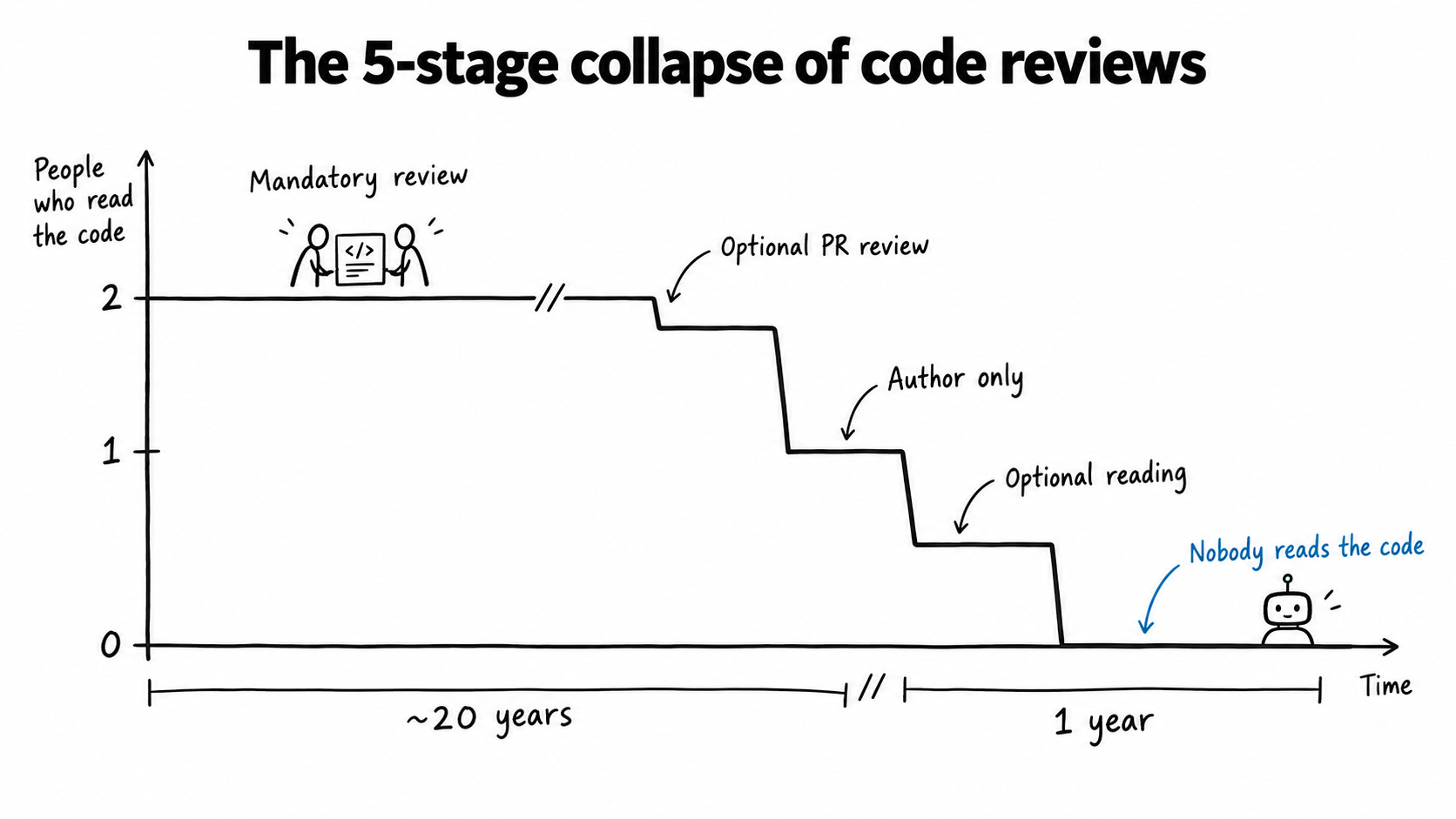
In AI-workflows, every PR was thoroughly reviewed by at least two people including the engineer who wrote the code.
In atlas-vibe, there were barely any PRs. We vibe code on the frontend, slowly improving the skills in our repo, and reducing the amount of substandard code a bit.
In the backend repo, we had optional code reviews. That’s an interesting one.
Slowly, it became more and more tempting to just not ask for reviews. It’s addicting to just develop a feature and immediately have it in production. There’s no need to have an open end in your brain.
But still, at that stage I didn’t accept an ‘I don’t know, Claude wrote it’ approach. Even if you don’t request a review from someone, it’s still your responsibility to read and understand it. You can’t let Claude make the decisions and ‘drive’ the work.
Output rose like crazy:
It took me a while to understand that the code review stage contains a lot of peer pressure. When you submit your code to someone, you feel responsible for understanding it better, and nobody likes getting tons of PR comments (senior engineers, least of all). But when you *know *that nobody will review it, it’s much easier to cut corners in your own understanding too.
So, in the span of a couple of months, we dropped from two people reviewing and understanding the code, to zero!
The result was what you’d expect: a buggy codebase full of duplications and non-optimal patterns.
From last October until March this year, I averaged one PR a week. Currently, it’s 20+. But more importantly, the nature of those PRs has changed: in March-June, it was mainly small things and side features, but since then I’ve taken on some more serious work myself, and it keeps increasing:
I know there’s a lot of hate for the demand to go back to being hands-on from EMs, and I really understand it: I believe that people need us more than ever, and EMs who code all day are usually much less effective managers.
In May, when we started to work on MyCo, I felt I just had to understand what our new flow looked like, and what we can improve. I believe it’s almost impossible to do this from the outside. For example, a debate with my engineer about our reduced quality in which I couldn’t participate properly without seeing the output myself, and I experienced both the advantages and limitations of the new flow.
As our careers change, I believe that to be a good EM there is absolutely no other way than to join the building activity.
I strongly believe that today, I have found a balance that works for me. I got rid of a lot of tedious work, and I feel as “present” as a manager as always, but now 10x more productive in my hands-on work. On Tuesdays and Thursdays I work from home and there are no meetings, and I’m able to release multiple big features a day. I was able to ramp up my parallel sessions to around 6-8, from 2-3 to fix some bugs along the way.”
Read the full essay by Anton, where he gets into how non-engineers started to ship production code, why the team ditched their home-grown agentic solution for Eve by Vercel, and what Anton thinks about the future of building with AI
We really enjoyed these five runner-up essays in this category about the “before” and “after” of AI and how it has changed software engineering:
PostHog engineer Paul D’Ambra makes an interesting point in his essay:
“Software engineers are turning into AI Engineers? No, we are turning into software machinists. Replacing handmade software with (increasingly) cheap, plentiful, machine-made software. Unlike tailors who handcraft each item, machinists build tooling and inspect samples and then produce in large numbers.
Two predictions:
continuous integration and review will change next
we make tools for our workshop
Okay, things have changed less for folks working on systems with critical safety requirements, or high performance systems where it is easy to cause an incident. But the majority of us now have a different job. It is no longer sufficient to pore over every line of code, following the practices of bespoke tailored software engineers. Now, we are software machinists.”
** Read the full essay** for details on tooling PostHog built like their deep review agents, and further predictions on change coming to CI.
Kira Howe is a Staff Engineer at analytics company Seeq and has been in a situation many of us can relate to. In her own words:
“At some point earlier this year, I realized I was not enjoying work the way I used to. I will admit that I was one of those software people who was very unimpressed by ChatGPT in the early days, and I found the hype and excitement around LLMs really insufferable back then.
Once it became obvious that these tools were becoming essential to how I work and not going anywhere,
I decided I had to either accept my AI-centric fate and learn how to use them well, or leave the industry. I’ve come to believe that being a software engineer but resisting the increasing spread of AI tooling and applications is futile, and a recipe for misery.”
** Read the full essay **– titled ‘Enjoying software engineering in the age of AI’ – for details on how Kira came around to feeling good about working with AI, and how practices at her company for CI, observability, and tooling changed.
Marc-André Moreau is CTO at Devolutions, a bootstrapped Canadian company of 250 people that builds remote desktop management and IT operations software. He writes:
“October 2025. Claude Sonnet 4.5 has just come out, and everyone at Devolutions is going through AI training from Mindstone. The message from the CEO is clear: we are taking all the necessary steps to make the company AI-native. Employees are offered a voluntary departure package if they don’t want to be a part of this new “Devolutions 2.0”. Those who stay need to be committed and go all-in on AI with the rest of us. Here is the story of the profound shift that happened at Devolutions, and how a major migration originally estimated at three years was completed in just one.”
** Read the full essay** for data-driven details of a complex application with 1,500 screens, the internal hackathon that ended up producing 60 useful skills, and how the company’s AI spending grew to $2M per year.
Carlo Beschi is a Lead Agile Coach at Treatwell, which employs 700 staff, and he shared a long list of what’s changed because of AI at the company in his essay:
**Paying off tech debt:Doing a lot more migrations and upgrades, and breezing through them.Prototyping: everyone is prototyping – not with Figma, Lovable, or Google AI Studio, but with Claude DesignThe “80/20 rule:”**This says that 80% of the work is easy to get done alone with AI, but people are needed for the final 20%.**Roles are blurring:devs are working outside of their domains and PMs are writing more codeMourning the craft:**many engineers are having a hard time accepting that AI is taking over what they love in their job: writing well-crafted code
** Read the full essay**, ‘The Earth is not flat’,
Bruno Felix, CTO at the fully remote, 8-person AI visibility startup XEO360 writes:
“The last year was one of the most intense periods of my career.
We’re in a transition where the main activity of a software engineer is shifting from
rowing(focusing on one thing at a time and producing good code) tosteering(managing multiple workstreams, context switching all day, and exercising sound judgment throughout).That is mentally taxing, and at times at odds with the skills, and sometimes the identities, we’ve built over the years.”
** Read the full essay** for plenty of data on commit volume, CI time, and how practices changed.
Below are some other essays sent in by readers that get into detail about how things have changed.
‘
by David Nisenbaum, Founding Engineer at Sphere, on how the company did it with agents.Rebuilding our Deterministic Tax Engine for an AI Native World’‘
’ by Levi Blackstone, Principal Software Engineer at Pulumi. Case studies of shipping features in days that used to take months, and how build systems and engineering practices have changed.A year of contrasts: how software engineering is changing at Pulumi‘
by Marcell Dietl, Tech Lead & Software Architect at Frontmark, on why non-functional requirements remain ones that humans make, and how engineering practices and hiring practices have changed.Gradually, then suddenly: from “learn to code” to “coding is solved”… and back again’‘
’What a small team with old code can do with AI (and what it can’t, yet)by engineering manager Ygor Cardoso, including interesting details on the extra work created for devs when non-engineers start to contribute code.by Abdul Osman, Founding Engineer atAI transformed the work at HomieHomieon how they rewrote the backend three times in a year, the move from IDEs to terminals, and how developer practices changed.. Victor Zhang studied software engineering in 2006, then moved to work in finance. In 2024, he returned to software engineering at a 50-person company to freshen it up in Python, using ChatGPT. He writes that 2026 “changed everything.”The return of a software engineerby Krzysztof Maliszewski, Software Engineer at Coralogix. This is an interesting survey of 40 engineers at Coralogix – where half admit they’re addicted to agents
We were impressed by some stories from readers about how far a single dev or a team of just 2–4 people can get these days, with agents helping them build software more ambitious than ever.
Edited excerpt from David Veszelovszki’s essay, the creator of Cmdr: ‘a file manager from 2026, the spiritual successor of Total Commander,’ and former Sourcegraph software engineer
‘After 30+ years of coding the old-fashioned way, I’m extremely enthusiastic and about 100x faster with AI! It has changed my entire workflow, and my life. While I’m writing this, I’m painting the kids’ room. Claude helped select the paint and calculate the amount I needed. I made all the decisions, I own everything that happened, while Claude did the research and prepared the decisions for me. That’s also exactly how I work.
Today, while I’m painting, Claude is fixing bugs, developing features, and p…