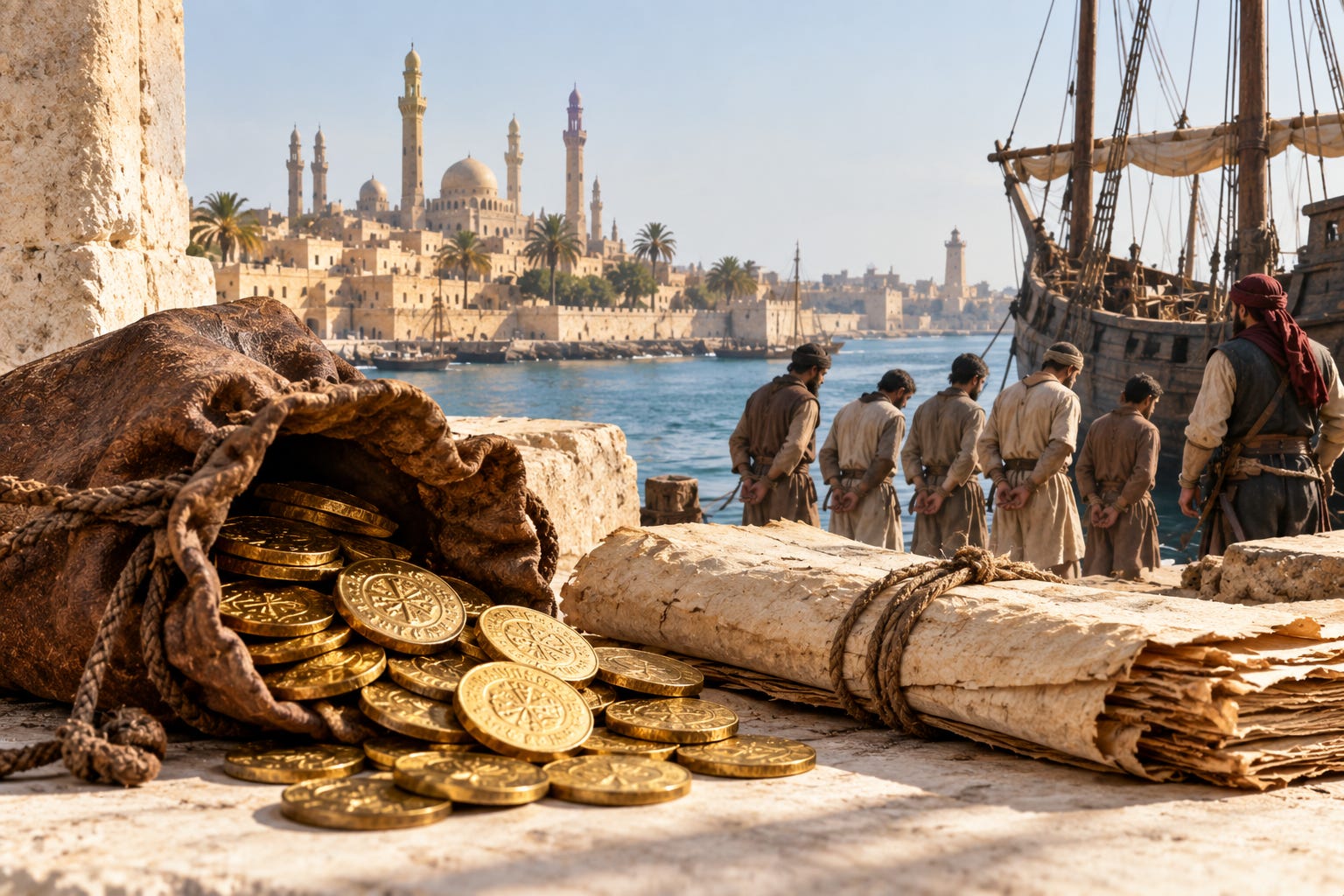
Sometime in the first half of the eleventh century, seven Jewish prisoners arrived in the port of Alexandria. They had been completely stripped of their former lives and thousands of miles from home. Taken from Antalya, a city on the southern coast of what is now Turkey. Four were Rabbanite Jews; three were Karaites. Their captors couldn’t have cared less about the religious differences between them. Whoever held the chains wanted money… 33⅓ gold dinars per person.
A single local benefactor stepped forward, paying the ransom for one. That still left six.
So the Jews of Alexandria did the only thing they could…they started writing letters. They dispatched appeals to the Jewish communities of Fustat, Tinnis, Damietta, and other towns scattered across the Egyptian delta. They asked Rabbanites and Karaites, wealthy community leaders and ordinary laborers. Somewhere along the trade routes, enough people would have to sacrifice enough of their own livelihood to purchase six strangers back from the abyss.
That letter survived and so did many others.
Today they sit among the hundreds of thousands of fragmented manuscripts preserved from the Cairo Geniza. Because Jewish tradition strictly forbade the destruction of any text that might contain the name of God, generations of Egyptian Jews tossed their discarded paperwork into a sealed lumber room of the Ben Ezra Synagogue in Fustat. Court records, merchant ledgers, and desperate pleas were entombed together in the dry dark. Unwittingly, they preserve a shadow history of the Diaspora that usually slips through the cracks of time.
For centuries, Jews were kidnapped on highways, captured in holy wars, seized at sea, imprisoned for ransom, and auctioned in foreign slave markets. Their families were left with a deafening silence, often having no idea where their loved ones had been taken. Sometimes the first word of their survival came years later when a frantic letter arrived hundreds of miles away begging another Jewish community to buy them back.
Out of sheer necessity, Jewish communities built an entire international system to do exactly that.
There is a Hebrew name for the redemption of captives: pidyon shvuyim.
The obligation is ancient—so old, in fact, that the Mishnah was already wrestling with the cruelest realities in the second century. Jews were commanded by religious law to redeem captives. But what happens when kidnappers figure out that there happens to be a specific group of people who come with a guaranteed payout?
To prevent open season on their people, the rabbis ruled that captives shouldn’t be redeemed for an excessive price. It’s a terrible line to draw when an actual human being is sitting in a dungeon waiting to be rescued. Yet it shows just how rampant the problem had become. Jewish law was actively trying to thread the needle between saving the victim in front of them and creating a lucrative business model for taking the next one.
Moses Maimonides laid down the other side of the law. Redeeming captives, he argued, superseded feeding and clothing the poor. Money collected for building synagogues or other communal needs could be redirected entirely toward it. There was no greater mitzvah, Maimonides wrote, because a captive was subjected to hunger, thirst, nakedness, abuse, and the constant threat of death. There was also the looming terror of forced conversion—the threat that a captive would not only be lost to their family, but lost to their people entirely.
These weren’t the writings of a detached philosopher. Maimonides knew the exact going rate for a human life.