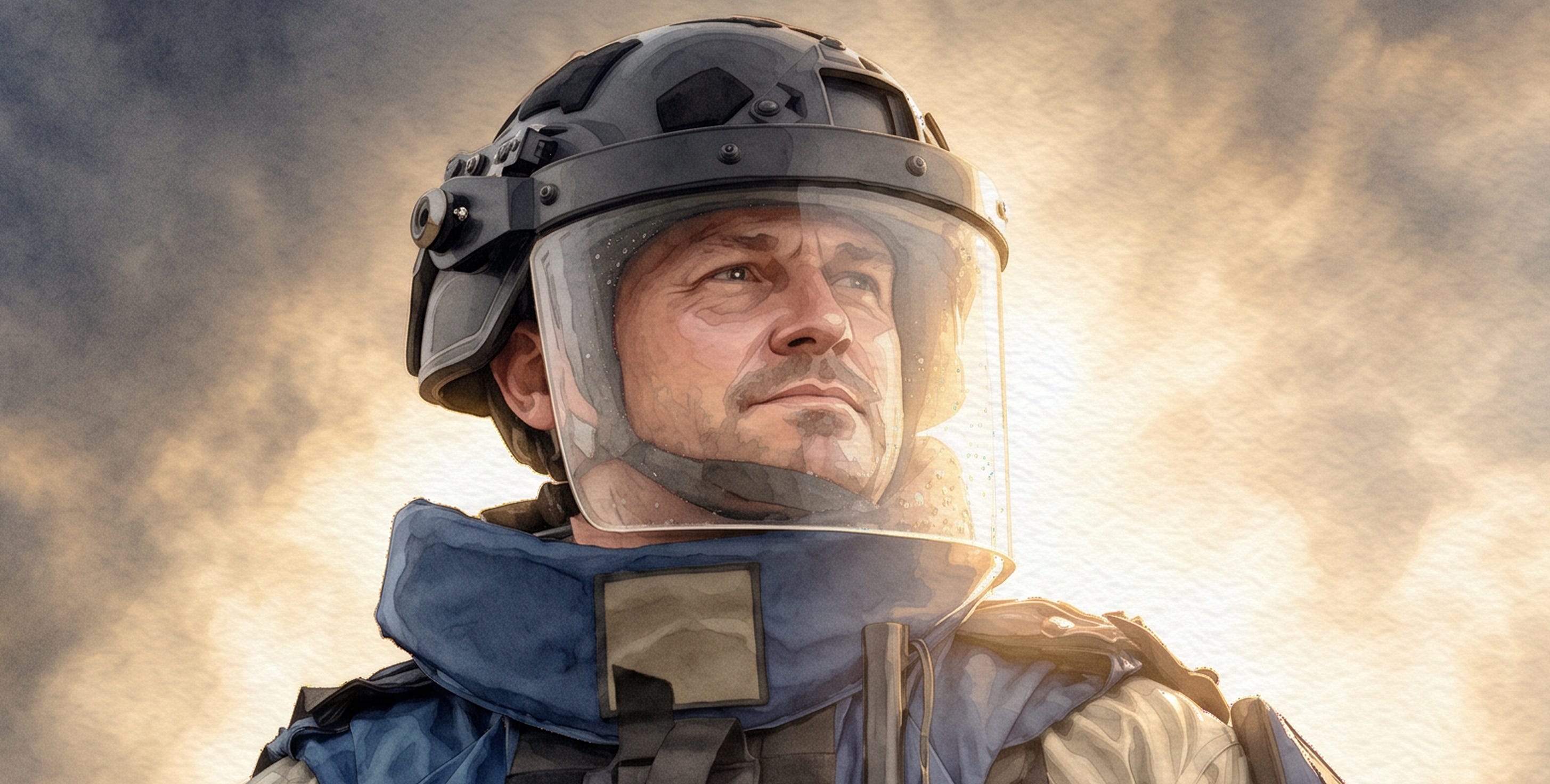
Russia’s invasion of Ukraine brought him back into service, this time as a humanitarian volunteer.
In this interview, he explains how clearing mines gave him back his purpose, what civilians endure beyond the headlines, and why American and Ukrainian veterans now work side by side to help families return home.
Welcome to Voices of the Fight— a Saturday Q&A series featuring the warriors, innovators, advocates, and volunteers standing under fire for free people.
My name is RYAN HENDRICKSON. I spent 22 and a half years in the military and retired as a Green Beret. Now I use the skills, training, and experience I gained on active duty to help people living through war, disaster, and instability. Right now, our work is in Ukraine.
I did eight deployments to Afghanistan. During a combat operation, I stepped on an improvised explosive device that nearly took my life. So I was very emotionally invested in that country.
We publish this newsletter every day at 9:05am NYC time / 4:05pm Kyiv.Your subscription fuels our work.
I left in July 2021, shortly before the full withdrawal. We had been closing bases where I had served, where people I knew had been injured or killed. When I got home and watched how quickly the Taliban took over, I went to a very dark place.
Then, in February 2022, I watched Russia’s full-scale invasion of Ukraine. I kept having this nagging feeling: Is there something I can do to help? I didn’t know what that would look like, but I felt I needed to do something for humanity after the way we had abandoned Afghanistan.
The problem with war is the ground itself is a weapon. A road you drove down every day before the invasion can now be mined. People were returning to familiar places and getting hurt.
I kept trying to talk myself out of it. I was telling myself, “You don’t even know where Ukraine is on a map, dummy. What do you think you’re going to do?” But the feeling kept getting stronger. In late March 2022, I went.
I linked up with Youth With A Mission, a missionary organization with a base in Kyiv. They were evacuating women and children from the suburbs threatened by Russian forces. That was my first work there.
After the Russians withdrew from the Kyiv region, I went into Bucha and Irpin on April 4. We brought food and medical supplies. People were coming out of basements and cellars, scared and unsure whether they could trust us. Then they heard this big-mouthed American talking, and that helped.
I had never experienced destruction and suffering on that level. But helping people started to help me, too. I felt like I had a mission again. I had an identity and a purpose.
As civilians returned to their homes, they wanted to pick up the pieces of their lives and see what was left. That is what people do after a wildfire, a hurricane, or a tornado. War is no different in that respect.
The problem with war is the ground itself is a weapon. A road you drove down every day before the invasion can now be mined. People were returning to familiar places and getting hurt.
I started volunteering with a Ukrainian territorial defense team in rural areas that weren’t getting much attention. Ukraine was fighting a war and dealing with an enormous humanitarian crisis. I wanted to help in places where resources were stretched.
At first, I would work with a demining team and find out what they needed: detectors, protective equipment, and other supplies. Then I would return to the United States, raise money, buy the equipment, and bring it back. I would work alongside the team and leave the equipment with them.
That is familiar work for a Green Beret: training, advising, assisting, and equipping others. I was using those skills in a humanitarian capacity, and it was incredible.
I then founded Tip of the Spear Landmine Removal because I realized this was what I wanted to do for the rest of my life. I wanted other veterans to experience it, too.
We also have Tip of the Spear Ukraine, an entirely Ukrainian team. Most are wounded veterans who can no longer serve in combat. This gives them another way to serve. We have American veterans and Ukrainian veterans working together to help rebuild, restore, and revitalize Ukraine.
For veterans, losing your identity and purpose after military service can be devastating. My experience after Afghanistan is unfortunately familiar to many of us. Through this work, I got my life back. I want other veterans to have that opportunity.
I have completed 13 missions to Ukraine and spent more than two and a half years there in total. My heart is in Ukraine, and I will always be involved there. Eventually, I would also like us to build teams in other countries where people need this kind of help.
In some of the darkest and most destructive places I have been in Ukraine, I have seen the best of mankind.
You look around and think: How can there be any hope here? How can there be any presence of God in a place like this? Then you see it through the people.
I have seen grandmothers and grandfathers come out of what is left of their homes, places their families have lived in for generations. Everything is destroyed, and yet they are grateful. They tell you, “I don’t have much, but I want to cook for you because you’re helping me.”
That is the light in the darkness. It comes from the Ukrainian people. You arrive to help them, and their response gives you hope.
A lot of people outside Ukraine don’t understand the suffering. They hear reports about military successes or high morale, and they can come away thinking people must be doing well.
But there are still civilians caught in the middle of this war. A successful military operation doesn’t make their suffering disappear. There are real human beings living through this, and I don’t think we explain that well enough in the West.
Stop trying to control everything.
My belief is that your life is like a book. The first chapter and the last chapter have already been written. When you are born and when you die are in God’s hands. What I can focus on is filling the pages in between.
I need a mission and a clear objective. Maybe we are helping a particular group of people or clearing an area. I know what we are trying to achieve, and I keep the steps between starting and finishing as simple as possible.
Everyone is going to have a story. How is yours going to read? Did you take chances? Did you help people? Did you do your part to make the world a better place?
That is what keeps me grounded in high-stress situations. I focus on what I can control and simplify everything as much as possible.
In Afghanistan and Iraq, I learned that the more complicated you make a plan, the more opportunities you create for failure. A simple plan that everyone understands has a better chance of succeeding.
We call it KISS: “Keep it simple, stupid.” That principle has stayed with me.
I need a mission and a clear objective. Maybe we are helping a particular group of people or clearing an area. I know what we are trying to achieve, and I keep the steps between starting and finishing as simple as possible.
Master what you can control. Don’t overthink everything until the plan becomes impossible. Keep the objective in mind, and go out there to help people.
4 | How can people support your work?
We are a nonprofit, so of course we need funding. The more resources we have, the more people we can help. But what I am especially looking for is strategic partnerships.
We need people who can connect us with institutions, foundations, and private donors that we would otherwise struggle to reach. You can’t always just pick up the phone and get a meeting. An introduction from the right person can open a door.
Alongside Tip of the Spear Landmine Removal, we have the Tip of the Spear Veterans Humanitarian Corps. Think of a Peace Corps made up of veterans. These are people with the experience to work in high-risk environments where many other organizations cannot operate because of safety concerns. Our work also includes mine action.
We want partners who believe in that mission and want to help us develop it, reach more people, and give more veterans an opportunity to serve.
I have brought people to Ukraine who said, “I just want to see what you’re doing.” I tell them, “Get yourself to Kraków, and as long as you have about three weeks free, I’ll pick you up.”
They come out with us and see the work firsthand. Then I put them on a train home, because I’m staying in Kharkiv to continue the mission.
We publish this newsletter every day at 9:05am NYC time / 4:05pm Kyiv.Your subscription fuels our work.
That is the kind of collaboration I’m talking about. Help us build the relationships that allow us to reach more people and give more veterans an opportunity to serve.
Above all, I want people to understand that humanitarian support and aid should not be political. It is humans helping humans because that is what we are supposed to do.
People sometimes call it heroic. I don’t see it that way. Helping another human being used to be considered normal. It is the right thing to do.
That is what this mission comes down to: humanity, and doing our part to make the world a better place.
5 | Where can people follow you?
The best place to start is landmineremoval.org. You can find the links to our social media there and follow our work.
I constantly share updates because I want donors to see where their money is going. People sometimes ask why I take so many videos. That is the reason. If someone trusts us with their hard-earned money, I have a responsibility to show them what we are doing with it.
Some supporters have come to Ukraine and seen the work for themselves. Most people can’t do that, so our social media gives them a way to follow the mission and understand what their support makes possible.
Tip of the Spear Instagram
Tip of the Spear Documentary on Amazon
Safe Ground Documentary on ▶YouTube
Nikolaus Muchitsch is chief of staff and strategy at Under Fire News.
Your subscription fuels our work.
underfire.news | PayPal | X | Instagram | LinkedIn | Youtube | Facebook