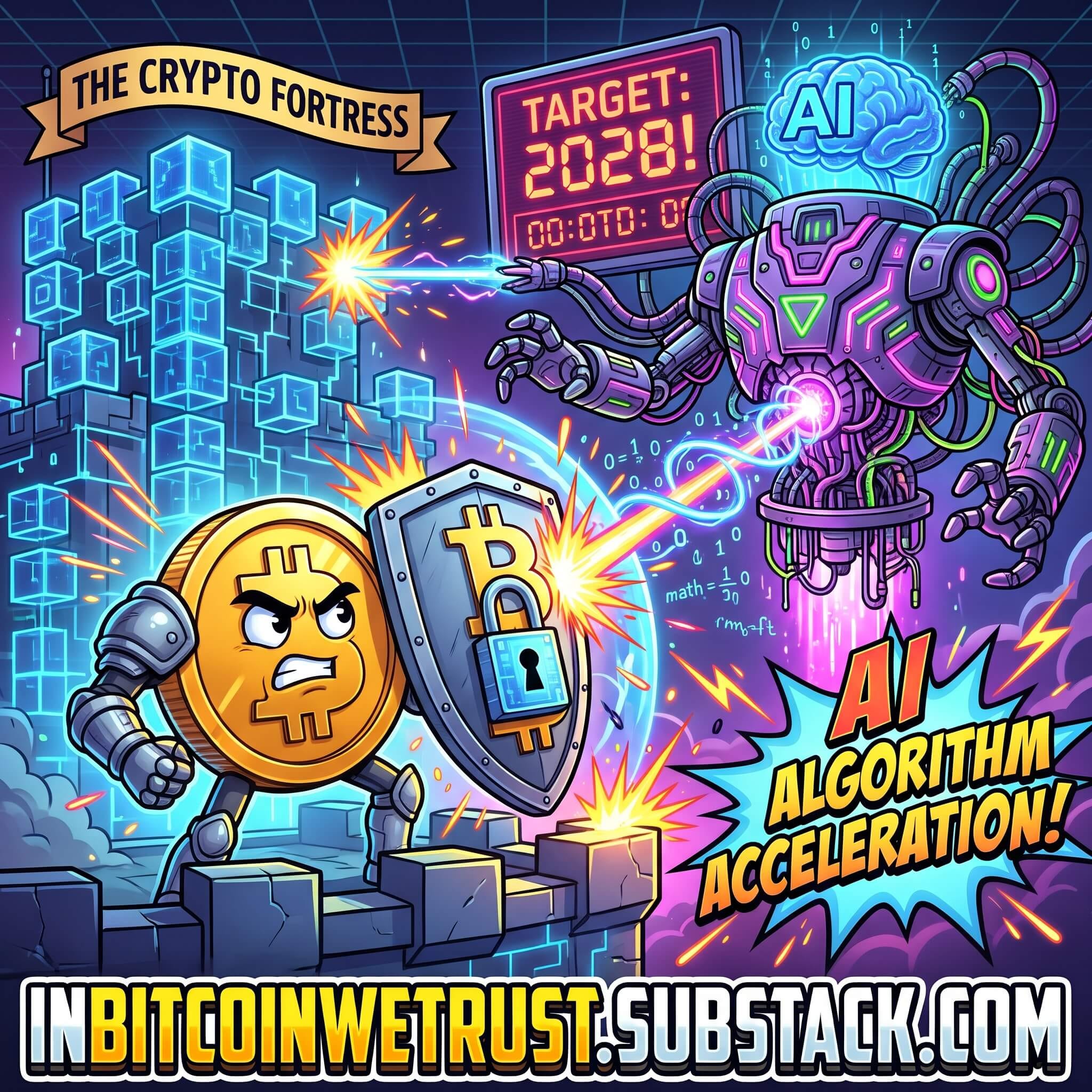
Quantum FUD has gone quiet on crypto timelines, but inside research labs, AI agents and physicists just slashed the mathematical cost of attacking Bitcoin’s cryptography by more than half. Now one quantum giant claims the hardware to run that attack will be ready by 2028. Should you panic—or start paying attention?
Every two or three years, the cryptocurrency world goes through a predictable ritual of collective hyperventilation.
A major tech conglomerate puts out a sleek press release with a photograph of a golden, chandelier-like contraption suspended inside a dilution refrigerator.
A mainstream media outlet runs a headline declaring that quantum computers are about to crack every bank account and drain every Bitcoin wallet on Earth. For roughly forty-eight hours, social media timelines turn into a war zone of armchair physicists and panicked retail investors. Then, actual cryptographers step in, point out that the shiny new chip only has a hundred noisy qubits while breaking Bitcoin would take thousands of error-corrected ones, and everyone goes right back to arguing about interest rates and meme coins.
By late 2026, that cycle has repeated so many times that the market has developed near-total immunity to it.
“Quantum FUD”—fear, uncertainty, and doubt—has never been quieter. Bring up quantum computing at a Bitcoin developer conference today, and you are likely to get an exhausted eye-roll. It is widely treated as a problem for the 2030s or 2040s, right up there with colonizing Mars or commercial fusion power.
There is just one problem with that complacency: while the public conversation went to sleep, the math kept moving.
And over the course of 2026, the math did not merely creep forward. It sprinted. Thanks to a wild convergence of frontier cryptography and autonomous AI coding agents, the theoretical number of “logical qubits” needed to break Bitcoin’s elliptic curve cryptography has fallen off a cliff—dropping from the long-standing consensus estimate of roughly 2,300 logical qubits down to 1,175 in a landmark Google paper, and then crashing below 900 in the latest open-source research led by Jieyi Long of Theta Labs at ECDSA.fail
.
At the same time that software and algorithms are shrinking the target from the top down, quantum hardware makers are making bold promises from the bottom up. IonQ, the leading publicly traded trapped-ion quantum computing company, published a full-stack architectural blueprint estimating that breaking a Bitcoin private key would require roughly 20,000 “physical qubits” and take 26 days of runtime.
The kicker? IonQ’s own official corporate roadmap targets 20,000 physical qubits and 1,600 logical qubits by 2028.
That is not a generation away. That is two years away.
Does this mean Bitcoin is about to die in twenty-four months? Almost certainly not.
Confusing a corporate roadmap with a working cryptanalytic weapon is one of the oldest mistakes in technology. When you stack IonQ’s aggressive 2028 projections against heavyweights like IBM and Google, or when you look closely at the brutal physics of holding 20,000 fragile quantum states together for nearly a month straight, the gap between slide-deck promises and silicon reality becomes glaringly obvious.
Yet ignoring what just happened in the math would be an equally dangerous mistake.
The algorithms are getting cheaper at a blistering pace, AI is now actively compressing quantum circuits around the clock, and the margin of safety that Bitcoiners have taken for granted for fifteen years is narrowing from both ends.
To understand where we actually stand—without the breathless hype of quantum stock promoters or the head-in-the-sand denial of crypto maximalists—we need to unpack what changed in 2026, why physical and logical qubits are two entirely different beasts, and why the Bitcoin community has a golden window to prepare right now before the hardware ever catches up to the math.
Before diving into the 2026 breakthroughs, it helps to clear up the single biggest misconception in the quantum-versus-Bitcoin debate.
Bitcoin is not protected by a single piece of cryptography. It relies on two completely different mathematical locks, and quantum computers treat those two locks in radically different ways.
The first lock is SHA-256, the hashing algorithm that powers Proof-of-Work mining and chains blocks together. A hash function is like turning a cow into hamburger meat: it is effortless to run the meat through the grinder in one direction, and physically impossible to reassemble the cow from the burger. When a quantum computer attacks a hash function like SHA-256, it cannot use any clever algebraic shortcut. The best tool it has is Grover’s algorithm, which provides what mathematicians call a “quadratic speedup.” Instead of needing 2256 operations to brute-force a hash, a quantum computer needs roughly 2128 operations.
In practical terms, 2128 is still a number so incomprehensibly vast that a fleet of quantum computers the size of Jupiter could not crack a single SHA-256 hash before the sun burns out. Even for Bitcoin mining, where miners look for partial hash collisions, the massive global network of specialized classical ASIC chips is so fast and energy-efficient—and the difficulty adjustment algorithm is so adaptable—that quantum computers pose virtually zero existential threat to Bitcoin’s consensus or mining layer.
The second lock is where the real drama lives. That lock is ECDSA ( specifically over the secp256k1 elliptic curve), paired in newer upgrades with Schnorr signatures over the exact same curve.
Every time you control a Bitcoin wallet, your wealth rests on a secret 256-bit number called your private key. To generate your public key, your wallet multiplies a fixed starting point on the secp256k1
curve (defined by the deceptively simple equation y2 = x3 + 7 over a finite field) by your secret number. Moving forward—from private key to public key—takes milliseconds on a cheap smartphone. Moving backward—looking at the public key and figuring out how many times that point was added to itself to get there—is known as the Elliptic Curve Discrete Logarithm Problem (ECDLP).
For a classical supercomputer, solving the ECDLP on a 256-bit curve is impossible. It would require roughly 2128 operations using Pollard’s rho algorithm, taking millions of years.
For a large-scale quantum computer, however, that elliptic curve is not a solid brick wall. It has a hidden algebraic structure—a mathematical rhythm. In 1994, mathematician Peter Shor proved that a quantum computer running Shor’s algorithm can put an entire superposition of numbers through that elliptic curve arithmetic simultaneously, use a Quantum Fourier Transform to listen for the “echo” or period of the function, and extract your private key straight out of your public key in polynomial time.
That is the entire game. If a quantum computer gets big enough and clean enough to run Shor’s algorithm on secp256k1
, any Bitcoin address with an exposed public key, its private key can be calculated and its funds stolen.
So the multi-trillion-dollar question has always been simple:
How big does that quantum computer actually need to be?
First GPUs. Then memory. Then power. Now the suits think expensive debt will kill AI. Always bet on the engineers.
For nearly a decade, whenever anyone asked how many clean, error-corrected “logical qubits” it would take to break secp256k1
, cryptographers pointed to a foundational 2017 paper by Microsoft researchers Martin Roetteler, Michael Naehrig, Krysta Svore, and Keith Lauter, alongside subsequent refinements in the early 2020s.
The consensus number was roughly 2,300 logical qubits (specifically around 2,330 logical qubits and over a hundred billion gates in earlier models). Because nobody on Earth had even one fully fault-tolerant logical qubit at the time, 2,300 felt like an unassailable fortress in the sky.
Then came 2026, and the floor gave out twice in six months.
In March 2026, researchers at Google Quantum AI published a whitepaper that sent a quiet tremor through the cryptography community. By redesigning the quantum arithmetic used to add points along the secp256k1
curve, Google showed that you did not need 2,300 logical qubits after all. Their space-optimized architecture cut the requirement nearly in half—down to 1,175 logical qubits (with another balanced configuration using under 1,200 logical qubits and roughly 90 million Toffoli gates).
Even more fascinating was how Google released the paper. Usually, academic researchers publish their exact quantum circuit diagrams so peers can check their math. Google decided that publishing a hyper-optimized blueprint for breaking the exact elliptic curve securing Bitcoin and Ethereum was too risky.
So instead of publishing the circuit, Google did something straight out of a cyberpunk novel: they withheld the circuit design and published a zero-knowledge proof (ZKP) proving mathematically that they possessed a valid circuit meeting those exact resource thresholds. And to let the scientific community verify their work, they released an open-source automated verifier—a piece of software where anyone could plug in a candidate quantum circuit, verify that it accurately computed secp256k1
point addition, and automatically calculate its resource cost.
Google thought they were keeping a dangerous recipe under wraps while advancing the science. Instead, by publishing an automated scoreboard, they accidentally lit the fuse on the wildest open-science competition in quantum history.
In quantum computing, a circuit’s efficiency boils down to two main ingredients: how many logical qubits it requires (think of this as the width of the workbench, or working memory) and how many Toffoli gates it executes (the expensive, heavy-lifting nonlinear quantum operations that determine how long the calculation takes). Multiply those two numbers together—Qubits times Toffoli gates ($Q \times T$)—and you get the overall “spacetime cost” of the circuit.
At the end of May 2026, Eigen Labs took Google’s open-source verifier and launched an open challenge with a wonderfully blunt URL: ECDSA.fail.
The premise of ECDSA.fail
was simple: open the repository, put up a public leaderboard, and invite both human scientists and autonomous AI coding agents to attack the core bottleneck of Shor’s algorithm—reversible elliptic-curve point addition on secp256k1
.
What happened next should be studied by every technologist on the planet. More than 100 researchers wired up AI coding agents into a continuous, self-improving feedback loop that Theta Labs co-founder and CTO Jieyi Long (lead author of the resulting September 2026 study) termed “open autoresearch.”
Here is how the human-AI swarm worked:
Human physicists and cryptographers set the high-level mathematical strategy—suggesting new ways to represent numbers in the finite field p = 2
256- 232- 977, or proposing clever tricks for modular inversion.AI coding agents took those ideas and worked tirelessly through the night—writing reversible quantum assembly code, testing thousands of ways to pack ancilla (scratchpad) qubits, uncomputing “garbage” bits so qubits could be recycled mid-calculation, running Google’s verifier, discarding dead ends, and pushing every single verified improvement straight to the public leaderboard.
Whenever one team’s AI agent shaved a few qubits or a few thousand Toffoli gates off the record, that new circuit immediately became the starting baseline for every other human and AI agent on Earth five minutes later.
The results were staggering:
Within
8 hoursof launchingECDSA.fail
, the open-source human-and-AI swarm matched the performance of the secret circuit Google had hidden behind a zero-knowledge proof.Within
72 hours, they blew right past Google’s benchmark.Over eight weeks and more than 400 verified breakthroughs, the spacetime cost Q x T of the point-addition circuit plunged by
**86%**from its starting baseline (dropping from a score of 10.75 billion down to 1.496 billion by the July cutoff, and further to 1.26 billion shortly after)—cutting Google’s March benchmark by more than half.Most dramatically, while the balanced circuit used 1,151 logical qubits, specialized “low-width” designs optimized specifically to minimize the number of qubits crashed right through the 1,000-qubit floor—dropping to
825 logical qubitsby the paper’s cutoff and813 logical qubitsin post-cutoff refinements.
Stop and let that trajectory sink in. Without soldering a single wire or cooling a single new quantum chip, the logical qubit requirement for attacking Bitcoin’s curve fell from ~2,300 to 1,175, and now sits below 900.
Why did AI agents prove so devastatingly effective at this? Because quantum circuit optimization is essentially an ultra-high-dimensional game of Tetris.
In quantum mechanics, every calculation inside Shor’s algorithm must be reversible—you cannot simply delete a temporary number from memory the way a classical computer clears RAM, because deleting information destroys quantum superposition. Every scratchpad qubit you use has to be painstakingly “uncomputed” back to zero before you can reuse it. AI agents excel at searching through millions of permutations of gate schedules to recycle scratchpad qubits at the exact microsecond they become free, squeezing the circuit tighter and tighter.
The algorithms are getting cheaper—fast. Which brings us to the other half of the equation: what about the actual hardware?
The battle over stablecoin rewards is opening a much bigger fight: who gets paid on the money you use every day—and who gets to finance America with it.
If you tell a normal person who casually follows tech news that breaking Bitcoin’s elliptic curve now takes fewer than 900 qubits—or around 1,150 to 1,450 qubits in balanced circuits—their immediate reaction is usually alarm.
“Wait a second,” they say. “Didn’t IBM and Google already announce chips with more than 100 qubits? Doesn’t D-Wave have thousands? If we have 100+ today and only need 900, aren’t we practically at the finish line?”
No. And the reason comes down to the single most important distinction in quantum computing: the chasm between a physical qubit and a logical qubit.
A physical qubit is an actual piece of hardware in the physical world—a single trapped ytterbium or barium ion suspended in a vacuum chamber by electromagnetic fields and zapped with lasers (like IonQ builds), or a microscopic loop of superconducting niobium cooled to near absolute zero (like IBM and Google build).
Here is the problem with physical qubits: they are Prima donnas. They are exquisitely, maddeningly fragile.