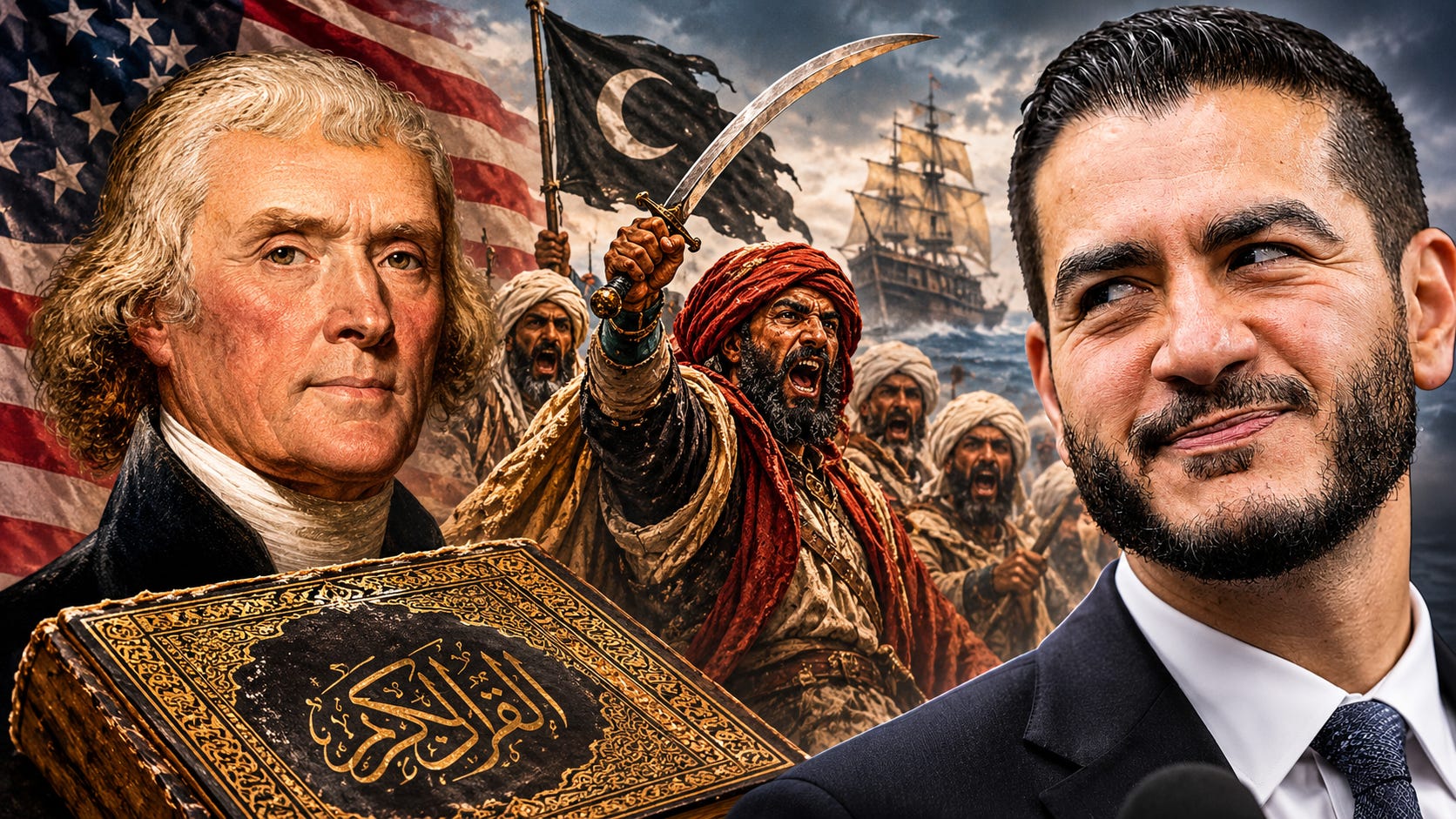
Michigan Senator-elect Abdulrahman El-Sayed recently announced that he will likely be sworn into the U.S. Senate not on a Bible, but on a Koran. He is considering two possibilities: Thomas Jefferson’s Koran, which Keith Ellison famously used when he was sworn into Congress in 2007, or an old copy held by the University of Michigan.
The symbolism is hardly incidental. Like other Muslims before him, El-Sayed is invoking Jefferson to make a larger point: that Islam and its holy book have “always been part of America’s history,” and that the Koran is as fitting a book to celebrate American religious tolerance as the Bible itself. Indeed, El-Sayed’s defenders will doubtless portray the occasion as yet another milestone in America’s supposedly long and welcoming relationship with Islam.
But there is a rather significant historical problem with this rosy narrative: the reason so many of America’s founders—and generations of Europeans before them—bothered to obtain and study the Koran in the first place was not to “celebrate” Islam.
Instead, from their first contact—or rather collision—with Muslims, non-Muslims wanting to understand what Muslims’ rationale for attacking them always turned to the Koran.
Beginning with John of Damascus (b. 675)—who said “There are many … quite ridiculous things in this book which he [Muhammad] boasts was sent down to him from God”—till the modern era, non-Muslims, particularly Christians and Europeans, reached an unwavering consensus that the Koran, that “most pitiful and most inept little book of the Arab Muhammad,” not only promoted hate and violence, but was full of “ugly and vulgar filth,” including by depicting paradise as a “sexual brothel” for those who die waging jihad, to quote the eighth century’s Nicetas Byzantinos, who had and closely studied a copy of the Koran.
Even the first English translation of the Islamic holy book (based on a French translation) was produced at a time when the Muslims of North Africa—the Barbary pirates—were terrorizing virtually every corner of Europe, enslaving at least 1.25 million Europeans, from as far away as Iceland. In this context, the translator of this first English language Koran (1648), Alexander Ross, explained why Englishmen should bother reading the Koran:
[In] viewing thine enemies in their full body, thou maist better prepare to encounter and, I hope, overcome them…. There have been continual wars, and will be still between us. It concerneth every Christian who makes conscience of his ways, to examine the cause and to look into the grounds of this war.
Then the age of political correctness fell upon us—an age of unrestrained censorship and deception. U.S. President Barack Obama declared that “Islam has been woven into the fabric of our country since its founding.”
As “proof” of this dubious claim, we were told that one of the earliest instances of the Koran’s introduction into America came under “progressive” circumstances. Speaking of his being sworn into the House of Representatives on the same Koran that Thomas Jefferson owned, Keith Ellison exulted:
It demonstrates that from the very beginning of our country, we had people who were visionary, who were religiously tolerant, who believed that knowledge and wisdom could be gleaned from any number of sources, including the Qur’an.
Well over a decade later, in January 2019, Rashida Tlaib, another Muslim elected to the House of Representatives, said she too would be sworn in on the same Jefferson Koran. “It’s important to me because a lot of Americans have this kind of feeling that Islam is somehow foreign to American history,” she said. “Muslims were there at the beginning. … Some of our founding fathers knew more about Islam than some members of Congress now.”
Several academics agree with this view, including Denise Spellberg, author of Thomas Jefferson’s Qu’ran: Islam and the Founders. While admitting that “it’s true” that Jefferson’s Koran was produced under the usual circumstances—to understand and combat one’s enemy, in this case, Islam—“it’s [sic] appeal went beyond” and “was really a bestseller,” she said. “By using Jefferson’s Quran,” she added of the aforementioned Muslim politicians, “they’re affirming the fact that Islam has a long history in the United States, and is in fact an American religion.”
How much if any of this is true?
None.
Continue reading below.
If you value unflinching, historically grounded analysis that mainstream outlets soften or ignore, consider upgrading. Paid subscribers get:
**Several new, full-length articles every week.**Carefully researched pieces you won’t find elsewhere.
Full access to the complete premium archiveArchive of in-depth writing, research, and commentary — all in one place.
Entry into the subscriber chatA private space for serious readers and thoughtful discussion.