I once thought deconstruction was something I was doing to Christianity. I had inherited a theological world that told me what was true, who I was, what God required, how a life should be lived, and what ultimately mattered. Taking that world apart was difficult enough. My assumption was that once the religious architecture had fallen, the essential work of deconstruction was finished.
It wasn’t. What followed has been a much longer encounter with the narratives and mythologies that have governed my life. Narratives and beliefs about success, work, money, masculinity, morality, health, happiness, and what constitutes a life worth living. Turns out I was unknowingly entangled in a web of ideologies beyond religion. Leaving Christianity did not automatically free me from them.
That is one reason I named this newsletter Deconstructionology. I have come to understand deconstruction as more than the dismantling of religious belief. It is a way of meeting life itself. It means becoming curious about the stories through which we interpret reality, especially the ones that have become so familiar we mistake them for reality. It asks us to notice what has been deciding for us what is valuable, normal, successful, shameful, possible, or true, and to bring those assumptions back into contact with our actual experience.
I often use the metaphor “inner anarchy.” Anarchy, in its most basic sense, means the absence of a ruling class. Much of my work explores the religious and cultural beliefs, narratives, ideologies, and assumptions that are programmed into us from an early age. Over time, these inherited constructions can become ruling powers within us, shaping what we believe, fear, desire, condemn, and imagine possible without our conscious participation.
Inner anarchy is the work of dethroning these powers. It is not the absence of meaning, values, or conviction, but the refusal to be unconsciously governed by inherited authorities we have never examined or freely chosen. Until we confront what rules us from within, we will continue reproducing many of the divisions, hatreds, injustices, and forms of violence that threaten our shared life.
The point is not to spend a lifetime tearing everything down or to arrive at some purified existence free from inherited narratives. We are meaning-making creatures; we will always live through stories, symbols, values, and frameworks. The deeper task is to participate more consciously in what governs our lives, relinquishing what no longer deserves our allegiance and remaining willing to examine what replaces it. Deconstruction, in this sense, is not a stage we graduate from. It is an ongoing practice of reality contact.
This Labor Day, I find myself turning that practice toward one of the most powerful stories many of us inherited without ever thinking of it as a story at all: the relationship between work, economic value, and human worth.
Labor Day is one of those American holidays whose meaning is easy to lose inside the holiday itself. There are sales, cookouts, travel, a long weekend, and the unofficial closing of summer. Somewhere beneath all of that is the reason the day exists: to honor the labor movement and the people whose work built and sustained the country.
I began writing this essay with César Chávez as one of its moral reference points. I can no longer do that without qualification. The allegations that have emerged against Chávez—including allegations that he sexually abused two girls, one beginning when she was 12, and Dolores Huerta’s account that he sexually assaulted her—are horrifying. They also confront us with a difficult question that reaches beyond Chávez himself: What do we do when a person associated with a just cause is accused of profoundly violating the human dignity that cause claimed to defend?
The farmworkers' struggle for dignity does not belong to César Chávez. It belongs to the thousands of people who organized, marched, boycotted, sacrificed, and demanded that human beings not be reduced to instruments of production. A movement is larger than the person history chooses to place at its center.
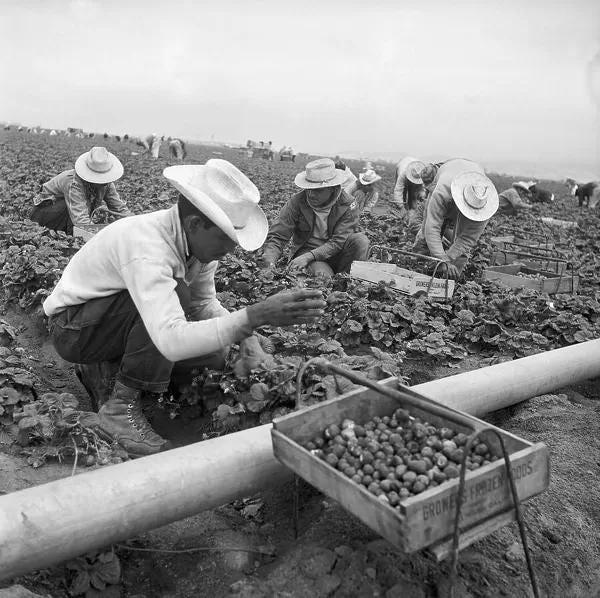
** Chávez** knew migrant labor from personal experience. Born into a Mexican American family in Arizona in 1927, he became a migrant farmworker after his family lost its farm during the Great Depression. He moved from field to field performing physically punishing work for little money and with little power over the conditions of his employment.
Chávez later became one of many people who helped build the modern farmworker movement. Alongside ** Dolores Huerta**, he helped establish the National Farm Workers Association, which joined the Filipino-led Agricultural Workers Organizing Committee during the Delano grape strike and eventually became part of the United Farm Workers. Through strikes, boycotts, marches, organizing, and other forms of nonviolent resistance, farmworkers and their allies challenged an extraordinary contradiction in American life. Their work was essential. The people doing it were often treated as though they were not.
There is something about that contradiction that reaches beyond labor history. A person could spend an exhausting day harvesting food that would appear on someone else’s table and still struggle to feed a family. Workers whose bodies were indispensable to an enormous agricultural economy possessed little bargaining power within it. Their labor had economic value, but the economic system surrounding that labor did not necessarily translate its value into security, dignity, protection, or power for the people performing it.
That contradiction remains with us because it exposes a question much larger than wages.
What is a human life worth?
Every economic system requires methods for assigning value. A bushel of wheat has a price. An hour of labor has a price. A house has a price. Businesses calculate costs, markets establish values, employers determine compensation, and consumers make decisions about what something is worth to them.
The problem begins when the logic of the marketplace escapes the marketplace.
Economic value gradually becomes confused with human value. Income becomes a rough measurement of importance. Productivity becomes character. Wealth suggests intelligence, discipline, or virtue. Poverty invites suspicion. Busyness becomes evidence that someone matters. Rest becomes something that must be justified by previous productivity.
We rarely state these beliefs explicitly because we don’t have to. They are embedded in the culture deeply enough to operate without announcement.
Listen to the questions we ask children. What do you want to be when you grow up? Listen to the questions adults ask each other shortly after meeting. What do you do? Notice how differently we experience ourselves when our careers are flourishing, when we lose a job, when money becomes scarce, when illness limits our productivity, or when retirement removes the occupational identity we carried for decades.
There is nothing inherently wrong with work, achievement, ambition, entrepreneurship, or wealth. Human beings create things, solve problems, build organizations, pursue excellence, and exchange their abilities for resources. Economic life is part of human life.
The danger comes when an economic system becomes an anthropology. It no longer merely organizes production and exchange. It begins supplying answers to deeper questions. It tells us who deserves what, what constitutes success, which lives should be admired, and what makes someone respectable. It defines failure and establishes the achievements by which we are expected to measure whether our lives have mattered.
At that point, economics has entered existential territory.
Leaving religion does not necessarily mean leaving behind the deeper logic religion taught us: that our worth must be established, our lives justified, and some authority satisfied.
The authority can simply change.
God becomes the marketplace. Righteousness becomes productivity. Blessing becomes success. Status becomes evidence that we are doing life correctly. Instead of asking whether we are pleasing God, we begin asking whether we are accomplishing enough, earning enough, producing enough, or becoming enough.
What makes this difficult to recognize is that the new system rarely announces itself as such. It presents itself as reality. Of course a successful life means financial security, professional achievement, upward mobility, and visible accomplishment. Of course the person working eighty hours a week is more ambitious than the person who refuses to organize life around work. Of course having more means you have somehow done better.
These assumptions can acquire remarkable authority over us without ever becoming convictions we consciously chose. They determine what we admire and envy, what embarrasses us, what makes us feel behind, and what we imagine must happen before we can finally regard our lives as enough.
This is why religious deconstruction can leave some of the deepest architecture of religion untouched. We may reject the doctrines while continuing to live before an invisible tribunal, searching for the verdict that says we have succeeded at being human.
You can leave the church and still spend your life trying to prove that you are worthy.
The altar has simply moved.
Calling capitalism a religion makes for a provocative slogan, but I think the more interesting claim is that capitalism, like other powerful social systems, develops beyond its economic function. It becomes an environment of meaning.
I explored some of this terrain recently in ** Is Capitalism a Cult? Unmasking the Man People Love to Hate**, where I returned to Karl Marx not as a political mascot but as a diagnostician of what happens when human beings become estranged from their labor, from one another, and eventually from themselves. Whatever one concludes about Marx’s political and economic prescriptions, his critique raises a question that capitalism's successes do not settle:
What happens to human beings when more and more of life is interpreted through the logic of commodity, exchange, production, and accumulation?
Capitalism is extraordinarily effective at certain things. Markets coordinate enormous amounts of human activity. Incentives stimulate innovation. Investment makes large-scale enterprises possible. Competition sometimes improves products and services. Economic freedom has contributed to extraordinary material development.
None of this requires pretending that markets are morally neutral or existentially harmless.
Every system trains perception. It makes certain things visible and pushes others into the background. A market sees demand, scarcity, productivity, efficiency, growth, risk, return, and price. Those categories are necessary for economic activity. They become dangerous when we begin imagining that everything worth knowing about human beings is legible through them.
A parent caring for a disabled child might produce little that appears in conventional economic measurements while performing work of immeasurable human importance. Someone sitting beside a dying friend might contribute nothing to GDP during those hours while doing something central to what civilization is supposed to protect. A teacher might transform the trajectory of a child’s life without ever receiving compensation remotely proportional to the significance of what occurred.
The market does not necessarily deny the importance of these things. It simply lacks the vocabulary to measure much of what makes them important.
The trouble begins when we forget that limitation. Then price becomes value, compensation becomes contribution, net worth starts sounding suspiciously like worth, and economic visibility becomes our proxy for human significance.
My own religious world sometimes intensified this confusion rather than challenging it.
The most obvious example is the prosperity gospel, where financial success becomes evidence of divine favor and giving money becomes entangled with promises of supernatural return. Faith, positive confession, obedience, and financial contributions are presented as mechanisms through which believers might secure health, wealth, and material blessing.
But the problem extends beyond televangelists promising a hundredfold return.
American Christianity has often absorbed the cultural mythology surrounding success and given it theological legitimacy. Large churches become successful churches. Expanding budgets become evidence of divine blessing. Charismatic entrepreneurs become spiritual visionaries. Wealthy members acquire influence and visibility. Growth becomes an unquestioned good because numbers appear to confirm that God is doing something important.
I know this world from the inside. I spent years as a pastor in American megachurch Christianity. I witnessed genuine generosity, compassion, sacrifice, and service there, and I have no interest in reducing that entire world to caricature. But I also saw how easily the measurements of American capitalism could become the measurements of spiritual success.
Attendance. Buildings. Budgets. Platforms. Influence. Growth. The language was religious, but the scoreboard was often remarkably familiar.
Meanwhile, someone living faithfully, generously, courageously, and anonymously on very little money might barely register within that system of significance.
César Chávez reportedly lived on remarkably little during his decades of work organizing farmworkers. During his lifetime, Chavez never earned more than $5,000 a year. By the measurements of prosperity Christianity, his financial life would hardly look blessed. By another measurement of a human life, the entire calculation changes.
Which raises an uncomfortable question:
What if our measurements are telling us more about the system doing the measuring than about the person being measured?
There was another way Christianity shaped my relationship with work that took me much longer to recognize. Work performed in the name of God was often exempted from the ordinary questions we might ask about any other kind of work. Was it sustainable? What was it doing to my body? What was it costing my family and relationships? Was I exhausted? Did I still want this? Was there enough of my life left over to actually live?
In the religious world I knew, “God’s calling” could override those questions. If God had called you to something, your task was obedience. Sacrifice became evidence of seriousness. Exhaustion could be interpreted as devotion. Boundaries risked appearing selfish. Rest required justification when there was still kingdom work to be done. The language of dying to self made it especially difficult to distinguish meaningful sacrifice from the gradual disappearance of the person doing the sacrificing.
I understand why this language has such power. Some things worth doing require sacrifice. Love costs us something. Commitments place legitimate demands upon us, and a life organized entirely around comfort would be impoverished. But sacrifice becomes something else when people are expected to surrender themselves to the authority of a leader, institution, or cause. The issue is not whether human beings should ever give themselves to something demanding. The issue is whether they remain participants in deciding what their lives will be given to, and whether the cause they serve still recognizes their humanity as something that must never be sacrificed.
Sacrifice loses much of its moral meaning when it is extracted by an authority that has already defined self-concern as spiritual failure. “God’s work” becomes particularly dangerous when no human being is permitted to ask whether the work itself is consuming people. An institution can always find another need, another crisis, another person to help, another program to sustain, another mission requiring one more act of fai…