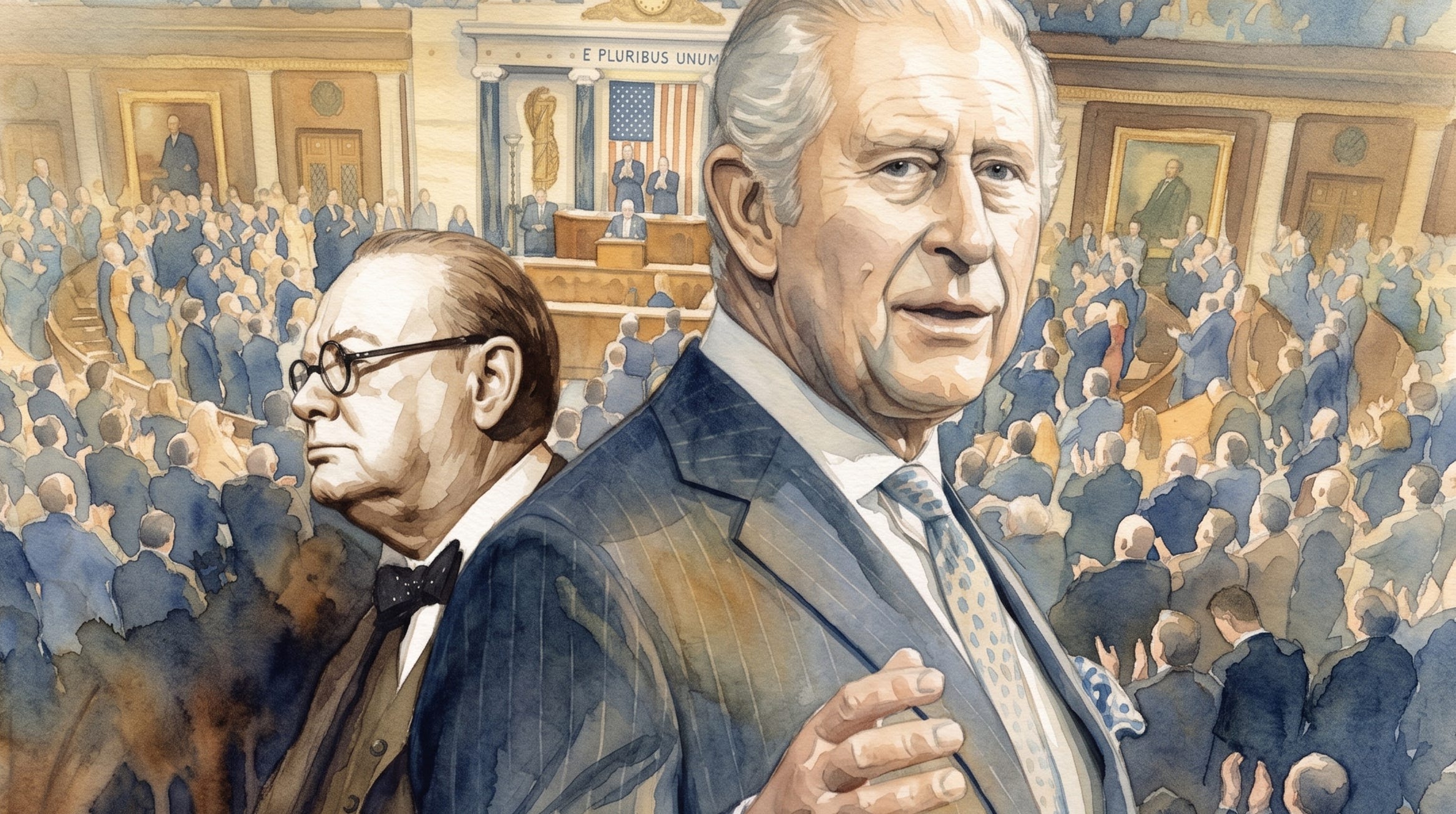
For 70 years Charles III was preparing to take the throne. Yesterday, April 28, after 250 years of American independence, the British monarch took the U.S. Congress.
Charles brought together America’s warring Congress perhaps like no president has—on the very occasion meant to mark America’s break with the British crown.
The response of the Members of Congress was like that of an abused animal finally treated gently, eager to hear the balm of a mere word.
The positive, bipartisan reaction of Congress to the British king shows that even Americans who appreciate Trump’s rapid-action leadership hunger for a father figure above the parties.
With good humor Charles joked he was not engaged in some “rearguard” action to reclaim what his five-times great grandfather had lost. Instead, the King-before-Congress threaded the needle to weave together the fragmented fabrics of hot button but essential issues, from defending Ukraine to protecting nature, from Christian virtues of hope and dignity to securing Western alliances.
We publish this newsletter every day at 9:05am NYC time / 4:05pm Kyiv.If you’re not already subscribed, why not do so now?
At this moment, Vance, yes, even Vance, applauded for “nature,” once the King had
couchedthe wondersof nature as necessary for the national security and prosperity of free peoples.
Speaking as, dare I say, the father of a nation to the equivalent of wounded, fatherless children—that is, Members of Congress—the King was tender but instructive. The response of the Congress was like that of an abused animal finally treated gently, eager to hear the balm of a mere word that soothed their particular wounds.
For the Democrats, that word was “nature”—and they applauded for many seconds to show how warm this made them feel in a warming world that somehow feels cold.
For the Republicans, the word was “Christian”—and they likewise applauded for many seconds, so happy to feel recognized after telling themselves no one (but maybe Jesus) cares.
Charles simply said, in essence, I support nature and I am a Christian. In other lands and climes these words would be met with a nod, with quiet respect, probably with silence. But in the USA, where every word is fraught with divisiveness, political weight, and seemingly-eternal consequence, the mere deployment of a noun is enough to get Congress to its feet—or, in one case, to keep a vice president in his seat.
Temporal kingship returned to America after 250 years and called us to our better selves—what Lincoln, in his First Inaugural, named “the better angels of our nature.”
Nature. Religion. All Faiths—and of None. Freedom. Magna Carta and the Constitution. Left, right, left, right—the King was conducting, but he was also revealing, and maybe even healing a wounded nation, a nation adrift because its own limit-breaking brilliance has uprooted it from things ancient, communal, and purposeful. We can go to the moon, but what for? To argue about it?
Well, as the King said, while it is good to strive for mighty constructions, it is also good to tend to the garden of the earth: to protect nature, yes, and also to protect peoples from diseased pollutants, Putin—though unnamed—among them, that seek to destroy what it means to be human.
Johnson was deciding whether it was OK to disobey Vance,
who sat therein persona Trumpi.
Here is where we saw Charles’s Ciceronian rhetoric on display. When the King spoke of defending “nature,” Vice President JD Vance, seated above Charles in his role as president of the Senate, refused to clap. He feared endorsing usage of a leftwing buzzword. Speaker of the House Mike Johnson, seated next to Vance, also above and in the camera’s frame of the King, rose to clap. After all, isn’t nature a rather innocuous thing to support?
“The mere deployment of a noun is enough to get Congress to its feet—or, in one case, to keep a vice president in his seat.”
As Speaker Johnson rose to clap, he looked to his right at Vance, feeling the gravitational political authority of the White House. Look closely: Johnson was deciding whether it was OK to disobey Vance, *who sat there *** in persona Trumpi, and clap anyway. He looked sheepish, timid, but in the end, encouraged by the actually-anointed king standing before him, Johnson stood up and yes, with the low bar we have set for what counts as courage in an America starting to look more Soviet, he clapped for a word, a single word!
But here King Charles was not done. He was speaking not just words but sentences with verbs, ideas, hopes, admonitions, and, yes, instructions on how to act.
JD Vance was afraid to clap for nature, afraid of a backlash from his base or his president, until the British king, with eloquent logic, gave Vance permission to stand up and applaud for the care of the good earth.
First, the King made the essential move to break the dam of misunderstanding. He aligned values.
Daring to speak of holy things in front of theologist JD Vance, who had only recently warned the pope, who sits in persona Christi, to be careful when speaking theologically, King Charles reminded the Congress that it is still the Easter season, “the season that most strengthens my hope.” His Christian credentials were clear, and the Congress approved with roaring applause.
He’s one of us!
**Second, the King, **having established a connection, and who the day before at the UK Embassy had discussed knitting with decorated British Olympic diver Tom Daley, threaded the needle through the fiery mess of American politics. He found a way to describe nature in a way that would enable even JD Vance to clap:
“We ignore at our peril the fact that these natural systems, in other words, nature’s own economy, provide the foundation for our prosperity and our national security.”
At this moment, Vance, yes, even Vance, applauded for nature, once the King had couched the wonders of nature as necessary for the national security and prosperity of free peoples.
“Today, Mr. Speaker, that same unyielding resolve is needed for the defense of Ukraine and her most courageous people.”
As with Mike Johnson feeling he needed permission to clap, all politicians are looking for permission to think and talk and do. JD Vance was afraid to clap for nature, afraid of a backlash from his base or his president, until the British king, with eloquent logic, gave Vance permission to stand up and applaud for the care of the good earth.
And so the King did with Ukraine—and here is a lesson in persuasion. Last week in Kyiv, Prince Harry, Charles’s estranged son, demanded that Trump help Ukraine. Trump dismissed this demand. The King, on the other hand, cast support of Ukraine as a noble action in union with the planet’s bravest, most loyal people, one that would benefit all of us. He defined Ukraine as an attractive cause worth joining.
Temporal kingship returned to America after 250 years and called us to our better selves—what Lincoln, in his First Inaugural, named “the better angels of our nature.”
Today, Ukrainians by their actions and Charles by his words are proving that being what Lincoln called “last best hope of earth” is something that transcends national boundaries.
Charles summoned America to go deep into its short but consequential history by recalling another of Lincoln’s speeches: the “magisterial Gettysburg address”:
“America’s words carry weight and meaning as they have since independence,” the King said. “The actions of this great nation matter even more. President Lincoln understood this so well with his reflection in the magisterial Gettysburg address that the world may little note what we say, but will never forget what we do.”
Today, Ukrainians by their actions and Charles by his words are proving that being what Lincoln called “last best hope of earth” is something that transcends national boundaries but that draws from a core foundation—traditions of freedom and faith.
“Today, Mr. Speaker,” the King said, “that same unyielding resolve is needed for the defense of Ukraine and her most courageous people.”
When the King said those words, JD Vance, longtime skeptic of Ukraine, hesitated and then decided that yes he had permission to stand and to applaud. Yes, King Charles got JD Vance to applaud for Ukraine.
Then he spoke all of Congress into silence, as, inverting Isaiah, he urged the West to stem the “beating of ploughshares into swords.” The congressional confabulators and senatorial speechifiers sat there. Silent.
Has Charles now set the stage for Trump to turn away from mousy Orban-style submissiveness to Putin and Xi and podcasting pandering, and toward a Western renewal—using at last the time bought by Ukrainian courage?
Trump himself, at the White House welcoming ceremony for the King and Queen earlier that day, spoke laudably of the UK-US heritage, saying that the veins of the American patriots “ran with Anglo-Saxon courage.” The UK, Trump said, gave the USA that “rarest of gifts, moral courage.”
That courage, wrapped in kingly and Churchillian rhetoric, was not on display but rather was in motivating mobilization on the dais in Congress on Tuesday. The King had returned. Tuesday evening, after the King’s speech, at the State Banquet in the White House’s East Room, President Trump praised Charles for his address, which he could not attend due to protocol but about which he had heard.
“I couldn’t believe it,” Trump said. “[Congress] liked him more than they have ever liked any Republican or Democrat … Congratulations. It is not an easy thing to do.”
Now, whither the prodigal nation—not to old political structures, but to greater harmony, higher and original purpose, and right action, with courage?
We publish this newsletter every day at 9:05am NYC time / 4:05pm Kyiv.If you’re not already subscribed, why not do so now?
**The UAE Quits OPEC—**The UAE isleavingOPEC, a serious blow to the 65-year-old oil cartel and a not-so-subtle sign that Abu Dhabi wants more freedom to pump, sell, and compete without waiting for Saudi-led quota politics. The country says it will keep increasing production gradually and according to market demand, but the immediate effect on prices is limited because Iran’s blockade of the Strait of Hormuz is still choking exports from Persian Gulf producers, including the UAE and Saudi Arabia.**The longer-term implications:**OPEC loses one of its few members with spare capacity and fast ramp-up ability, meaning the cartel may become weaker, less flexible, and less able to smooth out price shocks. The conservative read is simple: producer cartels always sound like “stability” until national interests change.
**Comey, Seashells, and the DOJ’s Very Serious Beach Case—**Former FBI Director James Comey has beenindictedagain, this time over a 2025 Instagram photo showing seashells arranged as “86 47” — read by prosecutors as a threat against Trump, the 47th president, because “86” can mean removing someone and, in harsher slang, killing them. Comey 86’d the post after criticism, said he thought it was a political message rather than a call to violence, and insists he is innocent. The Justice Department has charged him with making and transmitting a threat against the president, two felonies that can carry up to five years each.
**Magyar Offers Kyiv a Reset, With Strings Attached—**Hungary’sincomingprime minister Péter Magyar is offering to meet Zelensky in early June in Berehove, the symbolic center of Ukraine’s ethnic Hungarian community in Zakarpattia—a move that signals a real break from the Orbán era without turning Budapest into Kyiv’s automatic cheerleader.in relations and improve the position, which is not necessarily bad besides the fact of Russian war, of ethnic Hungarians in western Ukraine, especially on cultural, language, administrative, and educational rights. That is the clever part: he can distance Hungary from Orbán’s pro-Moscow obstructionism while still defending a national interest that matters to Hungarian voters. Kyiv, for its part, has reason to take the offer seriously.
Magyar says the goal is to “open a new chapter”A less hostile Budapestcould weaken one of Russia’s most useful pressure points inside the EU, but Magyar is also making clear that Ukraine’s European path will come with homework, not applause on demand.
**Ukraine Invents Air Defense-as-a-Service—**Ukraine is nowallowingprivate air-defense companies to help protect factories, energy sites and critical infrastructure from Russia’s nightly drone barrages, a very Ukrainian mix of wartime improvisation, market logic, and hard necessity.
Under a pilot program launched last year, 20 companies have registered, with two already offering operations; firms such asCarmine SkyandGvardiiaprovide layered local defenses ranging from interceptor drones to automated turrets with heavy machine guns.
Crucially, these units are not freelance militias with trigger rights: They must be authorized by the Defense Ministry, plugged into the Air Force command-and-control system, and can only engage targets when the state system gives the order. Recruits are vetted, reportedly including polygraphs, and interceptor pilots can be trained from scratch in around three weeks.
Poland Wants a Drone Armada, With Ukrainian Brains—Poland ismovingto create a “drone fleet” with Ukrainian expertise and EU support. The basic formula: Polish money and industrial ability, Ukrainian battlefield know-how, and European funds aimed at turning lessons from the war intoactual capabilities rather than white papers.
PM Donald Tusk has framed the effort as a Polish “drone armada.” Poland has already seenRussian drones violate its airspace, while Ukraine has spent four years learning, at terrible cost, how drones now shape reconnaissance, artillery, logistics, air defense and deep strike.
Odd Systems Builds the Camera Before Someone Else Controls It—Odd Systemshasunveiledthe Svitlych-662, its first daytime digital camera built specifically for drones, ground robots and fixed observation points using computer vision.The device offers Full HD imagery, works in low-light conditions, supports up to 60 frames per second at 1080p, and is compatible with Raspberry Pi, Jetson, and Orange Pi microcomputers, the kind of boring-sounding technical plumbing that increasingly
decides whether a drone sees, tracks and killsbefore the enemy does.The camera is ruggedized for field use, has optical protection, can be customized for specific missions, and is already being offered for pre-order, with serial production planned. More interestingly, Odd Systems wants to
reduce dependence on foreign componentsby building its own camera-sensor production in Ukraine, while also considering a similar facility in the United States after receiving American interest.
You might also find this interesting:
underfire.news | PayPal | X | Instagram | [LinkedIn](https://www.linkedin.com/in/jp-lindsley-600876…