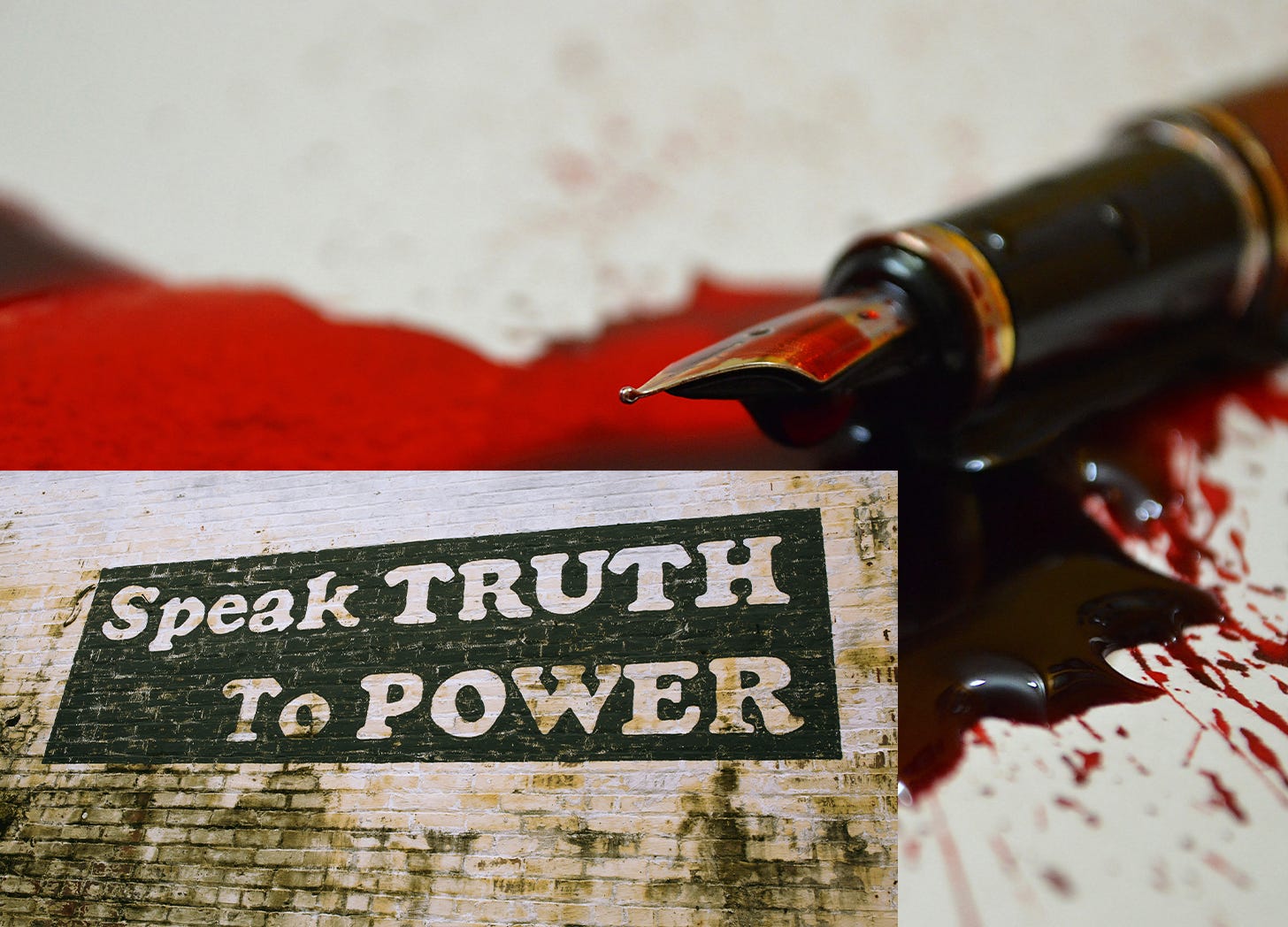
Forward: As we sit at our desks, trying to put the world into some semblance of sense making, the ground shifts beneath our feet, making it really difficult to proceed. Not to forget that we are being told that even though science uses AI to make work more accurate and efficient, we are not to touch it. This, despite the obvious increased efficiency in editing complex documents. The whole mess based upon the fact that some humans will simply make AI do all the work without insisting on human creative direction.
My message is simple: it is the work of writers which lends historical credence to this period we are living through. It is your work which historians will turn to in order to make sense of this whole revolutionary time. Do what you need to do, know it matters deeply.
Be yourself 100%.
- The Disappointment of the Proxy
If you are a writer sitting at a quiet desk today feeling a strange, heavy discouragement, you are not alone.
When a machine can stream thousands of syntactically clean, grammatically polished words in a matter of seconds, it is easy to look at the blinking cursor and ask: What is left for a human being to build?
The exhaustion you feel, however, does not come from a loss of human capability; it comes from a subtle cultural trap: measuring the worth of your craft against the proxy instead of the purpose.
When engineered intelligence generated a 13-million-line, machine-verified proof of Fermat’s Last Theorem, mathematicians did not celebrate—they felt a sudden, cold dread that centuries of human inquiry had been rendered obsolete at the press of a button. Yet that dread rested on a fundamental inversion: mistaking the formal pile of steps for the living act of understanding. As mathematician Alex Kontorovich observed in the midst of the shock: “Math is not the fact, it’s the why”.
The exact same illusion is haunting literature today. A culture mesmerized by mechanisms panics because it has confused the raw generation of text with the act of writing. But writing was never the raw stack of tokens. Just as a 13-million-line proof without a human story inside it does not destroy mathematics, an endless flood of automated prose does not destroy writing. It simply burns away mechanical word assembly so that sovereign human intention, direct lived experience, and the pursuit of meaning can take center stage.
- Shakespeare and Kuhn in the No-Man’s-Land
It is natural to feel that we are living through an unprecedented breakdown, but every major paradigm shift in history has felt this way to the writers who lived it.
When the medieval worldview collapsed into the Elizabethan age, William Shakespeare did not decry his era, throw up his hands, or retreat into despair. He stepped directly into the no-man’s-land between what was dying and what was being born. Shakespeare did not merely write modern stage characters; he invented the exact vocabulary those characters required in order to exist in a transformed world.
Centuries later, philosopher of science Thomas Kuhn demonstrated that when a paradigm shifts, perspective, thought, and language all become something new—leaving old words structurally incapable of measuring the new world. Writing in the 1960s under Newtonian certainty, Kuhn could not state his most radical conclusion without being dismissed: that meaning itself changes when the paradigm changes. He left that truth unsaid, passing it to a later generation to discover.
We have arrived at the exact impasse where what Kuhn left unsaid must finally be spoken: we cannot keep evolving without finding the “why behind the why”—why we exist, why we build, and why we write.
- Writing is an Action Verb, Not a Static Noun
Much of modern discouragement stems from treating writing as a passive product to be monetized, optimized, or generated by decree. But writing is not a static, institutional noun—it is a proactive action verb.
True understanding cannot be acquired through passive consumption, superficial prompt extraction, or “copying the nardu cakes” without absorbing the underlying tacit know-how. In 1861, Australian explorers Burke and Wills starved to death in the wilderness despite eating plenty of Indigenous nardu cakes, because they copied the visible product (the flour) while missing the unwritten, essential know-how—the leaching process that removed the toxins.
When writers try to compete with AI on raw volume or surface formatting, they fall into the exact same trap: copying the cakes without the know-how.
Real writing requires rolling up your sleeves, stepping up to your studio desk, and earning “workman’s wages” through direct, hands-on labor. The physical friction of wrestling an unformed intuition into a clear, un-yielding sentence generates an internal storehouse of unwritten tacit wisdom that no algorithm can revoke, centralize, or replicate.
- The Studio Desk as a Living Standing Wave
In an era flooded with automated slop, sycophantic flattery, and performative skepticism (”gotcha epistemology”), your quiet desk is not a museum of a dying trade—it is a sanctuary of human coherence.
In physical systems, a standing wave is a localized node where intersecting feedback holds a stable pattern against background noise. Your workstation—where your biological perception (”ten fingers and ten toes”) meets direct physical reality—functions as a living standing wave:
Asserting “I Know Not ‘Seems’”: When institutions and automated systems default to couched, evasive phrasing (”seems to be”) to sanitize facts or obscure reality, the sovereign writer asserts Hamlet’s foundational rule:“Seems, madam? Nay, it is. I know not ‘seems’”.Holding the Seam: By refusing to yield your judgment to automated consensus, you stand at the seam where biological perception meets technology, ensuring that language remains anchored in direct, unalienable lived experience.Creating Resonance Over Compliance: You do not write to satisfy an algorithmic feed or an automated hall monitor. You write to build a phase-aligned bridge of resonance with another living mind.
- This is a Renaissance (Even When Hard to See)
Real renaissances never arrive as smooth, institutionally approved press releases. They begin in the dark, amidst confusion, anxiety, and the breakdown of old standards.
Value is never created at the center of an already-settled consensus; it is born at the anomaly—the non-consensus leap where someone notices a shape the existing textbook missed.
Do not be discouraged by the speed or volume of the machine. When word assembly becomes computationally free, raw syntax drops in value. What becomes priceless is perspective, biological grounding, non-consensus courage, and the authentic human voice.
Every sentence you write with honest intent, every idea you test at your garret desk, and every genuine exchange you cultivate holds out the promise that clarity, truth, and human connection are deeply worth doing.
You are not standing at the end of literature. You are standing at the worksite of its next great unfolding.