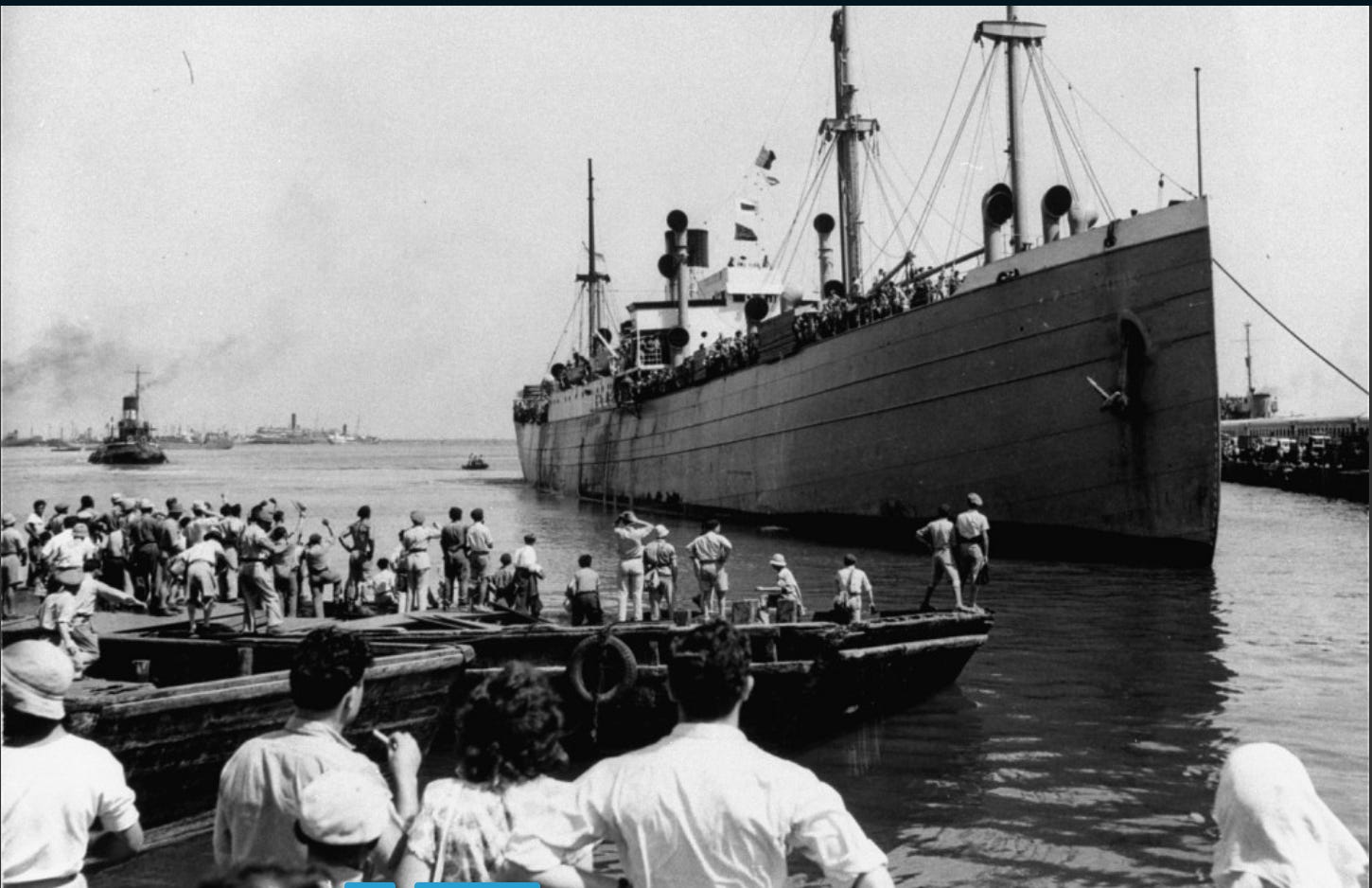
The American story was never only American. The airplanes, money, machinery, and people leaving the United States crossed into a much larger underground network. In Canada, Jewish veterans, pilots, sailors, fundraisers, and ordinary families joined the effort. Across Europe, another network was already moving survivors, volunteers, weapons, and eventually aircraft toward Israel.
That’s how what began as The American Jews Who Secretly Helped Build Israel became The Canadians Who Secretly Helped Build Israel. And once those trails crossed the Atlantic, there was no way to stop there.
Because Europe had a story of its own.
I’m on a mission as a “history activist” to document Jewish history before it’s rewritten, distorted, or erased. Equally, I’m on a mission to uncover the truth. Every paid subscription helps fund the research behind these essays and enables me to continue this work full-time. For $75 a year (just 21¢ a day), you’re doing more than supporting a writer. You’re helping preserve the Jewish story.
It was the summer of 1948. Outside Marseille 20-year-old André Wieder was desperately trying to get to Israel. He had already crossed Europe in one uniform, lost his father to the Nazis, and survived a war that had ended only three years earlier. Now he was volunteering for another one.
André was born in Czechoslovakia in 1927 but grew up in Belgium. His father had been a baker. The Nazis deported him in 1943 when André was only fifteen years old. When Allied forces liberated Belgium in September 1944, André was sixteen. He turned seventeen that December and volunteered for the Czechoslovak Armored Brigade, serving in England, France, Germany, and Czechoslovakia before returning to Belgium in 1947.
He didn’t stay home for long. In the summer of 1948, André joined about twenty young Jewish men and women leaving Brussels by train. They were heading for Israel to join the fighting. Most carried Belgian passports with French visas, but André still had a Czech passport and no French visa. French authorities stopped him at the border.
André and another volunteer, Maurice Gancarski, crossed illegally a few days later and made their way to Paris. Their group had already left, so the two kept going south until they reached Grand Arénas outside Marseille. The sprawling transit camp was packed with people waiting to leave for Israel, and André thought he was finally close to joining them.
Instead, an Israeli officer named Uri Atkin gathered André and about a dozen other French, Belgian, and Italian volunteers. Atkin told them they would serve where they were needed and took their passports. André had made it all the way to Marseille only to discover that the Haganah had other plans for him.
Grand Arénas was moving thousands of people toward Israel. André remembered 2,000 to 3,000 immigrants and Gachal recruits passing through every two or three weeks, many of them French-speaking Jews from Morocco, Algeria, Tunisia, Egypt, and Libya. Some were young men preparing for military service. Others were elderly or sick.
Volunteers were coming through from the other direction too. Lionel Druker and the first group of Canadians from Part Two had passed through Grand Arénas after crossing the Atlantic. British, Belgian, French, Canadian, South African, and other foreign volunteers moved through the camps around Marseille alongside Jews leaving Europe and North Africa.
André spoke French and already knew how to soldier. Atkin needed him in Marseille, so André drilled recruits, helped care for elderly and sick people, and organized groups leaving the camp for ships waiting between Marseille and Toulon.
His work continued after dark. André remembered secretly loading ships with spare parts, armaments, and other supplies for Israel. Many of the people running those ships, camps, warehouses, and ports had spent the previous years getting Jews past the British blockade.
André kept asking to go with them. Atkin kept saying no.