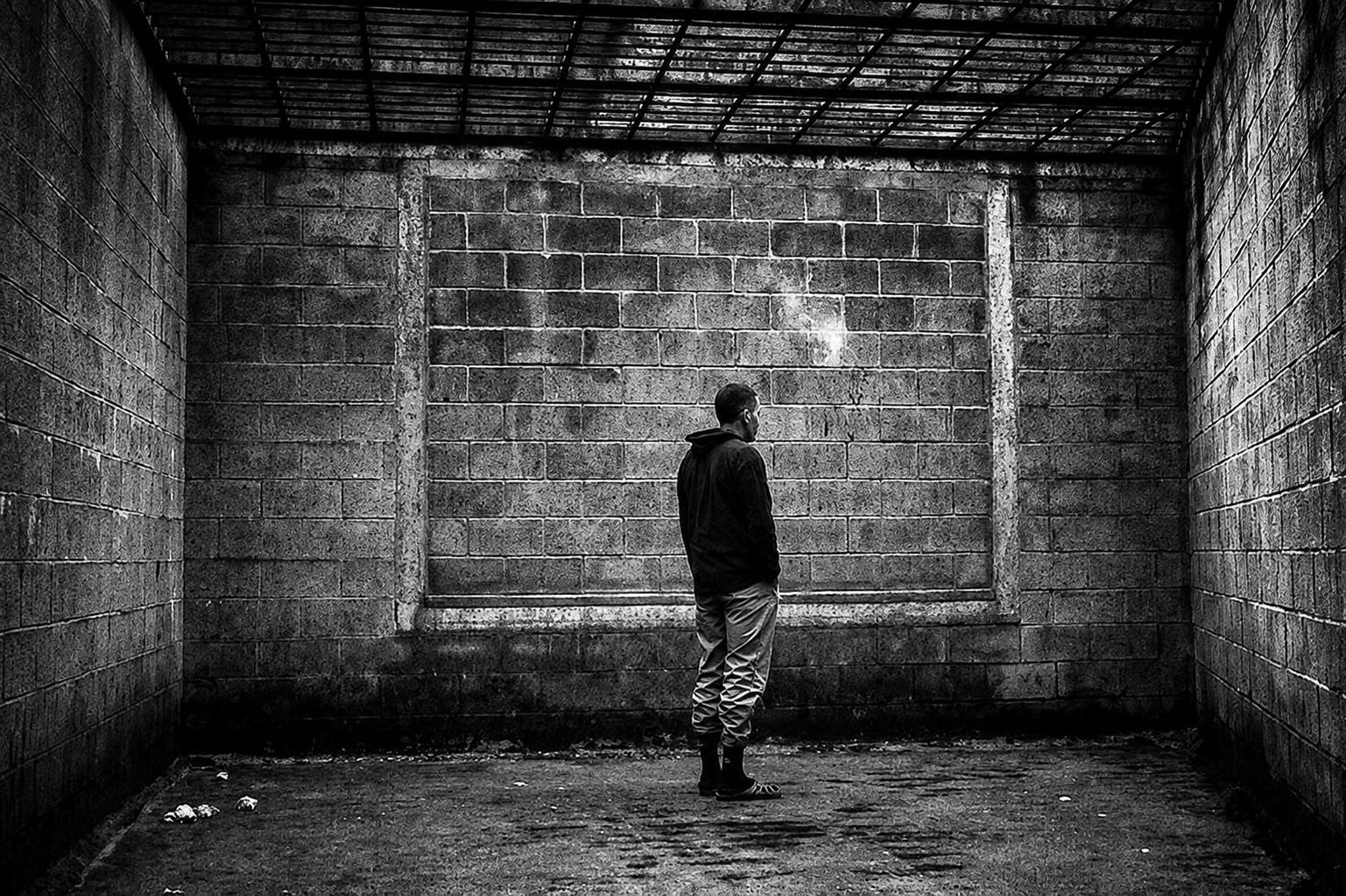
I have spent a great deal of time inside prisons. I have entered them as a chaplain and worked pro bono as a spiritual director with people who were incarcerated and those attempting to build a life after release. I have sat across from people convicted of serious crimes, listened to the histories that preceded those crimes, and witnessed the long human aftermath that no sentence can fully contain.
One of those encounters began with a letter from a man on death row. He had read Divine Nobodies and asked if I would come to see him. He knew that he was going to die. Before that happened, he wanted to tell someone his story.
I went.
I did not go to determine whether he deserved sympathy, revise the facts of his crime, or offer a final interpretation of his life. I went because a human being facing death had asked to be heard. He wanted someone to know that the worst thing he had done, however terrible and consequential, was not the only thing that had ever been true about him. He wanted to place his life in the presence of another person before the state brought it to an end.
That encounter has remained with me. So have the stories of others I have met inside prisons and after their release. Their experiences have forced me to think more carefully about what incarceration takes from a person, what accountability requires, and whether our institutions leave any meaningful possibility for someone to become more than the name of an offense.
This article grows from those encounters. It does not argue against accountability or minimize the suffering of victims. Nor does it presume that listening to someone’s story settles the moral meaning of what they have done. It begins with a narrower and more neglected question: What happens to a human life when an institution assumes control over its time, identity, agency, belonging, and future?
I call that condition existential custody.
What, exactly, does a prison sentence take from a human being?
The most obvious answer is freedom. A person can no longer decide where to go, where to sleep, what to eat, whom to see, or how to spend the day. Movement is restricted, privacy is diminished, relationships are interrupted, and ordinary decisions become matters of institutional permission. The loss is concrete enough to be measured in years, months, and days.
Yet the deprivation of liberty does not remain confined to movement. It reaches further into the structure of a life. Time changes its character. Identity becomes attached to an offense and administered through a classification system. Agency contracts around the demands of survival and compliance. Belonging becomes uncertain. The future no longer feels open in the ordinary way because its possibilities are filtered through a sentence, a record, a parole board, and the enduring judgment of others.
These effects are typically interpreted through the disciplines already equipped to study them. Psychology examines trauma, depression, anxiety, adaptation, and institutionalization. Public health addresses illness, mortality, addiction, and the unequal distribution of harm. Sociology traces family disruption, racial inequality, poverty, social exclusion, and the consequences of imprisonment for communities. Criminology considers punishment, deterrence, rehabilitation, recidivism, and public safety.
Each reveals something indispensable. None, by itself, fully names what happens when an institution gains extensive power over someone’s relationship to being someone, belonging somewhere, exercising meaningful choice, and having a future.
That is an existential event. To say this does not sentimentalize people who have caused harm, deny the gravity of their actions, or relieve anyone of accountability. It identifies another dimension of confinement that our moral and institutional vocabulary leaves underdeveloped. A society has legitimate grounds for restricting liberty in response to serious harm while remaining obligated to ask which forms of deprivation are justified, which are destructive, and what kind of people its institutions are preparing to return to the world.
The argument I want to pursue is that incarceration places more than the body under custody. Time, identity, agency, belonging, and futurity also fall under its control. I call this existential custody: the condition in which an institution acquires disproportionate power over the fundamental coordinates through which human beings inhabit their lives.
Seen in this way, rehabilitation and reentry begin to look different. Completing programs, securing employment, obtaining housing, and avoiding rearrest remain essential. Human reconstruction reaches deeper. Those emerging from prolonged external control must recover the capacity to make choices, inhabit an identity larger than an offense, belong without erasing responsibility, and experience the future as something more than the continued administration of the past.
That is the work of existential health.
A legal sentence specifies a punishment within formal boundaries. It names a period of confinement, a term of supervision, a fine, or some combination of these. The apparent clarity is reassuring. A wrong has occurred; the state responds; the punishment has a defined shape. Whatever moral disagreements surround the severity of the sentence, the law presents it as something bounded.
Lived punishment rarely remains within those boundaries. The sentence follows those who have served it into housing applications, employment decisions, professional licensing, education, voting rights in some jurisdictions, family relationships, and social reputation. Long after the formal period ends, the conviction continues to organize access to ordinary participation. The law declares the debt paid while the social world continues collecting.
I call this extension sentence expansion: the process by which a legally defined punishment spreads into domains of life that were never fully named at sentencing and continues long after formal custody ends. Sentence expansion helps explain why release often feels less like the end of punishment than a change in its administration. The walls become less visible, but the record travels. The institution no longer controls every movement, yet its judgment remains active in the decisions of landlords, employers, agencies, neighbors, and sometimes family members.
The scale of this reality in the United States makes it impossible to regard as an exceptional concern. The Bureau of Justice Statistics reported 1,254,200 people in state and federal prisons at the end of 2023. At midyear 2024, local jails held another 657,500 people and recorded 7.9 million admissions over the preceding twelve months.
Jail and prison are distinct institutions, and people move through them under different legal conditions. The human consequences also differ according to sentence length, age, gender, race, disability, family position, and facility conditions. Even so, the figures reveal the enormous number of lives exposed to some form of carceral control. They also obscure a crucial moral fact: in 2023, 70 percent of people in local jails had not been convicted of the charge for which they were being held.
Public discussion frequently divides these lives into two moral abstractions. One presents incarcerated people mainly as threats from whom society requires protection. The other presents them mainly as casualties of structural injustice. Both perspectives disclose truth, and both risk flattening the individual. Human beings exercise agency while being shaped by circumstances. They cause grievous harm and carry histories of harm within themselves. They bear responsibility without becoming reducible to the worst act of their lives. A serious account of incarceration must hold these realities together.
Existential health begins precisely where reduction fails. It asks what conditions allow a human being to face reality, take responsibility, sustain a coherent identity, remain in relationship, and participate meaningfully in life. Those capacities concern public safety as much as personal well-being. An institution that weakens them may achieve confinement while undermining the human resources upon which any durable rehabilitation depends.
Prison sentences are expressed in temporal units, as though a portion of life could be measured and removed. Five years, twenty years, life. The language gives the impression that punishment consists of taking a quantity from someone, much as a fine takes money. Yet confinement involves more than spending one’s days in an undesirable place. The experience itself changes when a person loses authority over how the present moves toward a future.
Outside prison, life is organized through projects, relationships, responsibilities, seasons, and anticipated events. Much of our existence involves moving toward something, even when the direction remains uncertain. We prepare for birthdays, raise children, change jobs, plan trips, care for aging parents, or simply expect next year to remain available for revision. These activities make our passage through life participatory. We shape its unfolding and are shaped by what we are moving toward.
Incarceration converts this participatory experience into an administered one. The day belongs to the schedule, the count, the meal call, the work assignment, the hearing, and the release calculation. Someone else determines when movement occurs and which events are possible. The future often narrows to a date, and for those serving life or indeterminate sentences, even that organizing horizon disappears. Waiting ceases to be an interval between meaningful activities and becomes the dominant form of existence.
I call this temporal dispossession: the loss of a person’s ordinary power to organize time around chosen commitments and an inhabitable future. Temporal dispossession does not mean that incarcerated people become passive or incapable of creating meaning. Many study, mentor others, sustain relationships, make art, organize, work, practice faith, and build forms of community under severe constraints. Such activity demonstrates human agency under pressure. It should not be used to romanticize the pressure itself.
The effects of temporal dispossession become especially visible in long sentences. The world outside continues without the participation of those incarcerated. Children grow, parents die, technologies change, neighborhoods disappear, language evolves, and intimate relationships take forms that letters and scheduled calls cannot fully sustain. Those inside may remain vividly connected to these developments while being unable to enter them. They are alive in history yet prevented from joining much of its movement.
Release does not automatically restore temporal freedom. Someone who has learned to endure time often struggles to initiate it. Choice requires anticipation, which easily becomes threatening after years in which most consequential decisions were made elsewhere. The open calendar that signifies freedom to one person feels like exposure to another. A reentry plan filled with mandatory appointments often reproduces the administered time of incarceration under community supervision, leaving little room for the gradual recovery of personal rhythm.
Existential health therefore asks more than whether a person is occupied. It asks whether they are recovering a future in which they have a part. Education, work, treatment, and routine contribute to that recovery when connected to personally meaningful commitments. Without that connection, activity remains another schedule imposed from outside. The decisive movement occurs when time becomes capable of carrying intention again.
Every prison must classify. Administrators need to know who requires medical care, who poses a security risk, where someone should be housed, and which services are appropriate. Classification serves real operational purposes. Its danger emerges when an administrative description becomes an ontological verdict, when a category used for management begins to stand in for the human being it describes.
Prison intensifies a process already present in criminal law and public culture. A complex life is compressed into an offense: murderer, addict, thief, violent offender, sex offender, felon. Some of these terms describe acts, patterns, or legal statuses that cannot be ignored. Through repetition, however, the description acquires the force of identity. Grammar performs a moral transformation. Something someone did, even something terrible, becomes who they are.
Under these conditions, the institution assumes a form of authorship. It produces the official account through case files, risk scores, disciplinary records, diagnoses, security levels, and parole reports. Each document may contain relevant information. Together they form an administrative self that often becomes more consequential than the living person. The file travels where the person cannot, speaks when the person is absent, and frames how every later action will be interpreted.
This is institutional authorship: the power of a system to produce the identity through which someone becomes legible to authorities and, eventually, to themselves. Institutional authorship differs from simple labeling because it carries material force. The description determines housing, movement, eligibility, credibility, and release. Resistance is readily interpreted through the description itself. Denial demonstrates lack of insight; anger confirms dangerousness; reserve signals evasiveness. The individual enters a narrative whose terms they did not choose and whose authority they cannot easily contest.
The effects reach inward. The self is partly relational. We learn who we are through the ways others meet us, remember us, and expect us to behave. When nearly every institutional encounter begins with suspicion and every privilege depends upon compliance, self-perception adapts. Some people internalize the role of the criminal. Others construct a hardened persona capable of surviving its imposition. Still others preserve an inner life hidden from the institution. Each response carries intelligence, cost, and risk.
Existential health does not offer the fantasy of an untouched “true self” waiting beneath these imposed roles. People are changed by what they do, what is done to them, and the environments they must navigate. The task is to recover authorship without falsifying the past. That requires language capable of holding continuity and change: I did this; I am responsible for this; this act belongs to my life; my life exceeds it; the person I become remains an open moral project.
Such language is demanding. Condemnation is easier because it freezes identity. Exonerating self-invention is easier because it evades responsibility. Self-authorship occupies the harder ground between them. It allows a person to tell the truth about harm without granting harm permanent possession of the self.
Correctional institutions often say they want people to become responsible decision-makers. Daily prison life frequently works against that goal. Rules regulate minute aspects of existence, incentives reward compliance, and punishment follows unauthorized action. Some degree of regulation is necessary for safety and order. Over time, however, a system that manages most decisions risks weakening the very capacity for judgment it later expects someone to exercise.
Agency is more than having options. It involves interpreting a situation, weighing competing goods, tolerating uncertainty, accepting consequences, and acting from an internally organized sense of responsibility. Compliance requires a narrower capacity: determining what authority expects and adjusting behavior accordingly. Compliance is often prudent, ethical, and essential to collective life. It becomes a poor substitute for agency wh…