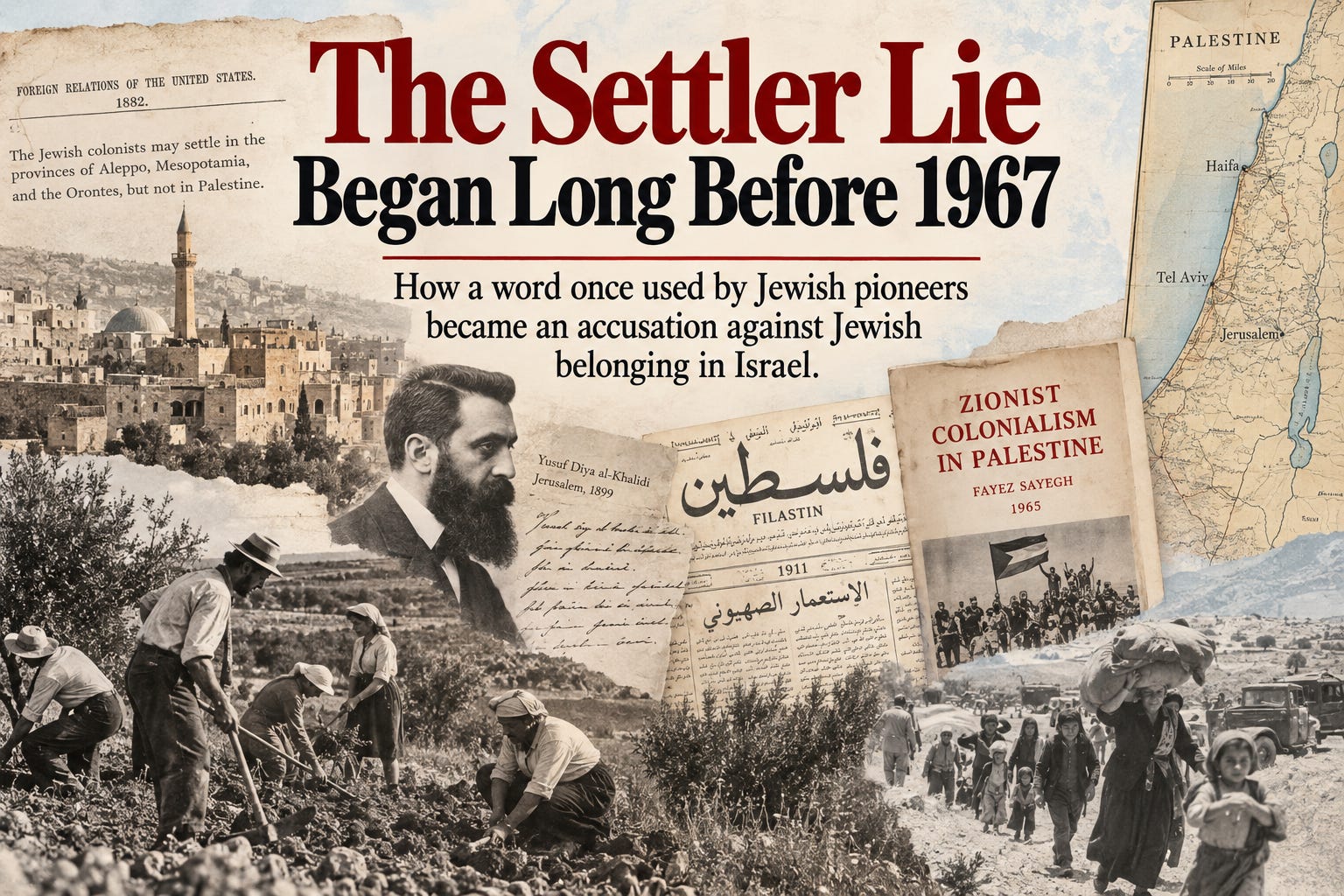
In September 1965, a Palestinian fella named Fayez Sayegh published a 78-page booklet in Beirut called Zionist Colonialism in Palestine. The Palestine Liberation Organization’s Research Center published it, and chapter three carried the title “The Character of the Zionist Settler-State.”
I’m a history activist on a mission to document the Jewish story before it’s rewritten or erased. Your paid subscription supports this deep daily research and unlocks every daily briefing, tracking report, and archive**.**
Subscribe now
Sayegh was an educated man. He had earned a doctorate from Georgetown University and taught at several American universities. He was also one of the people who helped establish the PLO’s Research Center. He knew how to put together an argument, and the one he was making went well beyond the territory Israel would capture in the Six-Day War.
He described Israel as a settler state. That included Tel Aviv, Haifa, Jerusalem, the agricultural villages established by Jewish immigrants, and the communities where Jews had lived before the establishment of Israel. His argument concerned Zionism and the Jewish state as a whole.
Jordan controlled the West Bank and East Jerusalem when the booklet appeared. Egypt administered Gaza. Sayegh’s accusation was directed at Israel within its existing boundaries.
He would later help write and present the 1975 United Nations resolution declaring Zionism a form of racism. His booklet also found its way into the academic literature, where scholars continued to discuss it long after his death.
The word settler had been around for generations. Jewish immigrants had used it themselves, as had British officials and Arab newspapers. But in Sayegh’s hands, it was part of an argument that treated Jewish national independence as the outcome of a foreign colonial movement.
When Settler Meant Someone Establishing a Community
In June 1882, two Jewish men, Ascher and Weinberg, went to see Lew Wallace, the American minister to the Ottoman Empire.
Wallace was the author of the award-winning novel, Ben-Hur. He was also serving in Constantinople when the men arrived on behalf of forty-nine Jewish emigration committees in Romania.
Romanian Jews had been living under discriminatory laws that restricted their opportunities to work and support their families. The committees were collecting money to help people leave. They hoped to buy agricultural land somewhere in the Ottoman Empire and establish communities where families could earn a living.
Wallace took their request to Ottoman officials. The government agreed to admit groups of Jewish families willing to become Ottoman subjects. They could establish agricultural settlements near Aleppo, along the Orontes River, or in Mesopotamia.
Palestine was excluded.
Read more