Welcome! Is weed killer linked to increasing rates of colon cancer in young people?
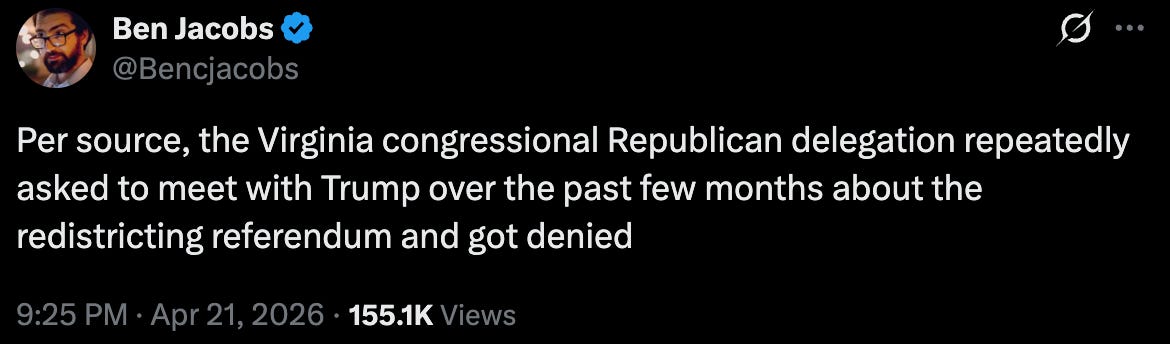
🚨 BREAKING: Virginia’s redistricting map passed by a 2-point margin and the blame game is here.
👀 HEADLINE: 2 Americans Killed in Mexico Crash Were C.I.A. Officers - NYT (free)
🔥 NEW: Is Ron DeSantis heading to the Trump administration? - Axios
👉 NOTABLE: DOJ readies up to $3.5 billion in law enforcement grants, 1 year after steep cuts elsewhere - CBS
💰 OUCH: United Airlines says it will raise summer fares as much as 20% as fuel prices surge amid Iran war - NY Post
➡️ A brief correction: This morning I said, as others have also said, the RNC spent $0.00 in the Virginia redistricting fight. An RNC official reached out to say this is not true. The RNC did spend, but did so through other groups instead of directly tying the spending to the Republican National Committee. This does suggest the RNC understands the brand is pretty radioactive these days, which is true, and suggests some level of self-awareness.
👂 The Show Notes is my blueprint for radio but is only for subscribers. You can subscribe and listen here.
Hours after Donald Trump extended the ceasefire with Iran’s fractured government, the Iranian navy seized a cargo ship and a container ship, forcing them ashore for inspection. Shortly after, IRGC gunboats fired on three other vessels in various parts of the Strait of Hormuz.
One of the attacked ships was a Libyan-flagged vessel that was granted permission by the IRGC to pass the Strait. Hours later, and without radio communication, an IRGC gunboat approached and opened fire.
The Iranians say the attacks are in response to the continued US blockade of Iranian ports. Around 800 vessels are still stuck in the Persian Gulf, with the International Maritime Organization working on evacuation plans, according to Bloomberg.
Donald Trump is allowing “another three to five days of ceasefire to allow the Iranians to get their shit together," according to a senior official at Axios. "It is not going to be open-ended."
Pancreatic cancer is one of the deadliest cancers. It killed nearly 52,000 Americans last year, many within a year of diagnosis. Now, there are some new experimental medicines with the potential to change that.
New data from two drugs showed it might be possible to keep the disease in check for longer than ever before. One drug, developed by Revolution Medicines, shrank tumors in roughly half of people who used it as a first treatment. And an mRNA vaccine made by Germany-based BioNTech and Genentech kept most patients who responded to it alive six years—an unusually long stretch for a cancer that normally leaves only around one in eight people alive five years after diagnosis.
“This is a pivotal point in time for this disease, there’s no question,” said Dr. Eileen O’Reilly, a gastrointestinal oncologist at Memorial Sloan Kettering Cancer Center in New York City who led one of the RevMed-funded trials.
Full story at WSJ (free).
A small group of unauthorized users have accessed Anthropic PBC’s new Mythos AI model, a technology that the company says is so powerful it can enable dangerous cyberattacks, according to a person familiar with the matter and documentation viewed by Bloomberg News.
A handful of users in a private online forum gained access to Mythos on the same day that Anthropic first announced a plan to release the model to a limited number of companies for testing purposes, said the person, who asked not to be named for fear of reprisal. The group has been using Mythos regularly since then, though not for cybersecurity purposes, said the person, who corroborated the account with screenshots and a live demonstration of the model.
Full story at Bloomberg & Tech Crunch.
Dr. Norman Rowe, a plastic surgeon with offices in New York and Florida, advertises on his website that breast reduction surgery usually costs between $15,000 and $25,000.
But these days, his practice sometimes earns $440,000 for the procedure.
Dr. Rowe has taken full advantage of a new arbitration system, part of a major consumer protection law Congress passed in 2020 with bipartisan majorities. The No Surprises Act was designed to eliminate surprise medical bills, for patients who showed up in the emergency room and were treated by a doctor who didn’t take their insurance.
It bars those out-of-network doctors from billing patients directly. Instead, they can plead their case to a government-approved arbitrator. If they win, the patient’s insurer has to pay their desired amount.
By all accounts, the law is successfully protecting patients against bills from doctors they never chose. But it has also generated an expensive unanticipated consequence: Doctors have flooded the arbitration system with millions of claims. Most are winning, often collecting fees hundreds of times higher than what they could negotiate with insurers directly or what they could have earned from patients before the law passed.
Full story at NYT (free).
The Trump administration is nearing a rescue deal for Spirit Airlines, people familiar with the matter said.
Under the agreement being discussed, the U.S. government would loan the embattled discount carrier as much as $500 million, receiving in return warrants to take a potential significant stake in Spirit, the people said.
The Transportation Department and Commerce Department are involved in the discussions, which aren’t yet final, and the terms of any agreement could still change.
President Trump met Tuesday night with Commerce Secretary Howard Lutnick and Transportation Secretary Sean Duffy to hash out a deal to keep Spirit Airlines alive, according to people with knowledge of the talks.
Full story at WSJ (free).
For decades, Americans scoffed at Russia’s rigid, centralized military and its inability to adapt. That picture is dangerously out of date. After four years of war in Ukraine, Moscow has developed an impressive, pragmatic approach to military innovation that prioritizes what works over what is elegant, what scales over what is ambitious, and what delivers battlefield results over what impresses on paper.
Russia is reshaping the future of warfare in real time, building artificial intelligence-enabled command and control and, it appears, deploying fully autonomous weapons without the ethical constraints that govern Western militaries.
The stakes extend beyond the war in Ukraine, as the United States has learned firsthand during the war with Iran. Iranian Shahed drones being fielded by Tehran with Russian
[support]have[struck]American equipment and installations in the Middle East. The advances Moscow is making in autonomous warfare will make such drone attacks even more devastating. Understanding Russia’s approach to the future of warfare is urgent for the United States.
Full story at NYT (free).
Mom who lost 3 kids in Louisiana shooting still has a bullet lodged in her face, cousin says -
NBCSome Democrats regret voting to expel George Santos -
AxiosGoogle unveils chips for AI training and inference in latest shot at Nvidia -
CNBCScoop: Trump set to reclassify marijuana soon -
AxiosRepublicans release budget, hope to end shutdown -
SEMAFORLast Rounds? Status of Key Munitions at the Iran War Ceasefire -
CSISTrump weighs consequences for NATO allies on ‘naughty’ list -
PoliticoHey, Washington: Guess Who’s Coming to Dinner -
NYT(paywall)
For years, I’ve warned about the dangers of big banks using the financial system to push political agendas. But thanks to Consumers’ Research and the Open Banking Rule, consumers have access to more competitive banking options than ever before. That’s why I’m proud to stand with Consumers’ Research as they fight to keep you in charge of your financial future, not big banks that discriminate against conservatives and crush competition. Learn more about their work here.
For years, my friends at the American Energy Institute sounded the alarm on the progressive war on affordable energy. But thanks to the Trump administration’s commitment to safe, reliable nuclear energy, America’s energy future is brighter than ever. That’s why I am partnering with my friends at American Energy Institute to drive economic prosperity through abundant, affordable, and reliable energy for everyone. Learn more about the bright future of American energy here.