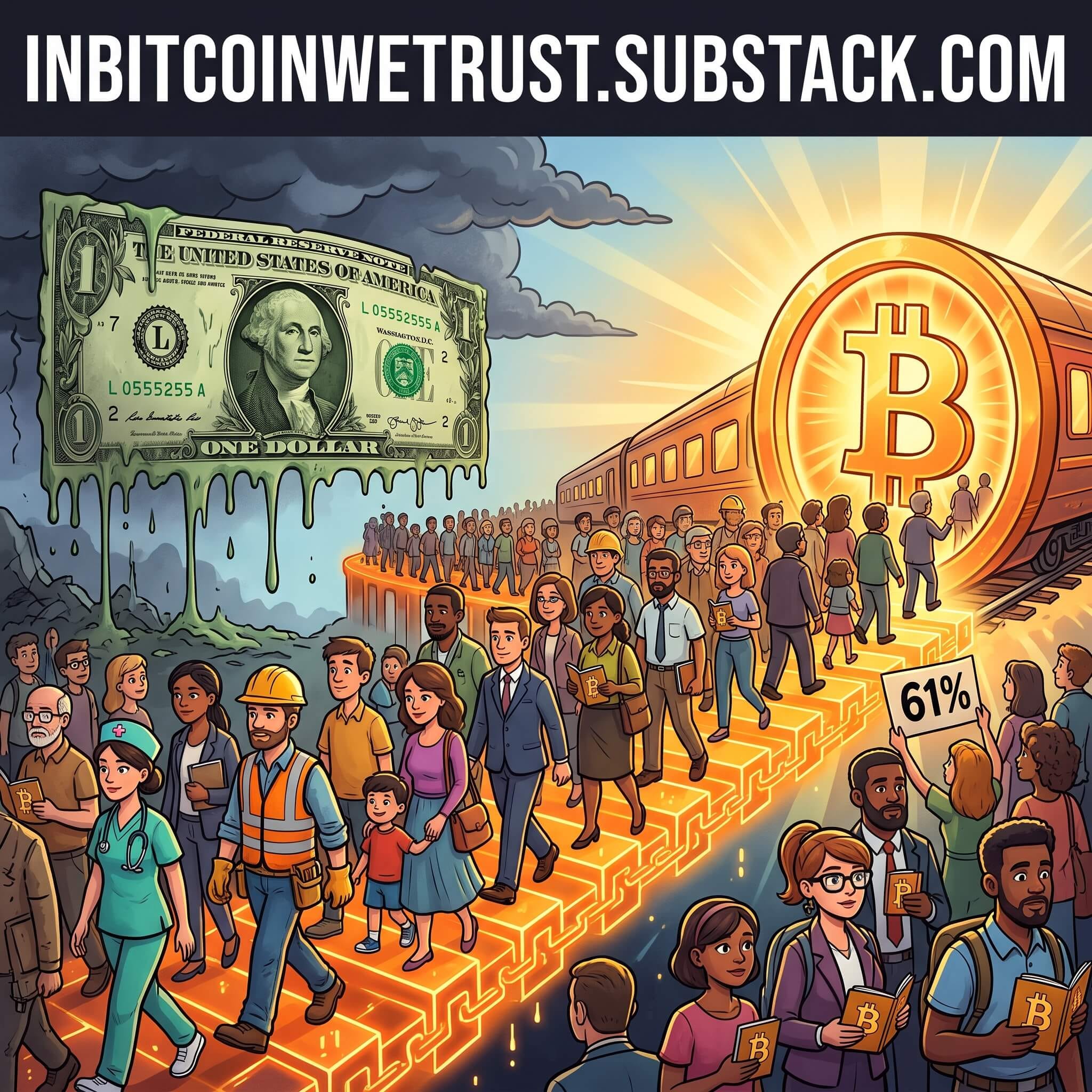
Three-quarters of the country no longer trusts fiat currency to hold its value. A landmark national study reveals a massive, hidden wave of everyday citizens looking for an exit—if the Bitcoin movement can finally step out of its own echo chamber.
Stand in the checkout line of a Kroger in Columbus, Ohio, or a Publix outside Nashville, Tennessee, on a Tuesday evening in October 2026.
Watch the face of the person ahead of you as the register tallies up two bags of basic groceries—milk, eggs, ground beef, school lunch snacks, a box of laundry detergent—and flashes a number that used to buy a week’s worth of food for a family of four.
They don’t pull out a treatise on the Triffin Dilemma. They don’t mutter about Federal Reserve reverse repo facilities, M2 money supply velocity, or the sovereign debt-to-GDP ratio crossing the point of no return. They just stare at the screen for a half-second longer than they used to, let out a quiet, almost imperceptible sigh, and tap their plastic card against the terminal.
That quiet sigh is the most powerful macroeconomic force in the world today.
For years, financial television pundits and Washington bureaucrats have tried to convince the public that the economy is a collection of seasonal adjustments and smoothed-out CPI prints. They point to surging equity indices and tell working families that their anxieties are merely a “vibe session.”
Yet beneath the veneer of official statistics, a profound, irreversible psychological rupture has taken place across the United States. Everyday citizens may not speak the arcane language of central banking, but they know when the scoreboard is rigged. They feel it in their property tax assessments, their auto insurance renewals, their utility bills, and the shrinking purchasing power of their 401(k) contributions. They know that the time and sweat they trade for forty hours a week is being stored in a leaky vessel.
Recently, the Bitcoin Policy Institute (BPI), in partnership with the national polling firm Cygnal and the educational nonprofit Neighborhood Bitcoin, released a landmark, three-phase research study titled “Identifying the Bitcoin Messages that Resonate with Everyday Americans.”
Conducted across a national segmentation survey of 1,516 registered voters, eight deep-dive in-person focus groups in Ohio and Tennessee, and a 1,000-voter national validation poll, the data laid bare a seismic shift in the American psyche:
**94%**of registered American voters have heard of Bitcoin.**74%**of registered voters have little to no trust in the U.S. dollar retaining its value in the years ahead.**61%**of Americans want to learn more about owning Bitcoin.
Read those numbers again. Nearly three out of every four voters in the issuer nation of the world’s reserve currency no longer trust that currency to hold its value. And nearly two-thirds of the electorate are actively raising their hands, asking for an education on the only decentralized monetary alternative on earth.
We are no longer living in an era where Bitcoin has to fight for name recognition. The battle for awareness is over—94% of the country knows Bitcoin exists. Instead, we have entered the era of the 61% Mandate.
There is just one massive problem: the study also proved that the way the Bitcoin community has been talking to the public for the last decade is actively repelling the very people who are desperate to listen.
A cornered White House, a vengeful Congress, and the coming shock to the AI supercycle.
To understand why 61% of Americans are suddenly asking for Bitcoin education, we first have to examine the 74% who have lost faith in the greenback.
In monetary history, currencies do not die when the printing press runs out of ink; they die when the public runs out of belief. Fiat money is, by definition, a confidence game—a social contract enforced by legal tender laws and sustained by the collective illusion that a dollar saved today will command roughly a dollar’s worth of human labor tomorrow.
For forty years, between the early 1980s and 2020, that illusion held together reasonably well for the average American middle-class household. Deflationary tailwinds from globalization, cheap manufacturing in Asia, and incremental technological efficiency masked the steady expansion of the monetary base. Sure, the price of a house or a college degree crept upward, but televisions got cheaper, software got faster, and the erosion of the dollar moved slowly enough that most people mistook the rising tide of monetary debasement for normal economic growth.
The decade of the 2020s shattered that anesthetic forever.
Between the unprecedented fiscal expansions of 2020–2021, the subsequent inflationary shockwaves, the weaponization of global payment rails, and the current reality of structural fiscal dominance—where the U.S. Treasury must issue trillions in new debt simply to service the interest on existing obligations—the mask slipped off the machine.