First, I’m afraid I failed to push this out yesterday and meant to. This is my interview with the Hon. Michael Oren, former Israeli Ambassador to the United States. We did the interview yesterday, on the third anniversary of the October 7 terror attack.
Next up, I want to steer a bit out of the way from politics today on something very important from my radio monologue yesterday. Antisemitism is a growing social contagion. There is another one out there we need to take seriously.
In July of 1518, a woman named Frau Troffea stepped into a street in Strasbourg, France, and began to dance. She could not stop. Within weeks, dozens of others had joined her, and some accounts put the number as high as 400. The city council decided the afflicted needed to dance it out, so the city leaders built a stage and hired musicians to keep the dancers dancing until they collapsed. The outbreak ended only when the dancers were carried into the mountains to a shrine of St. Vitus.
Historians call what happened in Strasbourg a social contagion, and the historical record is full of them. Girls in Salem fell into fits, the accusations spread with the fits, and 19 people were hanged. In 2011, a cluster of high school girls in LeRoy, New York, developed Tourette’s-like tics, and when TikTok returned to the story a decade later, teenage girls across the country developed the same tics. We have documentation of social contagions spreading for seven centuries. A behavior appears, people see it, and people imitate it.
The press has understood this for a long time. In 1774, Goethe published The Sorrows of Young Werther, in which the hero takes his own life. So many young men across Europe followed him, with The Sorrows of Young Werther found at the scene of multiple suicides, that cities banned the book. In 1974, the sociologist David Phillips named the phenomenon the Werther Effect after documenting that suicides rose measurably after newspapers covered them.
Responsible newsrooms now follow guidelines on suicide coverage. They do not describe the method, they avoid sensational headlines, they keep the story off the front page, and they print a crisis hotline at the bottom. When Vienna, Austria’s newspapers agreed in the 1980’s to stop sensationalizing subway suicides, the subway suicides fell sharply. The rules work, and the press follows them because it accepts that the way a story is told can cost lives.
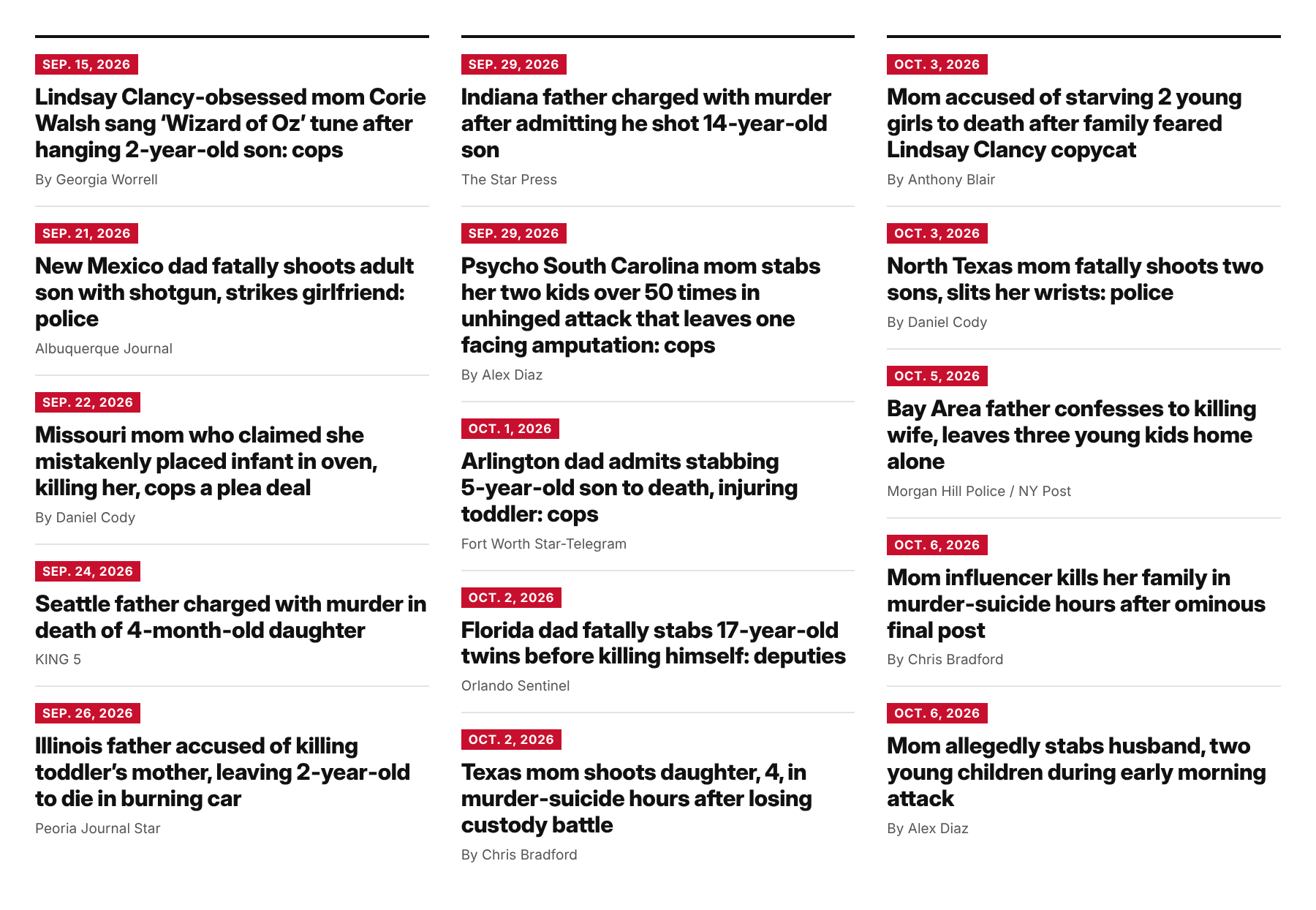
Now look at the headlines from just the last three weeks.
A Missouri mother claimed she mistakenly put her infant in an oven. A South Carolina mother stabbed her two children more than 50 times. A Texas mother shot her young daughter and then herself hours after losing a custody battle. A mom influencer killed her family hours after an ominous post. The fathers are on the list too, including an Arlington father who stabbed his five-year-old son to death, a Florida father who killed his seventeen-year-old twins and then himself, and an Indiana father who shot his fourteen-year-old son. One October 3rd headline reported that relatives of a mother accused of starving her two little girls had feared a “Lindsay Clancy copycat.”
Again, these are just from the last three weeks.
The press play up and amplify these stories. These stories sell papers, as the public is addicted to hearing about these horrors and the true crime podcasts pick them up and twist them.
The press put the word “copycat” in headlines. Yet the same outlets that will not print the method of a single suicide will tell you how many times a mother stabbed her children, what song a mother sang after hanging her son, and what the influencer posted before she killed her family. Every rule newsrooms adopted to hold back the Werther Effect gets thrown out when the victims are children and the killer is a parent. I cannot prove that any one of these parents read about the last one. Phillips could not prove that any single young man had been inspired by prior suicides. But the pattern was his evidence. The pattern is plain here. If coverage of a suicide can inspire the next suicide, coverage of a mother killing her children can inspire the next mother.
The press should change how it covers these stories, but better coverage only slows the spread. It does not explain why so many parents are standing at the edge to begin with.
Willy Rice, the president of the Southern Baptist Convention, recently told Fox News that Christians need to be more involved in politics. I do not disagree with him. A lot of Christian activists online have gone further, though, and they want pastors preaching politics from the pulpit.
Unfortunately, no politician is going to stop a mother in Texas from turning a gun on her daughter. No Republican majority is going to stop a father in Arlington from stabbing his son. Too many Christians on the right have convinced themselves that a spiritual crisis needs a political savior. They have nominated immoral men, demanded that the church hold its nose and vote for them, and watched things get worse instead of better.
Talk to missionaries who have worked where the gospel never took root and witch doctors still hold sway. The missionaries will tell you what every student of church history already knows — when the church recedes from a society, the old gods come back. Violence against children is one of the oldest marks of a pagan culture. Molech demanded children. The Romans left unwanted infants to die on hillsides, and the early Christians went out and picked them up. A society whose parents have started killing their own children is a society in spiritual crisis, and evil is on the march in this one, from homes where mothers and fathers turn on their kids to college campuses where Jews are chased and beaten.
A church that becomes a political force stops being a spiritual force because the Holy Spirit does not care about our politics, but our souls. Christians who conform their faith to their politics have the order backwards. The country does need a church with a far stronger presence in the town square, but the message in the square should not be “vote Republican.” It should be “repent and be saved,” delivered to both parties and to every neighbor who is lost. We need pastors in the pulpit preaching Christ crucified and church members in the streets sharing the gospel with people who have never heard it.
The city council in Strasbourg thought it was taking the crisis seriously when it built a stage and hired the musicians, but it only made the dancing worse. The dancing stopped when someone carried the afflicted to a place of prayer. Christians who want to stop what is spreading now should do the same.