There is a tension in writing something called The Spiritual Crisis Emergency Kit that I want to acknowledge. People whose religious worlds are falling apart often need help. They may need language for what is happening, some sense of orientation, and the reassurance that others have traveled through this territory. At the same time, many are leaving systems in which someone else claimed the authority to tell them what was true, who they were, how they should live, and what their questions meant.
The last thing I want to do is reproduce that arrangement in a different form. I have no interest in becoming another person who stands outside your life and tells you what your journey is supposed to mean. I cannot give you a map that will tell you where you should end up, and I would be wary of anyone who promises one.
Still, refusing to become an authority does not require us to abandon one another to figure everything out alone. There is a difference between telling someone where to go and sitting beside them while they find their bearings. We can share what has helped us, name patterns we have encountered, offer questions worth considering, and point toward things that might provide a little stability when the ground is moving.
This is one of the reasons I founded the Center for Non-Religious Spirituality in 2019. I wanted there to be a space for people navigating life beyond religion where no one had to surrender their authority in order to belong. A place where we could accompany one another through uncertainty without pretending to possess the answers, and where questioning, exploration, and self-trust were part of the work rather than problems to overcome.
That is the spirit in which I offer what follows. Take what helps. Question what does not. Change your mind. Trust your experience enough to remain in conversation with it. This is not a guide for getting your life after religion right. It is simply something I hope you can reach for when you need enough ground to stand.
There is a point in religious deconstruction when the questions stop being interesting. What began as curiosity about theology, Scripture, church history, or contradictions that could no longer be ignored becomes something much more personal. The questions move out of books and podcasts and into the body, relationships, memories, and the quiet hours when there is no one around to distract us from them.
Then the questions that once seemed settled suddenly reopen. Is there a God? Does life have a purpose? What happens when we die? More immediate questions surface alongside them. Can I trust myself? What will I tell my family? Where will I belong if the community that once gave my life its shape can no longer hold me?
This is where deconstruction stops being primarily theological and becomes existential.
The beliefs being questioned often held together much more than ideas about God. They organized identity, relationships, morality, sexuality, community, understandings of suffering, hopes for the future, and expectations about death. They provided a story about where we came from, why we were here, what was expected of us, and where everything was ultimately going.
When that story begins to collapse, disorientation is hardly surprising. Something much larger than belief has been disrupted. The coordinates that once located us in the world are changing, and for a while it can be difficult to know which direction is north.
I know something about this territory. I have lived through my own unraveling of religious certainty, and I have spent years sitting with people somewhere along this road. The details are different for everyone, but I have noticed how quickly the loss of one map creates a desperate search for another.
We start looking for the belief system, philosophy, teacher, book, community, or spiritual framework that will tell us where we are now. We feel pressure to replace the answers we lost with better ones because uncertainty feels dangerous when certainty has been treated as a spiritual virtue.
There are moments, however, when another map is not what we need. We need somewhere to put our feet. Before deciding what comes next, there needs to be enough stability to find our bearings. Before settling what we believe about the universe, we need to recover the much simpler experience of being human inside it.
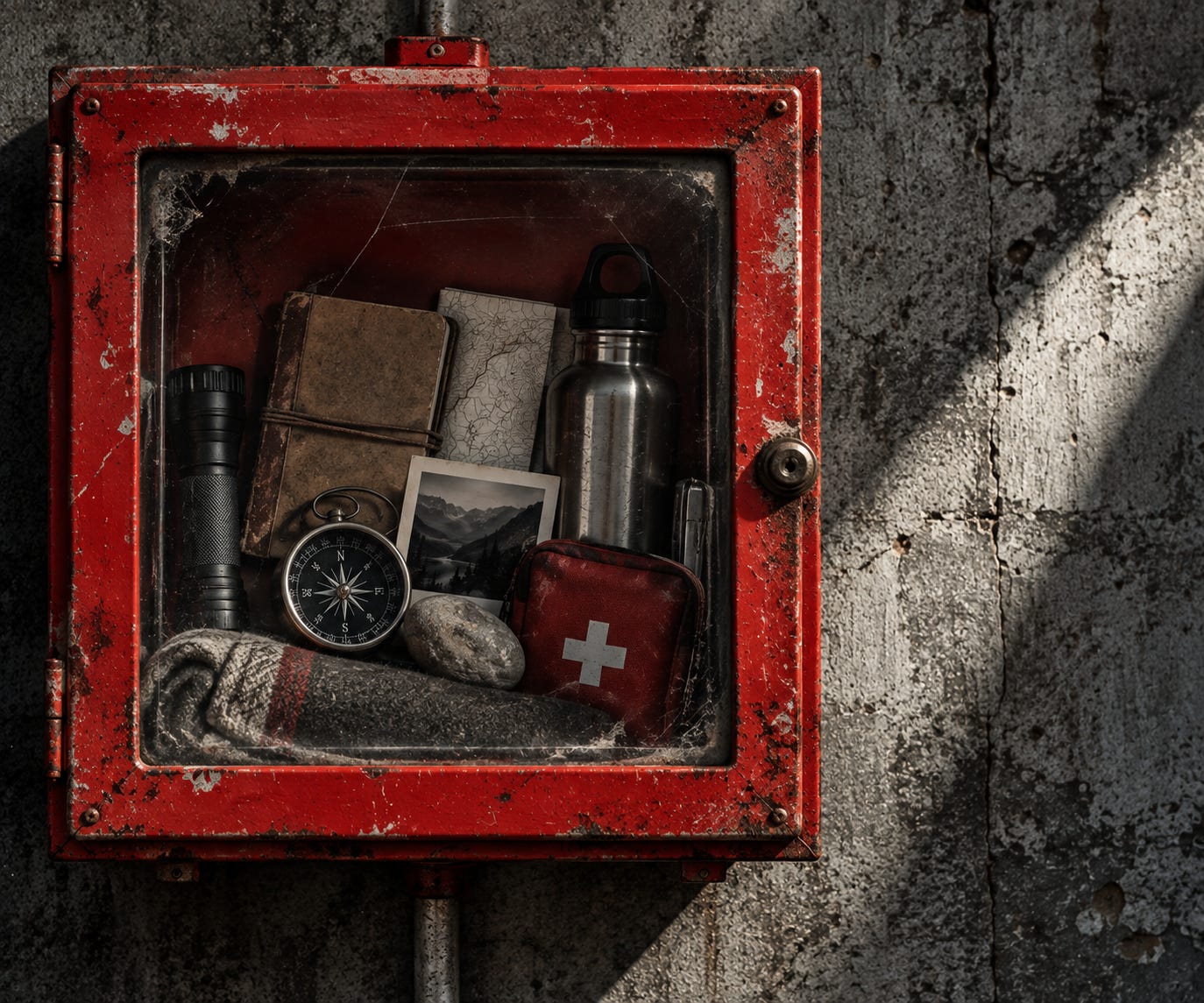
Think of what follows as a spiritual crisis emergency kit. It is not a new worldview, a program for reconstruction, or a substitute religion. It is a collection of things worth keeping nearby when a religious world has fallen apart and what comes next remains uncertain.
The collapse of certainty often produces an urgent desire for new certainty. If Christianity is no longer true, what is? If the Bible is no longer the final authority, what takes its place? If God is not directing your life, how do you make decisions? If heaven has become uncertain, what happens when you die?
The questions multiply because they are connected. Pull one thread and suddenly you are holding half the sweater in your hands. What appeared to be a disagreement with one doctrine exposes an entire structure of assumptions underneath it.
That experience creates pressure to build another coherent worldview immediately. We start reading compulsively, moving from theology to philosophy to psychology to neuroscience to Buddhism to atheism to mysticism, hoping somewhere in the pile to find a system strong enough to make the ground stop moving.
There is nothing wrong with searching. Curiosity is often part of finding our way forward. The problem begins when searching becomes an emergency response to uncertainty, because urgency makes us vulnerable to anyone offering another complete explanation.
You are allowed to leave questions unanswered for a while. You do not need to settle the existence of God this week or establish a theory of consciousness before breakfast tomorrow. You do not need an airtight account of morality, a position on the afterlife, or a new label that explains who you have become.
Some questions need to be lived with before they are answered. Others change as we change, and a few remain open for the rest of our lives. Learning to live beside an unanswered question is one of the important capacities we develop after certainty.
The language of deconstruction and reconstruction has been useful for many people, including me. It gives us a way to describe what happens when an inherited religious framework begins coming apart and we start wondering what, if anything, comes next.
But the language has limitations. Deconstruction often makes the process sound more deliberate than it is. Sometimes we do not dismantle our religious world so much as discover that it no longer holds. A belief stops making sense. An experience contradicts what we were taught. A question refuses to go away. Something that once felt solid becomes impossible to inhabit.
Reconstruction carries a different problem. It quietly suggests that after taking one worldview apart, our next task is to build another one.
That expectation creates unnecessary pressure. We begin searching for the new framework, identity, philosophy, spirituality, or set of beliefs that will replace what we lost. We wonder what we are now. We assume that maturity means eventually arriving at another coherent structure capable of explaining our lives.
Maybe it doesn’t.
Perhaps some things should remain dismantled. Some questions stay open. Certain beliefs never need replacements. You may even discover that you need fewer conclusions than you once imagined.
There is also a danger in treating your life as a construction project. You are not a building that became structurally unsound and now requires renovation. You are a human being whose relationship with reality is changing. Some of that change will involve choosing what you believe and value. Much of it will happen through relationships, grief, work, pleasure, mistakes, curiosity, responsibility, and the ordinary experience of living.
This is why I increasingly think less in terms of reconstruction and more in terms of participation.
You do not have to finish rebuilding yourself before you begin living again. You are already living. The question is not necessarily what new system will replace the old one, but how you want to participate in the life that has become available now that some of the old answers no longer determine it.
Call that deconstruction if the word helps. Call what follows reconstruction if that language gives shape to your experience. Just do not mistake the language for the journey. Your life does not owe anyone a finished architecture.
When your metaphysical world becomes unstable, there is wisdom in returning to the physical one. Feel your feet against the floor, drink some water, eat something nourishing, walk outside, take a shower, sit beneath a tree, or notice the temperature of the air against your skin.
This can feel almost absurdly ordinary while wrestling with God, eternity, salvation, morality, identity, and the ultimate nature of reality. Yet the ordinary world is precisely where we need to return. The mind is wrestling with the universe while the body is sitting in a room on an otherwise unremarkable Tuesday afternoon.
Start with the room. Notice the chair beneath you, the air entering your lungs, the sounds coming through the window, and the light falling across the floor. There is a world here before anyone has decided what the world ultimately means.
Religion often provided an explanation for everything you encountered. The stars belonged to a creation story. Your suffering belonged to a divine plan. Beauty pointed toward God. Morality revealed God’s character. Death opened into eternity. Your own life occupied a particular place within a cosmic drama.
When the explanation becomes uncertain, it can feel as though the world itself has become uncertain. But reality is larger than your explanation of it. Losing an interpretation of reality is not the same thing as losing reality itself.
There is something quietly stabilizing about discovering that the world remains available to you without demanding that you explain it first. The rain still sounds like rain against the roof. Bread still tastes like bread. Someone’s hand still feels warm in yours. The world does not disappear because your theology of it has changed.
One of the strangest discoveries after leaving religion is that beliefs sometimes disappear before the fears attached to them do. The intellect may have moved on while the body remains several miles behind.
You can stop believing in hell and still wake at two in the morning terrified that you are going there. The teaching that questioning God is rebellion can lose its hold while guilt still rises when the questions come. You might understand exactly why you needed to leave a religious community and still experience your departure as betrayal.
This does not mean your old beliefs are secretly true. It means human beings are not brains floating above their histories. What we have feared, practiced, repeated, imagined, and been warned about becomes woven into us in ways that cannot always be undone by changing our minds.
Fear deserves compassion because fear is an experience you are actually having. It does not deserve automatic authority over what the experience means.
When fear arrives, it helps to become curious about the distance between what is happening and the story attached to it. Feeling afraid is not identical to being in danger. Feeling guilty does not necessarily mean you have done something wrong. Feeling lost does not prove that there is nowhere to go.
These distinctions seem small, but they matter. They are part of learning how to remain in contact with your experience without allowing every inherited interpretation to determine what that experience means.
When large parts of your inner world are changing, ordinary routines become surprisingly important. Make coffee the way you always make it, walk the dog, water the plants, go to work, cook dinner, read before bed, or keep meeting your friend on Saturday morning.
There is wisdom in continuity because the ordinary reminds us that not everything has disappeared. There are still dishes in the sink and clothes that need washing. Someone needs groceries. Your body needs sleep. The sun still crosses the room at roughly the same time each afternoon.
These things may seem painfully insignificant beside the possibility that your entire understanding of God and reality has collapsed. Yet sometimes insignificance is exactly what saves us from the unbearable weight of ultimacy.
Not every moment needs to carry the meaning of your entire existence. Not every cup of coffee needs to become a spiritual practice. Sometimes drinking coffee is enough because it is one small way of continuing to participate in a life that remains yours even while your understanding of it is changing.
Religious deconstruction becomes much harder when you are surrounded by people who experience your questions as a threat. Some will try to bring you back, while others will hurry you toward atheism, another spiritual tradition, or whatever conclusion brought relief to them.
Be selective about who gets access to you during vulnerable periods of transition. You need at least one person who can hear the words “I don’t know” without interpreting them as a request for answers.
Look for someone who does not need your journey to validate theirs. You need a person who will not panic when you change your mind twice in the same conversation or insist that your uncertainty must be resolved before you are allowed to rest.
There are times when the most important thing another human being offers is not wisdom but company. Someone remains beside you without demanding that you become certain again, and slowly you discover that uncertainty is survivable because you are no longer carrying it alone.
This is one of the reasons community matters after religion, though it must be a different kind of community from the one many of us knew. Belonging cannot depend upon arriving at the same answers. Sometimes belonging begins when another person makes room for the questions we have not yet learned how to carry by ourselves.
Religion often provided the language through which people understood nearly everything about themselves. You were a Christian, a child of God, saved, forgiven, chosen, called, perhaps a sinner redeemed by grace with a purpose assigned by God and a destiny extending beyond death.
When those categories stop working, the question of identity can become terrifyingly literal. If you are no longer the person your religion told you that you were, what is underneath?
There is an important distinction here. The interpretation of your life is changing, but the life being interpreted is still here. Before any of us knew what to call ourselves or possessed a theology, we were already alive, capable of attachment, fear, curiosity, pleasure, pain, wonder, tenderness, anger, loneliness, and love.
There is a human being beneath the categories. There is no urgency to define that person. This period is less about discovering the correct new identity than becoming curious about who remains when inherited identities loosen their grip.
That curiosity takes time. Along the way, suppressed preferences emerge, previously forbidden questions surface, and parts of the personality that had no place in a religious identity become visible. Ways of being alive that once seemed unavailable begin to open.
There is no final version of you waiting at the end of deconstruction. There is only a life becoming increasingly available for your participation.
Leaving religion is often narrated as liberation, and sometimes it is. Walking away from beliefs, expectations, or communities that had become impossible to inhabit can bring enormous relief.
Liberation…