As we saw, a few days ago, a crusader army launched a decisive assault that captured the Tower of Damietta, breaking the Muslim defenses across the Nile and opening the way for the Fifth Crusade’s advance into Egypt.
Taking Damietta itself would, however, prove an arduous task; a lengthy siege commenced, with occasional, and ever increasing, assaults—often led by the Templars.
Sultan al-Kamil eventually fled his own camp near the city wall, which was quickly appropriated by the Christians—with the knights of the Temple, once again, in the van:
The Templars, leaders in the ascent of the horses, having put up their banners, hurried to the city in a swift march, throwing down the wicked ones who came boldly from the gates to resist those who were advancing.
The sultan, terrified by their audacious advance, proceeded to offer generous terms to the crusaders. In exchange for their withdrawal from Egypt, he would restore Jerusalem to the Christians, establish a thirty-year truce, return all castles captured west of the Jordan River, and pay a tribute of between 15,000–30,000 gold bezants (sources differ).
John of Brienne, titular king of Jerusalem, was eager to accept this ostensibly handsome offer, but the papal legate, Cardinal Pelagius, who by now shared leadership of the army with John, rejected it.
In fact,
Pelagius might have consented had it not been for the opposition of the military orders. They claimed that it would be dishonorable to accept such a peace when all Egypt could be won by a little further effort, and they represented that the making of the proposal was a proof that al-Kamil feared the Christian might. Pelagius was convinced and he rejected the Sultan’s offer.
The military orders’ reasoning was sound. Why would al-Kamil be so willing to relinquish what for a century had been the chief source of contention between Muslims and Christians—Jerusalem—if not because he believed that he was on the verge of defeat?
But there was another reason why those crusaders who had long lived with, and intimately knew, the enemy rejected this Muslim olive branch. In the words of James of Vitry,
Many of our pilgrims judged these offers [by al-Kamil] important and proper to satisfy us, but those who knew by experience the fraud of these men [Muslims] who change unceasingly, and principally the Templars, the Hospitallers, and the Teutonic Knights, the legate, the Patriarch, the archbishops, the bishops, all the clergy and some of the pilgrims, made nothing of their false words, thinking that the Saracens had no other intention than, under the veil of a simulated peace, to disperse the army of Christ as soon as the pilgrims had retired.
It is interesting to note that all those who mistrusted the Muslim offer as a ruse were of a distinctly Christian station—either brothers of an order or clergymen—whereas those who took the offer at face value, such as John of Brienne, were seculars. (Clearly, if Christians today are as “innocent as doves,” their medieval counterparts were as “wise as snakes,” Matt. 10:16.)
So, the crusade continued, though the Christians made little head way even as disease and dysentery, which had plagued their ranks from the start, continued to harry and reduce their numbers.
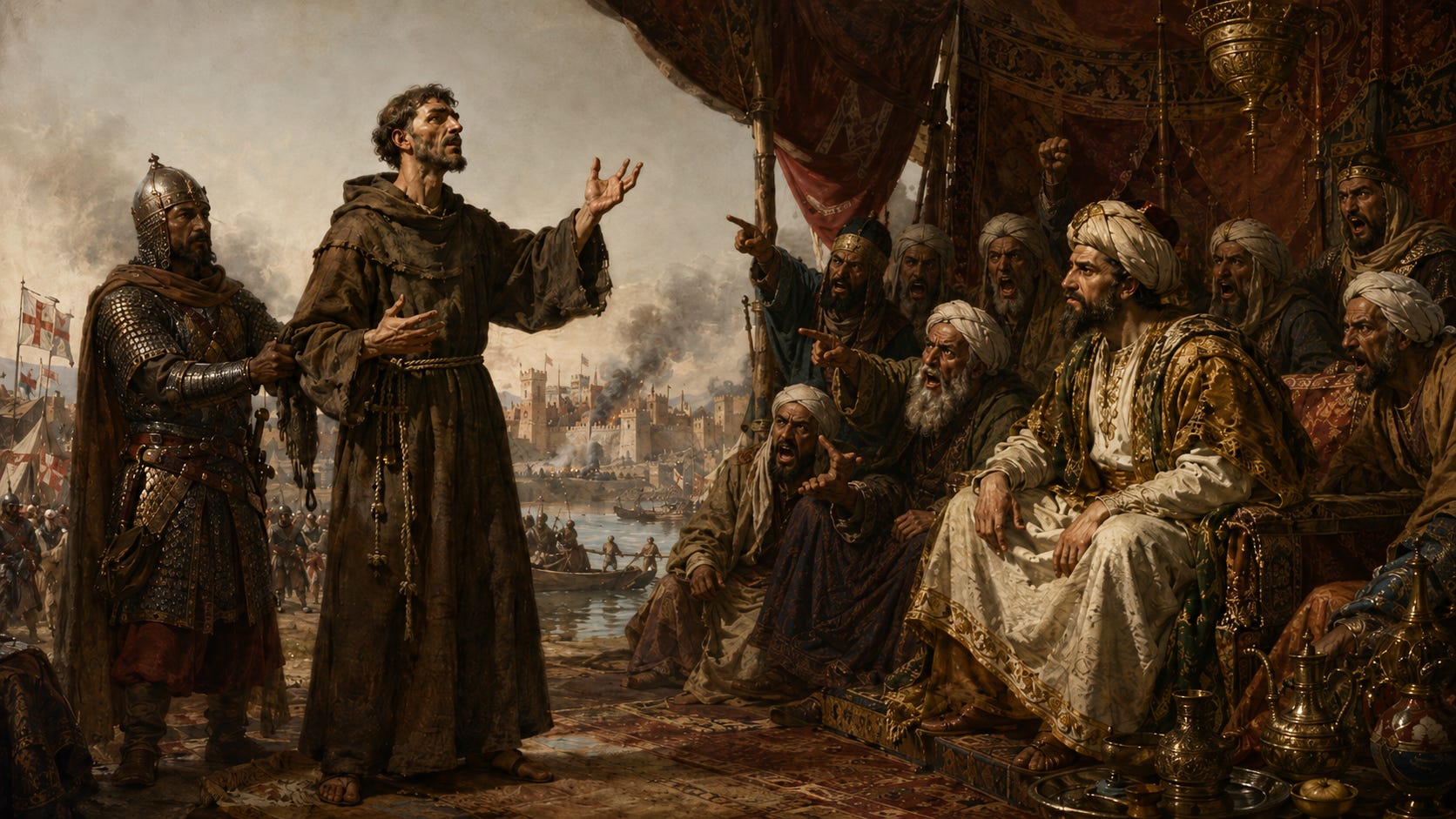
It was during this downtime that one of history’s most memorable “interfaith dialogues” took place: Francis of Assisi, a mystic, ascetic, and itinerant preacher, whose pious exploits would go on to earn him sainthood, had arrived at crusader-held Damietta in early August 1219 with the express purpose of converting the Muslims to Christ, both to save their souls and end the war: “Francis, like the crusaders,” writes Christoph Maier, an expert on the saint, “wanted to liberate the holy places in Palestine from Muslim rule. What was different was his strategy.… He wanted their total submission to the Christian faith.”
Continue reading below.
If you value unflinching, historically grounded analysis that mainstream outlets soften or ignore, consider upgrading. Paid subscribers get:
**Several new, full-length articles every week.**Carefully researched pieces you won’t find elsewhere.
Full access to the complete premium archiveArchive of in-depth writing, research, and commentary — all in one place.
Entry into the subscriber chatA private space for serious readers and thoughtful discussion.