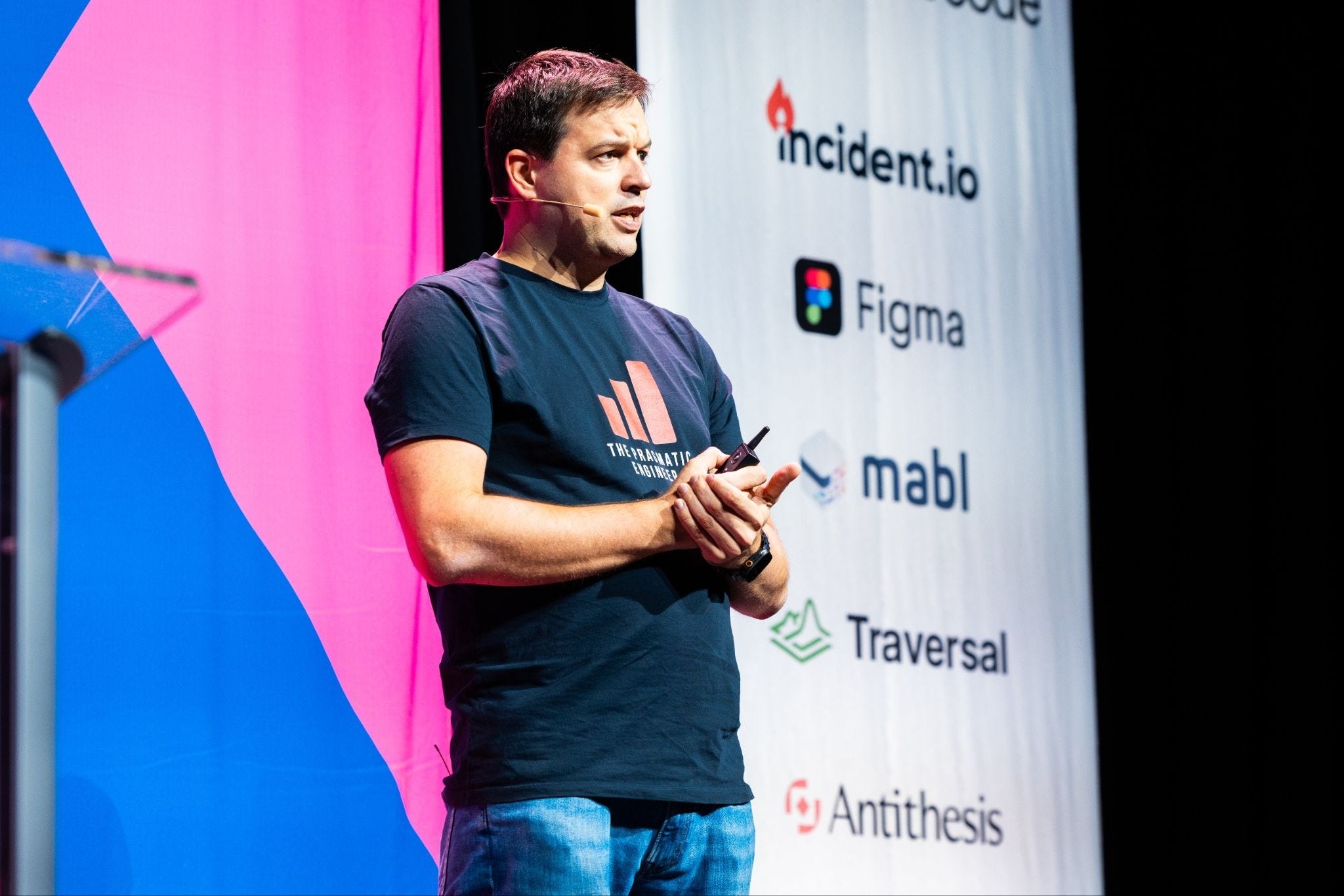
I recently delivered the keynote at the LDX3 engineering leadership conference in New York, attended by 2,000+ engineering leaders, CTOs, Director+ and Staff+ engineering folks, in which I attempted to create a snapshot of where the tech industry is at this exact point.
It came after I had the chance to visit the AI labs OpenAI and Anthropic, meet innovative startups like Ramp, Uber and others, get new, unpublished data from GitHub, Factory AI and Linear. Thanks to the kind access to these teams!
Before the conference, I spent weeks identifying and recording trends that didn’t exist a year ago – or were much more nascent back then – and also things that are currently broken, and others that remain unchanged. Today, we cover:
**Speed of change.**In the tech industry, change has never been this large-scale, this fast. Industry legend Martin Fowler confirms.**What’s changed:**practically nobody writes code by hand anymore, working with 5-10 agents more common, the fading of the IDE, and 13 more changes from the last year.**What’s broken:**assumptions about code output broke, code reviews became theatrical, quality and reliability is down, and more.**What’s still the same:**teams are still important, as is planning; non-engineers are still not shipping code, and more.**What comes next?**Cloud coding agents and harnesses, engineers to stop reading the code, companies building a new type of AI infra, and more are already starting, and should accelerate.
You can watch the full talk, which is 29 minutes long:
The bottom of this article could be cut off in some email clients. Read the full article uninterrupted, online.
People in tech are more than used to change; seeing the internet go from zero to everywhere, the arrival of mobile communications and smartphones exploding in popularity, cloud computing rising from a niche concern, and the development of programming languages like Go and Rust, and frameworks like React (web) and Jetpack Compose (Android).
Despite this, the scale and pace of the impact AI is having at present is still without precedent. That’s how industry veteran Martin Fowler described it ▶at The Pragmatic Summit:
“
Nothing has hit with the magnitude of AI.This is a whole size difference from anything that we’ve faced before.On a smaller scale, we were very much involved in the growth of object-oriented languages. [object-oriented languages] scared a lot of people, but it didn’t scare us so much because we were part of it.
The internet had a huge impact upon us all. And, of course, we were spreading the challenge of agile software development. [Agile] had a very big impact on a lot of organizations because you could tell by how hard they resisted it.
But [for all those other changes] we kept talking about how important they were and how valuable they were and trying to persuade people of the importance of them. It may sound surprising, but even for the internet, there were people who wouldn’t think that was important!
For AI there’s no argument about how important it is.You cannot put blinkers on to deny the importance of this thing.”
My own take is similar; we are without doubt at the beginning of a massive technological transformation, and after it, software will be built differently from how we’ve been doing for decades, although some parts of development will remain the same. At the very least, the tooling and best practices will look different, and things are changing faster than ever.
As the calendar enters Q4 of this year, we see this has solidified into a mega trend since the end of 2025 year when models greatly improved at coding. Related to this, in the very first article of this year we asked the question: when AI writes almost all code, what happens to software engineering?
Today, there are plenty of signs that most engineers have stopped writing code by hand, and it was also a sign of the times recently when the Ruby on Rails creator sparked a “death of coding by hand” debate. Personally, I’m excited by the new opportunity that AI creates, and it’s exciting to experience this revolution firsthand. As mentioned in that deepdive, I’m certain that my way of coding will change drastically in 2026, and there’ll be plenty of knock-on effects.
For more on this topic, check out this recent edition of The Pulse.
I like talking to engineers at AI labs because their working practices are often a few months ahead of the rest of the industry. Claude Code creator, Boris Cherny, revealed the new way he gets things done on the podcast:
“
I have 5 terminal tabs.Each one of them has a checkout of their repository. I’ll round robin and start Claude Code in each one. I also run 5-10 Claudes on Claude Web, in parallel with my local Claudes.”
A few months after these comments, on last week’s pod with Cockroach Labs cofounder, Peter Mattis, – who’s an extremely productive developer who wrote circa 100K lines of code/year, pre-AI – said he’s doing something similar:
“Oftentimes, I’m doing things in parallel.
I find my cognitive overhead is about 5-10 agent sessions concurrently.But sometimes those sessions will have many subagents doing things.”
I also asked a former coworker at Uber, who’s also an extremely productive software engineer, how he works these days. Dima Zaytsev (now a software engineer at Linear), told me:
“It used to be a simple world: one mouse, one keyboard, one screen. You physically can’t work on more than one thing at once. Now, you no longer have that limitation.
I end up having 5-10 (literally) worktrees locally that I rotate between.Prompt one agent, and while it is working, move on to another to test output or review code.”
Nearly all of the most productive software engineers I’ve met – who were hand-writing code a year ago – no longer write the code by hand and also run several parallel agents. What a change!
Fresh data that GitHub shared with me:
I’ve given GitHub grief for its ongoing reliability issues, but seeing how rapidly agent-generated PRs are growing makes me a lot more empathetic for the load which the platform is dealing with.
**Food for thought: there were more agent-authored PRs in August 2026 on GitHub than human-authored ones! **It’s reasonable to speculate that the number of agent-generated PRs will be permanently exceeding human-generated ones on the platform, going forward.
To give a sense of the number of AI-generated PRs: as of today (October 2025), there is likely to be 3x as many fully AI-generated PRs, per month (probably 75M+), than human generated ones at the end of 2023 (25M in December 2023). And the pace of AI-generated PRs does not seem to be slowing down, at least not now.
Agents are not just generating PRs, they’re also opening tickets. Some more exclusive data, this time from my friends at Linear, which added first-class MCP support for agentic creation of issues:
Both engineers and non-engineers use agent skills, and lots of companies are building their own agent skills repositories for all staff to create, share, and evaluate. An interesting data point on skills usage trending heavily up comes from autonomous software factory vendor Factory AI, which shared with me:
I have great respect for software engineer Steve Yegge, who’s good at identifying emerging trends and learning about them. In a podcast episode, he said the IDE is effectively over:
Gergely: “Speaking about the job as developers, you’ve said something that can be triggering for a lot of people. You’ve said, on the AI Engineer Summit, that if you’re still using an IDE now, you’re a bad engineer.”
Steve: “Yeah, well, you got to be a little provocative. Let me put it this way. Okay, I’m not going to say you’re a bad engineer because I know some very, very good engineers, better than I am, who are still at level one or two in my chart [of AI usage]? But I feel profoundly sorry for them.
I feel pity for them like I’ve never felt in my life. For these grown people who are good engineers or used to be. And they’re like, ‘yeah, you know, I use Cursor and I ask it questions sometimes. And I’m really impressed with the answers. And then I review its code really carefully.’
And then I check it in and I’m like: ‘dude, you’re going to get fired. And you’re one of the best engineers I know!!’ “
Steve described his levels of AI usage like this:
No AI usage
AI agent in the IDE, with strict permissions
AI agent in the IDE, with “YOLO” mode (permissions off)
AI agent in the IDE, no longer looking at the code, but interacting with the agent
CLI-first: abandoned the IDE
Running several agents in parallel
Running 10+ agents
Built a custom agent orchestrator to run 30+ (or 100+) agents
Steve believes that “AI-pilled” engineers will abandon the IDE, and I’m seeing data from the market which backs that prediction:
**Antigravity 1.0 was the last IDE released, based on a VS Code fork.**It was released in November 2025. After that, no major IDE that is a VS Code Fork has launched. In May 2026, when Antigravity 2.0 launched, the productmoved awayfrom the IDE concept.Codexlaunched as a non-IDE in Feb 2026, and they’re glad they did so, despitebeing torn aboutmoving away from the IDE concept, at the end of 2025.**Cursor moved away from the IDE.**In April 2026, Cursorrelaunchedand got rid of the IDE interface. It now looks pretty similar to the Codex and Claude desktop apps. When I talked to their team over the summer, they told me they maintain the “legacy” VS Code fork version for existing enterprises, but the future is agentic for them.**JetBrains seems in a hurry to pivot from IDEs.**JetBrains has built some of the most beloved IDEs for developers, but the company is now also pivoting toJetBrains Air, and agentic development environments.
Industry legend Kent Beck told me something interesting when we discussed why IDEs are slowly vanishing:
“It’s not that we don’t need more perspective and context for our human-based decisions; it’s that the context has changed.”
I wonder if what is really happening is the IDE evolving into something different to work better with coding agents. Steve Yegge also talked about how the IDE needs to evolve into a conversation and monitoring interface, but not an editor, given that we no longer write the code.
I’d also add that IDEs need to evolve into a validation and verification interface: how do we know that the agents’ output works as expected, how can we verify what tests it passes, how it looks, and whether you can try out whatever the agent builds. Tools like this are surely coming and will be widely adopted.
In August, I posed a question on social media about whether it’s possible to be a serious tech business without having built an AI harness:
I asked it because most mid-sized-and-above companies have built their own agent harnesses, at this point! A few examples:
Ramp building
Inspect– a case studywe covered in depthStripe (Minions), Uber (Minion), Block (Goose), Shopify (River)
Google (Agent Smith), Meta (Devmate), Amazon (Kiro + Crew), Dropbox (Nova), Spotify (Honk)
DoorDash (Flux), Grab (LLM-Kit), WorkOS (Horizon), Hubspot (Crucible)
Monzo (Agent Chip), Sierra (Pinecone), Harvey (Spectre), Browserbase (bb)
… and many, many more!
What I’ve learned by visiting startups is that more and more development kicks off inside Slack. At OpenAI, it’s “@Codex, implement this”; within Anthropic, it’s “@Claude build this”, while inside Linear, it’s “@Linear work on this”. More startups have their own Slack integration of their coding agent – often a custom one.
Coding agents work really well when deeply integrated into a company’s stack, when the Slack agent kicks off a coding agent that runs in the cloud.
We have covered in-depth how OpenAI is building an agentic software factory, and a lot of feedback from readers about that article has been an “we are too!” type response. Many readers say that their company is building a similar “agentic software factory.”
The “agentic software factory” adds AI functionality to a bunch of existing systems such as the CI/CD system; for instance, in being able to interact with CI/CD via Slack, or creating brand new systems with agents in them like agentic code review tools, OpenAI’s agentic deploy system, or the Perf Factory.
We’re seeing many migrations that would have taken years to complete, now taking mere weeks or months:
Anthropic: migrating the package manager Bun from Zig to Rustin 11 days(versus an estimated 1.5 engineering years)OpenAI: the API layer is being migrated from Python to Rust. The migration istaking around 5 months, versus several years that it would have taken, without AIAirbnb: migrating 3,500 end-to-end test files from Enzyme to React Testing Library:took 6 weeks(instead of years)Asana: migrating 4,000 end-to-end test files from Enzyme to React Testing Library:2 weeks, instead of an estimated spread out over five yearsUber: migrating 600,000 JUnit 4 tests across 15 million lines of code (!!) to JUnit 5: took4 months(instead of estimated several years)
In May, we covered the trend of companies wanting to cut back on AI spend within engineering departments, and last month, I reported on how tech companies are moving to open AI models to save 50% or more in token costs. Uber is a good example, where, despite token usage trending upwards, costs have stayed flat since May thanks to them running open models and doing smart model routing:
Three weeks after my article, Bloomberg confirmed the exact same trend. As I covered in my original deepdive, lower-cost models and smart routing account for the majority of cost savings at most companies. If you’re only doing two things, consider those techniques.
Katelyn Lesse, Head of Engineering for Claude Platform, told me how her team works inside Anthropic. From our deepdive:
“On an individual project, you often cannot have more than two people work…