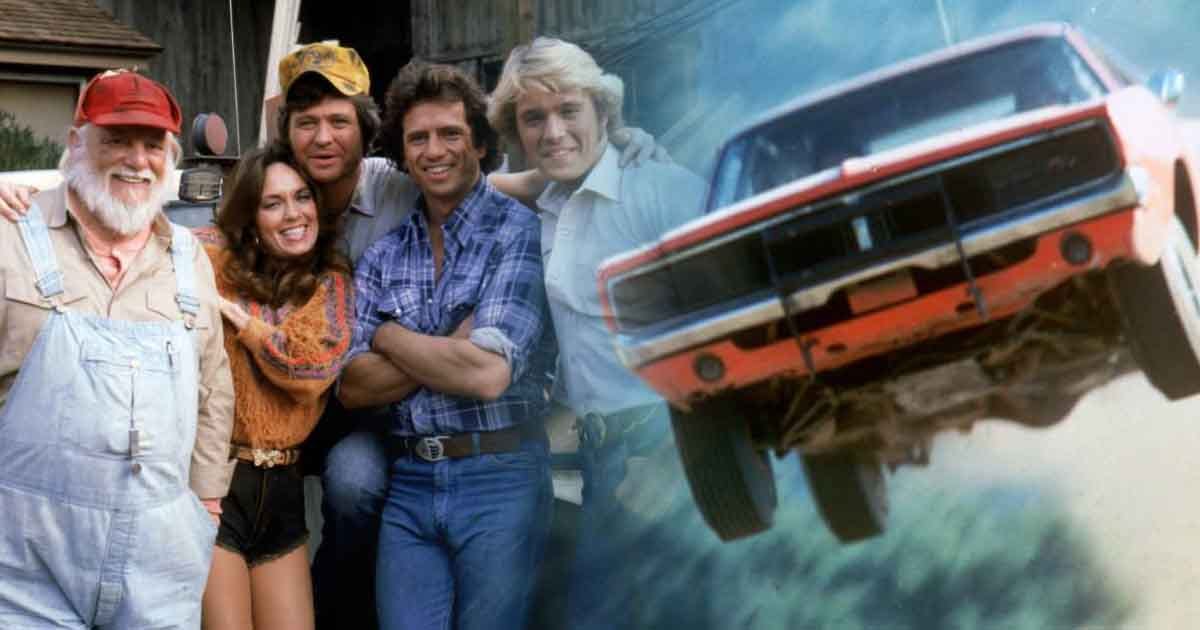
If you were a kid growing up in the late 1970s, there is a good chance that you watched “The Dukes of Hazzard.” Among its cast of colorful characters was Ben Jones, who played “Cooter” Davenport, the sidekick mechanic of cousins Bo and Luke Duke.
The show followed the Duke boys, two fearless cousins in rural Georgia, who used their iconic orange 1969 Dodge Charger, the “General Lee,” with its iconic Confederate battle flag painted on the roof, to outwit a corrupt county commissioner and a bumbling sheriff.
“In our show the good guys always won, and nobody really ever got hurt,” Jones recalled in his 2008 memoir ‘Redneck Boy in the Promised Land.’ “There was comic action and mock violence, but in the end, nobody bled and nobody suffered real pain. Crime and greed never paid off, and virtue was its own reward.”
It was good fun.
Jones died yesterday at the age of eighty-four.
In recent years, Jones was an unapologetic defender of the Confederate flag even after the horrific murder of nine churchgoers in Charleston in 2015 by a self-admitted white supremacist who proudly embraced the flag.
Most obituaries are leading with his role in the iconic 70s television show, but his life traced a more interesting arc, especially as it came to center more on the defense of Confederate symbols.
That arc offers a window into how one Confederate descendant, whose career came to be defined by a car named after Robert E. Lee, wrestled with the tension between personal identification with the past and history.
Jones came of age during the civil rights movement in North Carolina. In his memoir, Jones recalls being shot at by Klansmen after attending an integrated party and later having ammonia thrown into his eyes at a whites-only grocery store. Despite his later embrace of Confederate symbols, there can be no question that his commitment to racial justice was deep and sincere.
UPDATE: After posting a link to this post on Bluesky, Ben Jone’s daughter responded with the following:
The Dukes of Hazzard appeared in the wake of the civil rights movement, United States defeat in Vietnam and in the midst of a suffering economy. .
The show made Jones and his castmates famous in an era when the flag was migrating out of statehouse grounds and Klan rallies into mainstream popular culture. As opposed to the civil rights era, when the flag was one of the most popular symbols of “massive resistance” against forced racial desegregation, it could now be seen on beach towels, shot glasses and countless other products.
Despite the widespread use of the Confederate flag as a symbol of white supremacy, Jones spent the rest of his life defending it. He served as chief of heritage operations for the Sons of Confederate Veterans from 2014-18 and stood outside the Supreme Court in 2015 arguing for the group’s right to put the battle flag on Texas license plates.
Capitalizing on the continued popularity of his show, Jones opened three Cooter’s Place stores in Virginia and Tennessee, stocking them with memorabilia and plenty of items featuring the Confederate flag. He did so even after Warner Bros. pulled it from official Dukes of Hazzard merchandise following the Charleston church massacre that same year.
Jones remained defiant in the wake of the murders, at times appearing to collapse any distinction between the fictional world of the show and reality:
Our beloved symbol is now being attacked in a wave of political correctness that is unprecedented in our nation of free speech and free expression. Activists and politicians are vilifying Southern culture and our heritage as being bigoted and racist. We know that this is not the case. And we know that in Hazzard County there was never any racism.
When we say our flag stands for ‘heritage, not hate’ and ‘pride, not prejudice,’ we mean it Cooter’s is going to continue to sell our Southern symbols as long as there is a Cooter’s. I will fight these people until hell freezes over, and then I will fight them on the ice.
Interestingly, Jones never denied that the Civil War was about slavery and at times he did not feign ignorance of the flag’s darker uses.
Instead he argued that his own personal history and his family’s connection to the Civil War gave him standing to declare the flag redeemed—a kind of privileged status. In essence, Jones argued that a man who had marched and bled in the civil rights movement could vouch for the flag as heritage rather than hate because he, of all people, would know the difference.
In doing so, Jones regularly invoked Martin Luther King’s dream of reconciliation as though featuring the battle flag on a beloved television prop were itself an act of racial healing rather than a deflection from it.
Talk about trying to rewrite the past.
Historians of Civil War memory will recognize this move. The claim that personal antiracist credentials can neutralize a symbol’s history is a common feature of recent Lost Cause thinking and defense of Confederate symbols.
Jones appears to have genuinely believed both his civil rights activism and defense of the Confederate flag were expressions of the same values of courage, family, and defiance of illegitimate authority. Unfortunately, he never fully absorbed that the flag itself had already answered, for most mainstream Americans, the question of what it represented.
That sincerity offers an uncomfortable lesson. Good intentions and a genuine commitment to racial justice did not stop Jones from becoming one of the country's most visible defenders of Confederate iconography. If anything, his story shows how much the flag’s rehabilitation relied on witnesses who should have known better, people who convinced themselves, and convinced their fans, that they did.