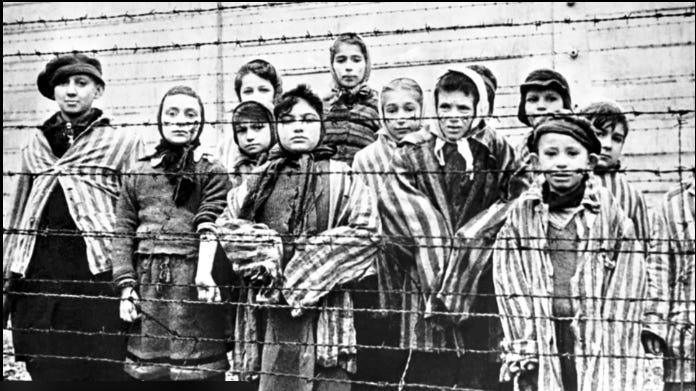
For years Gaza has been called an “open-air prison.” Since October 7, the language has gotten darker. Concentration camp. Warsaw Ghetto. Auschwitz.
There is absolutely no comparison.
People stepped off the trains carrying suitcases because many had been lied to about where they were going. They brought clothing, family photographs, food for the journey, children’s things, whatever they thought they might need when they reached wherever the Nazis were taking them.
Within minutes families were pulled apart. SS doctors stood on the arrival ramp deciding who might still be useful for labor. Men and women considered strong enough went one way. Babies, young children, many mothers, pregnant women, elderly people, the sick, and people with disabilities usually went another.
Most Jews deported to Auschwitz were murdered shortly after arrival. Many never received prisoner numbers because they were sent directly from the train to the gas chambers.
Those kept alive had their belongings taken and their hair shaved. Civilian clothing disappeared. A prisoner number replaced the identity the camp no longer cared about, and at Auschwitz that number was tattooed onto the body.
Food became another way to destroy people. Prisoners woke to something called coffee or tea that was generally little more than boiled water with a grain substitute or herbs. Lunch was thin soup made from potatoes or rutabagas with small amounts of flour or grain. Prisoners remembered rotten vegetables and soup that could be difficult to swallow. Supper brought a small ration of poor-quality black bread with a little margarine, sausage, cheese, or marmalade. That bread was supposed to last into the next morning. Starving people often ate it immediately.
And they worked. Prisoners dug ditches, built roads, worked in factories, mined, hauled materials, and performed heavy labor for 11 hours a day or longer. They did it hungry and exhausted, without adequate clothing or equipment, through Polish winters and summer heat. Guards and kapos beat people who moved too slowly, failed to meet quotas, collapsed, or simply happened to be within reach.
At the end of the workday prisoners sometimes carried the bodies of the people who had left camp with them that morning. Roll call could mean standing outside for hours afterward.
The barracks were overcrowded, filthy, damp, and infested with lice and rats. Sanitation was miserable. In parts of Birkenau hundreds of prisoners shared only a handful of washing and toilet facilities. At one point prisoners in an entire sector had no access to running water except in the kitchen. Disease spread easily through bodies already being consumed by hunger.
Eventually starvation had a recognizable appearance. Fat disappeared. Muscles wasted away. People became skeletal. Internal organs began to fail. Auschwitz prisoners had a word for those who had reached the final stages of physical collapse: Muselmänner.
Becoming too sick to work didn’t mean being sent somewhere to recover. SS doctors periodically selected registered prisoners who were sick, starving, or exhausted. Some were murdered with phenol injected directly into the heart. Others were sent to the gas chambers.
Bergen-Belsen had its own horrors. By early 1945 overcrowding, starvation, almost nonexistent sanitation, and shortages of water had produced epidemics of typhus, tuberculosis, typhoid fever, and dysentery. Tens of thousands died during the final months of the camp.
When British soldiers entered Bergen-Belsen on April 15, 1945 they found about 55,000 prisoners, many desperately ill, and thousands of corpses lying unburied around the camp. More than 13,000 former prisoners were so sick that they died after liberation. Anne Frank died there. So did her sister Margot.
At Mauthausen prisoners carried granite blocks up more than 180 quarry steps until men collapsed. Ravensbrück imprisoned women who were starved, beaten, worked, sterilized, subjected to medical experiments, and murdered. Dachau prisoners were used in experiments involving hypothermia, high altitude, malaria, and seawater. Buchenwald prisoners slept packed into barracks and assembled under SS guard for roll call.
Those are the places being invoked when Gaza is called a concentration camp. Those words have a history, and the people who lived and died inside those camps left us a record of what they meant.
So let’s go to Gaza.