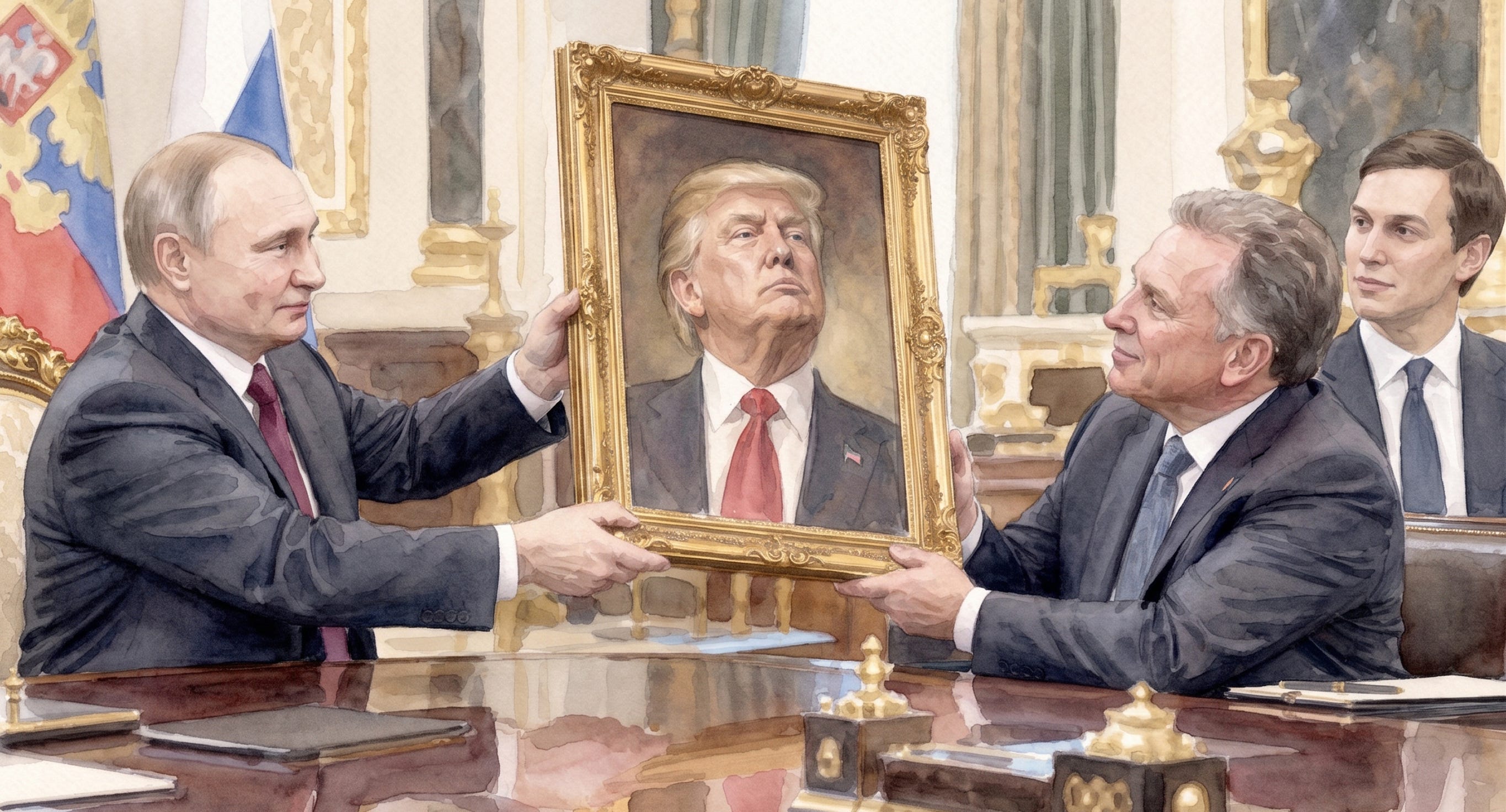
ODESA—Russia used to spend serious money recruiting Americans willing to advocate for Russian interests in Washington. Now an American presidential envoy does it after a few meetings and a thoughtful gift. In March 2025, Steve Witkoff returned from Moscow carrying a portrait of Donald Trump and a touching story about Vladimir Putin praying for the American president.
“I don’t regard Putin as a bad guy,” Witkoff told Tucker Carlson. The former KGB officer had apparently passed the character assessment. Ukraine’s position would now have to compete with a painting.
We publish this newsletter every day at 9:05am NYC time / 4:05pm Kyiv.Your subscription fuels our work.
By October 2026, Witkoff and Jared Kushner were still pursuing a settlement, with Moscow announcing agreement in principle to resume trilateral negotiations in November. The diplomatic machinery continues producing appointments. Russia continues producing casualties.
Look at the people conducting these negotiations and the decline of American negotiating power becomes easier to understand.
Yuri Ushakov spent a decade as Russia’s ambassador to Washington and has advised Putin since 2012. Sergei Lavrov became foreign minister in 2004 after serving as Russia’s representative to the United Nations. Both graduated from Moscow’s elite Institute of International Relations. They have spent decades watching American administrations arrive with fresh ambitions and domestic pressures, always with the naive conviction that they can finally straighten out the Russians.
They are career diplomats working within a system whose intelligence services have their own seats at the table. Russia’s May 2025 Istanbul delegation included military intelligence chief Igor Kostyukov alongside Vladimir Medinsky, Mikhail Galuzin, and Alexander Fomin. Above them sits Putin. These people understand deception, coercion, and the advantages of letting an opponent believe he has discovered a special relationship. Across the negotiating channels, Washington relies on Witkoff and Kushner, two real estate businessmen.
The deception works by dressing Russian ambitions in language the Americans want to hear. Territorial conquest becomes a difficult property dispute. Prospective business opportunities encourage Washington to imagine the rewards of agreement before Moscow has surrendered anything substantial.
The Russian delegation’s assignment does not require achieving a peace agreement. Talks can buy time, weaken sanctions pressure, divide Ukraine’s supporters, and establish Russian demands as the starting point for the next discussion. An American envoy desperate to announce progress can be useful even when he secures nothing. Especially then, if he blames Kyiv.
One man supplies the commercial seduction: Kirill Dmitriev. With Stanford, Harvard, Goldman Sachs, and McKinsey behind him, Putin’s investment envoy can speak fluently about the money everyone might make once this unpleasant business with Ukraine has been tidied away.