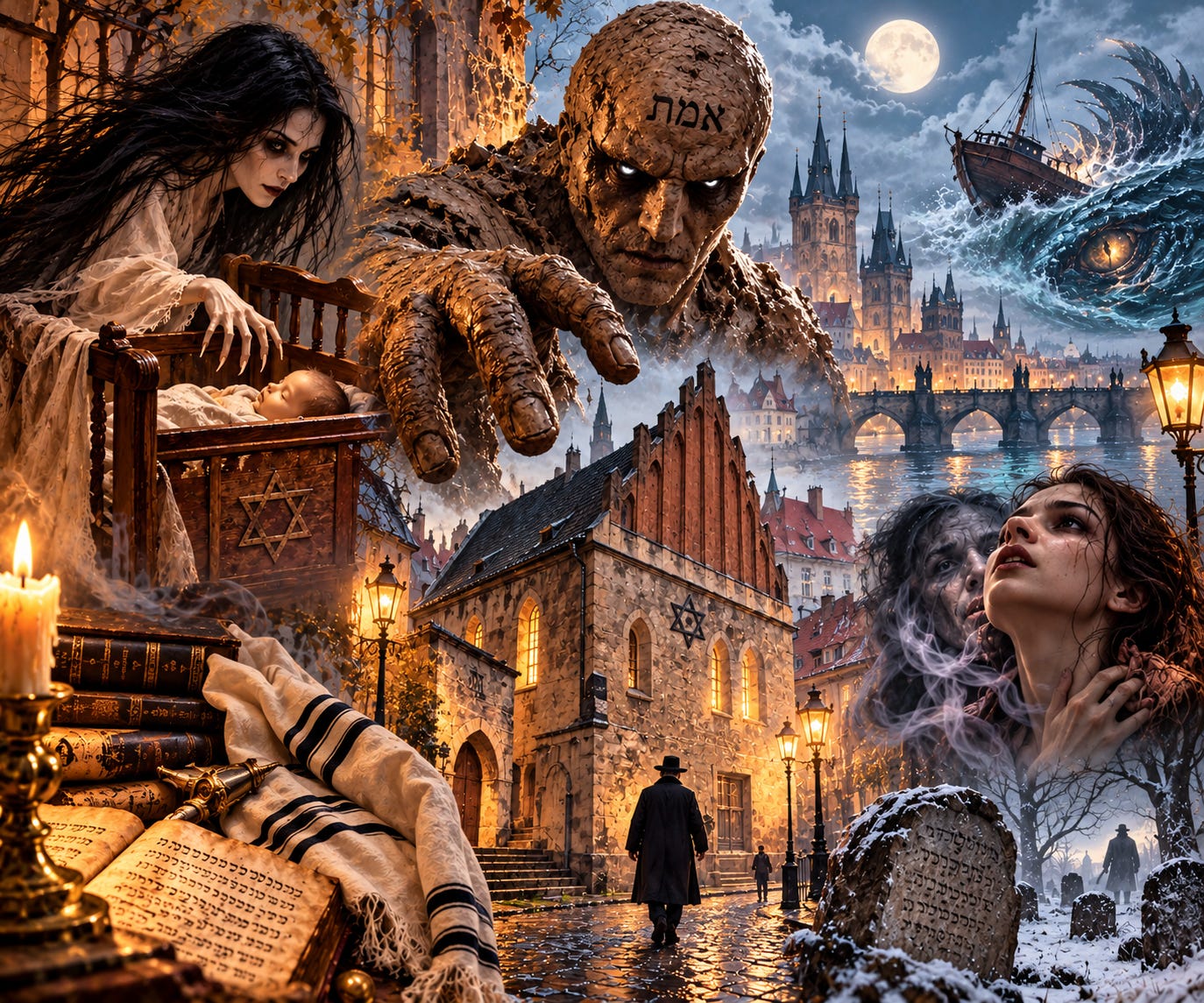
This is an original Halloween horror story inspired by Jewish folklore. Rabbi Judah Loew, Prague’s Old-New Synagogue, the golem legend, dybbuk traditions, Lilith, and Leviathan all have historical or literary roots. The characters, hauntings, and connecting scenes are fictional. AI helped smooth it out. All ideas and most of the words are all MOI! Did I ever tell you that fiction writing is my absolute passion? No? Well, now you know!
The first knock came just after midnight. It was so faint that the old caretaker mistook it for the wind rattling the roof of Prague’s Old-New Synagogue. With a slight shudder and sigh, he looked up from his book, waited for the sound to come again, and listened to the rain as it trickled down the ancient stone walls. His oil lamp burned beside him, throwing restless shadows across the empty benches and the vaulted ceiling.
Then came three more knocks. Each one heavier and more demanding than the last. The wooden beams groaned overhead, and a fine sprinkling of dust drifted onto the open pages of his book.
For forty years, the caretaker had swept these floors, polished the brass fittings, and tended the lamps. He knew every crack in the stone and every creak and moan of the old building. But he had never opened the attic door, and neither had the caretaker before him.
His grandfather had warned him about that door when he was a boy. The old man would lower his voice whenever he spoke of it, glancing toward the ceiling as though something might be listening.
“Some things are buried because they’re dead,” his grandfather had told him. “Others are buried because we hope they’ll stay that way.”
The caretaker had laughed at the time. Now, as something heavy dragged itself across the floor above him, he remembered how his grandfather’s hands had trembled when he spoke.
Prague’s Jewish Quarter had survived centuries of fear, violence, and accusations against its inhabitants. Behind its walls and narrow streets, Jewish families lived under the protection of their own communal institutions, though that protection could never guarantee their safety. Among the legends that grew around the quarter was one about Rabbi Judah Loew, the Maharal of Prague, a real scholar who lived during the sixteenth and early seventeenth centuries.
Generations after his death, storytellers began describing a secret creation attributed to him. They said the rabbi had gone to the banks of the Vltava River, gathered the dark mud, and shaped it into the form of a giant. Its shoulders were broad enough to fill a doorway, its hands powerful enough to crush stone, and its face smooth and expressionless beneath a heavy brow.
Through sacred words, the clay began to move. The creature, called a golem, rose from the earth without a heartbeat or a voice, ready to obey the commands of the man who had made it. It was meant to protect Prague’s Jews from danger, and for a time, according to the legend, it did exactly that.
But the stories also told of its strength becoming uncontrollable. A creature capable of tearing apart a wooden door could just as easily tear apart the person standing behind it. Eventually, Rabbi Loew removed the sacred source of its life, and the giant collapsed into a mound of lifeless clay.
Its remains were supposedly carried into the attic of the Old-New Synagogue and hidden beneath old prayer shawls and religious books. Generations passed, and the story changed with every retelling. But one detail remained…the creature was still there, waiting to be awakened.
The caretaker had heard that story since childhood. He had always imagined the attic filled with broken chairs, brittle antique books, and the sort of dust and cobwebs that gathered in places nobody wanted to go near enough to clean. But now, as he approached the narrow staircase, he saw something that stopped him in his tracks.
A dark stain had appeared on the top step, slowly spreading across the wood. He raised his lamp and saw a stream of gray mud seeping beneath the attic door, thick enough to leave ridges as it crept toward the edge.
He touched it with his fingertip. The mud was cold and gritty, reeking of river water and freshly turned earth. When he rubbed it between his fingers, he felt something hard embedded inside. He held it closer to the lamp and recognized a small fragment of bone.
Above him, the floorboards groaned again beneath an immense weight. A shadow moved across the narrow strip of light beneath the attic door, followed by a long, rasping breath that seemed to draw every bit of warmth from the staircase.
Far from Prague, in a Jewish village surrounded by forests, a young woman named Rivka began waking in the middle of the night with dirt beneath her fingernails. Her mother found muddy footprints beside the bed, though the doors had been bolted and the windows were too narrow for anyone to climb through.
At first, the family blamed sleepwalking. Rivka had always been a restless sleeper, and the strange noises coming from her bedroom might have been nothing more than bad dreams. But then she began speaking about people she had never met, describing houses that had burned down decades earlier and repeating conversations held before she was born.
One evening, while the family sat around the stove, Rivka’s spoon slipped from her fingers and struck the floor. She stared at her father with an expression so unfamiliar that he leaned forward to look into her eyes.
“Who are you?” he asked.
Her lips parted, and a man’s voice answered.
“You know me.”
Jewish folklore calls this spirit a dybbuk…a wandering soul believed to cling to a living person. Stories about dybbuks became prominent in Jewish mystical traditions from the sixteenth century onward, eventually spreading throughout Eastern Europe. Some spirits were believed to seek forgiveness, others revenge or shelter from punishment, and the unfortunate person they entered could find themselves sharing a body with someone who had absolutely no intention of leaving.
Rivka’s father sent for an elderly rabbi who had spent years studying accounts of such possessions. He arrived after sunset, carrying a prayer book beneath his coat, and found Rivka sitting beside the window with her hands folded neatly in her lap. Her eyes followed him as he entered, though her head remained perfectly still.
The rabbi placed a candle on the table and began questioning the spirit. Rivka answered in the same rough voice, describing a burial that had taken place twenty years earlier, when the rabbi was still a young man. The dead man’s body had never been recovered, and the coffin lowered into the ground had contained only stones.
“You buried an empty coffin,” Rivka said, smiling so widely that the corners of her mouth began to bleed.
The rabbi’s hands shook as he turned the pages of his prayer book. Rivka leaned toward him, her neck bending at an angle that made her father gasp, and a second voice began whispering beneath the first.
It was Rivka’s own voice, faint and desperate, as though she were calling from the bottom of a well.
“Help me. He’s still here.”
The candle flame turned blue. Rivka’s father rushed toward her, but the rabbi caught his arm before he could touch her, pointing toward the floor beneath the chair.
Two shadows stretched across the boards.
Only one person sat in the chair.
In some Jewish communities, mothers placed protective amulets beside newborn babies, carefully fastening them to cradles or hanging them near the bed. The amulets carried prayers, sacred names, or the names of angels believed to offer protection against dangerous spirits, including one whose name had traveled through centuries of Jewish and Near Eastern folklore.
Lilith.
Her story changed over time, appearing in different forms in ancient traditions, Jewish writings, and medieval folklore. The version describing her as Adam’s first wife became widely known through the medieval Alphabet of Ben Sira, while other traditions portrayed her as a dangerous night spirit associated with childbirth and infants. Whatever version a family knew, the warnings often concerned the same terrible possibility: something might come for a child while the household slept.
In one such tale, a young mother woke to the sound of her baby’s cradle rocking. The room was dark except for the faint orange glow of embers in the stove, and her husband slept beside her, his breathing slow and steady beneath the heavy blankets.
The cradle creaked again, its wooden runners moving gently against the floorboards. The mother sat up, expecting to find her baby awake, but instead saw a woman standing beside the cradle with her back turned. Long black hair hung almost to the floor, and one pale hand rested on the wooden rail.
“Who are you?” the mother whispered.
The stranger stopped rocking. For several moments she remained perfectly still, then slowly turned her head until the mother could see her face.
It was her own face.
The same eyes, the same mouth, even the small scar beneath her chin. But the smile was impossibly wide, stretching her lips back from rows of narrow teeth that glistened in the firelight.
The mother reached for her husband, shaking his shoulder hard enough to move his entire body. He didn’t wake, and when she looked back toward the cradle, the stranger was bending over the sleeping child, her hair spilling across the blanket like black water.
The mother threw herself from the bed, knocking over a chair as she lunged forward. The stranger vanished before she reached the cradle, leaving only the smell of damp earth and something sour, like flowers rotting in a vase.
Her husband woke at last, startled by the overturned chair and his wife’s cries. He searched the room, checked the window, and examined the lock, but found nothing. The baby slept peacefully, one tiny fist resting against its cheek.
Then the mother noticed four deep scratches carved into the cradle’s wooden rail. A strand of black hair lay across the blanket, and when she picked it up, the hair curled around her finger and tightened until the skin turned white.
She screamed and pulled, but the strand wouldn’t break. It slid slowly up her hand, winding around her wrist as though searching for something beneath her skin.
The Jewish villages of Eastern Europe had their own stories about the dead, told during long winters when snow buried the roads and darkness settled over the houses before supper. Families gathered around stoves and whispered about wandering souls, haunted cemeteries, and spirits that returned to places they had known in life.
Some tales warned of unfinished obligations or wrongdoing, while others were ghost stories that grew more frightening with every generation. One concerned a widow whose husband had died during a bitter winter, leaving her alone in a small house at the edge of the village.
His grave lay in the cemetery beyond the fields, where snow drifted so high that the headstones nearly disappeared. For several weeks after the funeral, the widow kept the stove burning and slept beneath the heavy wool blanket her husband had used during his final illness.
Then the footsteps began.
They came just after midnight, crunching slowly through the snow outside her house. The widow heard someone stop on the wooden step and scrape the soles of his boots against the edge, exactly as her husband had done whenever he came home from work.
She sat upright in bed, listening as three soft knocks sounded against the door. Her husband had always knocked three times when he arrived home late, a little signal that told her she could stop worrying and put the kettle on.
“Who’s there?” she called.
For several moments, the only sound was the wind moving around the house. Then came a familiar cough, followed by a voice so painfully recognizable that tears sprang into her eyes.
“It’s cold. Let me in.”
The widow climbed from the bed and crossed the room, but stopped before reaching the latch. Something was wrong with the voice, though she couldn’t explain what it was. Her husband sounded exactly as he had in life, yet each word seemed to come from a mouth filled with water.
She spent the night beside the stove, watching the door until daylight finally seeped through the curtains. The following morning, she went to the village rabbi, who listened without interrupting and warned her that whatever came to the house after dark, she mustn’t open the door.
That night, the footsteps returned, followed by the familiar scraping of boots and three gentle knocks. The widow sat rigid beside the stove as her husband’s voice called through the wood, pleading with her to let him inside.
“Please. You know me.”
She began to cry, pressing her hands over her ears as the voice grew softer and more desperate. Then, without warning, it changed.
“Open the door.”
The words were spoken in her own voice.
She stared at the latch as something dragged its fingernails slowly down the other side of the wood. The scratching continued for hours, stopping only when the first gray light of morning appeared beneath the curtains.
At sunrise, she opened the door and found footprints leading from the cemetery to her doorstep. There were no footprints leading away, but across the outside of the door, carved deep into the wood at the height of a man’s face, were two words.
I waited.
Not every creature in Jewish folklore was small enough to hide in a house or cemetery. Ancient Jewish writings describe Leviathan, a terrifying sea creature whose immense strength and armored body are depicted in the Book of Job. Later Jewish traditions expanded the stories, imagining a monster so powerful that ordinary human beings could do nothing against it.
Its scales were described as tightly sealed, its teeth terrifying, and its power beyond anything a person could hope to overcome. In the imagination of storytellers, Leviathan lurked beneath waters too deep for sunlight, waiting in a darkness no fisherman could ever reach.
In one imagined tale, a fisherman was alone on the water when the sea suddenly became still. His boat drifted beneath a moonless sky, and the wind died so completely that the sail hung limp against the mast. Even the waves stopped slapping against the hull.
Then something struck the underside of the boat, hard enough to throw the fisherman against the wooden rail. He grabbed the edge and looked down, holding his lantern above the black water as small ripples spread outward from the hull.
Far below, two pale shapes appeared. At first, he thought they were reflections, but they began moving upward, slowly and steadily, growing larger until he could make out the dark circles at their centers.
The shapes were eyes.
The boat began to rise as something immense pressed upward beneath it. Water poured away from the hull, exposing dark scales as large as doors, and the wooden boards groaned beneath the pressure. The fisherman fell backward, clutching the mast as a ridge of armored flesh broke through the surface.
The creature’s body stretched into the darkness beyond the reach of his lantern. He could hear a deep grinding sound beneath the water, like enormous stones being dragged across the seabed, and the entire boat trembled with each movement.
Then one eye opened directly beneath the hull. Its pupil narrowed into a thin black slit, and something scraped slowly against the wood, testing the boat’s strength.
The fisherman dropped his lantern. It struck the water with a hiss, leaving him in darkness as the sea around the boat began to sink, drawing the vessel toward a widening hollow.
He gripped the mast with both hands, feeling the wood splinter beneath his fingers. Somewhere below him, a vast mouth opened, and the water rushed downward with a roar that drowned out his screams.
Back in Prague, the caretaker stood halfway up the attic staircase, watching the mud creep toward his shoes. The scraping had stopped, but the brea…