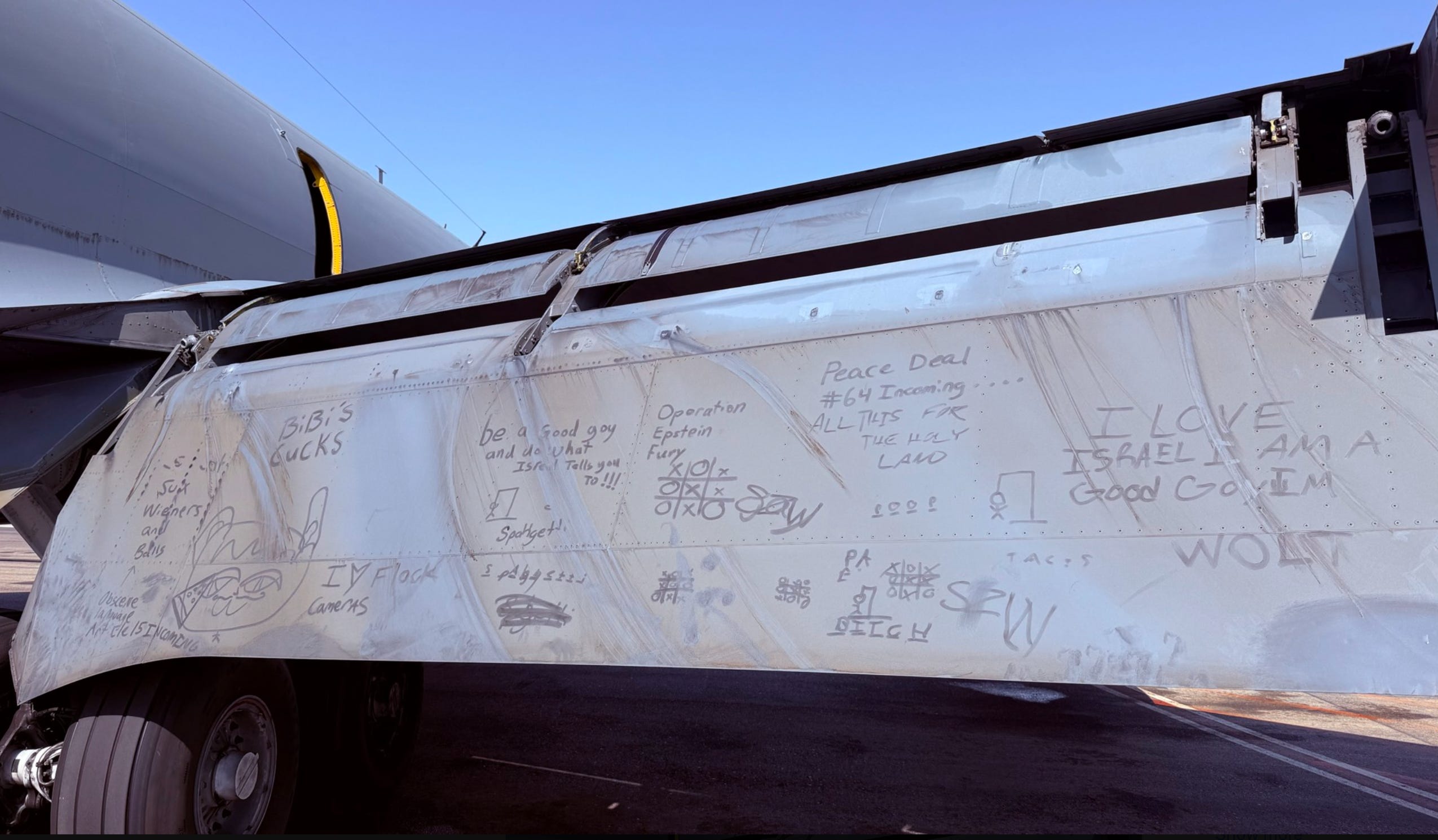
This image comes from 𝕏this Trita Parsi tweet, excerpted:
Of course you have to question whether this is real or fake. Parsi is a strong opponent of the war, which doesn’t mean that he deliberately posted something fake, but still. Yet a trusted military source who is generally pro-Israel told me that this is almost certainly not fake — and it’s not because the troops are anti-Semites either. The lack of morale thing, said my source, is real. Soldiers and sailors are like most Americans: they don’t know what the hell this war was for — or at least, they don’t understand why Trump has chosen to fight it in this way.
I remind you that it’s fine to criticize Benjamin Netanyahu for his role in this US military debacle … but Bibi is not the US Commander in Chief. Donald J. Trump is. It was always possible to tell Netanyahu (and Lindsey Graham) no. We would be fools to slip into an “if only the Tsar knew…” way of thinking.
Because I backed Trump in 2024, it gives me no pleasure to be this way, but it’s important not to make the mistake of scapegoating anybody else for Trump’s bad call. Trump had some key advisers around him — both in his cabinet and in the military — warning him off this Iran folly. But he wouldn’t listen, because he is vain and impulsive.
Along those lines, the Commander in Chief released this banger last night:
This is absolutely unacceptable! The president is turning his back on our longtime ally, South Korea, which faces a hostile, nuclear-armed Communist dictatorship, all because the South Koreans wouldn’t join his stupid war. Or maybe he’s just afraid of provoking North Korea, because our arsenal has been so depleted by the Iran War.
Think of it: The President of the United States is doing a huge favor for the Communist dictator of North Korea, either because he’s mad at the South Koreans for not joining him in his ill-advised crusade, or he is aware that if North Korea chose to move on the South, the US could not fight a conventional war to defend it. Maybe both.
We can’t beat Iran, so how would we be able to beat the vastly stronger North Korean military, absent nuclear weapons? Kim knows this now. So does Xi Jinping.
If this is Making America Great Again, I wish he’d stop.
This man is increasingly unstable, in ways that are starting to get scary. America really is getting into a precarious military position — and we have real enemies in the world who will take advantage of our weakness. Whenever Donald Trump leads office, he will have greatly diminished the authority and power of the United States abroad. I don’t see how anybody can doubt it at this point. It feels like the Late Ottoman period of declining empire.
If we can get to 2028 without China attempting to take Taiwan, I will be shocked. Trump’s terrible decisions have made this threat to one of America’s most important allies a lot more likely. Before, the question was, “Will the US fight for Taiwan?” Now an added question: “And if so, with what?”
(You might be wondering why I’m writing this morning after saying Saturday that I wouldn’t be. It’s because I had a slight change in my travel plans, and won’t be getting home till late tonight. I had time to write something for this morning.)
Saw this online yesterday:
Christopher Clay was the straw that broke the camel’s back for my Catholicism. For two and a half years, I had been staring into the palantir of the Catholic sex abuse scandal, and fighting hard to hold on to my trust in the Catholic Church. The thing is, it wasn’t just me: it was also my wife, who knew everything that I was learning, as I was learning it. It was a tremendous burden to her too. She converted to Catholicism before we married in 1997. I did not ask her to convert, but she read her way into the Catholic Church as she was trying to figure out what Catholics believe, so she could talk me out of it. We were true believers.
And then came the scandal. While we were white-knuckling it out in Dallas, a diocese that was awash in the sexual abuse scandal, we finally found a parish where we felt that we could trust the priests, both theologically and otherwise: St. Mary the Virgin parish in Fort Worth. It was a 45-minute drive there on Sunday mornings, a long way with two small boys, but it was worth it. For a while.
Father Christopher Clay was the assistant pastor there, or so we thought. He was a charismatic, conservative priest who gave great homilies. As we got to know him, he told us that he is a native Dallasite, but had been serving in the Diocese of Scranton. He got crossways the liberals in the diocese, and had been sent away.
That’s just like the liberals, I thought, doing that to a strong conservative priest.
Later that summer, I helped lead a friend to Catholicism. I urged her to go to Father Clay for instruction. “He will tell you what the Catholic Church really believes,” I said. My friend, Rachel, was somewhat liberal, and I trusted Father Clay to give orthodox Catholicism to her in a sensitive way.
A month went by, then Rachel and I met for coffee. I was eager to learn how her instruction was going. As I wrote in my Dallas Morning News column at the time:
She raved about Father Clay and what a "treasure" he is. I agreed enthusiastically, and said, "Can you believe the liberals ran off such a good priest?"
"That's funny," she said. "He told me he came home to Dallas because the conservatives drove him away."
Rachel went home and ran Father Clay's name through an Internet search engine. She discovered he had been suspended by Scranton in 2002 after a sex-abuse allegation involving a male teen. Rachel e-mailed this information to me that night, saying, "Please don't let this be true."
She had discovered that Father Clay had actually been suspended by the Scranton bishop after an accusation that he had gotten a teenage boy drunk and molested him. It was an accusation, not confirmation. (Clay was associated with this gay scandal-ridden group of ultra-traditionalists.) But Clay was not supposed to be in parish ministry at the time. He had skipped town in Scranton, came home to Dallas, and somehow went to work in that Fort Worth parish.
When I came out of my home office that night and told my wife the truth about Father Clay, she was overwhelmed by anger. Crying, she said, “We can never trust them again!”
And we never did.
I blew the whistle on him publicly in my column. More:
What to do with this information? I wasn't worried about Father Clay. I was worried about Father Allan Hawkins, the parish's very fine pastor, and the good people of the congregation.
I thought: Can't this be handled quietly, so Father Hawkins and the parish aren't embarrassed?
And then I thought: If I go that route, I am no better than the bishops and others I have criticized. They kept it in-house for the sake of the church and led us all off the cliff. Public exposure is the only sure way to handle Father Clay.
But he might be innocent! Yes, he might be. But Father Clay is on suspension. He surely knew that before he presented himself to Father Hawkins and offered to help. Why was it so important for him to get back into parish work?
Because of my inquiry, the Scranton diocese had already issued a press release about Father Clay. Why not let the Pennsylvania media break the story?
If I do that, I thought, what do I tell my editors when they want to know why I didn't tell reporters at my own newspaper? The answer would have been: Because I was protecting a parish and a pastor I didn't want to see hurt. That is, because I am a hypocrite.
I couldn't be a hypocrite. The protection of children must come first. I wrote down everything I'd learned and sent it to the religion desk. Susan Hogan/Albach worked the story and wrote the article in yesterday's paper.
Rachel and I feel absolutely horrible about all this. But I have no doubt that we did the right thing. Father Clay had to be stopped. Parishioners looked up to Father Clay, liked him, admired him, trusted him. How ironic that his downfall came out of a conversation in which Rachel and I gushed about what a wonderful priest he is.
Rachel, God bless her, still wants to become a Catholic. I am searching for a new parish for my family, though my wife and I are left wondering if we'll ever be able to trust the church with the safety of our two young boys.
I am left with two lessons: First, the church's child-protection rules are only as reliable as those people whose job it is to enforce them. Catholic parents cannot have faith in bureaucratic procedures.
Second, I have more empathy with those I have denounced. I have never been able to understand why bishops and parents of abused kids would try to handle things quietly. Well, I get it now. The only reason I anguished over any of this was not for the sake of Father Clay, but for trouble publicly exposing his deception would cause innocent people.
In the end, though, kids have to be shielded, and the church has to be liberated from this curse of secrets, lies and clerical privilege. I did what I had to do, and am not sorry for it.
Rachel did become a Catholic, in the end. And I was wrong in this column to have held Father Hawkins up so high. As I would soon find out, Father Hawkins, who died in 2023, had known the truth about Father Clay all along — as had the parish council, according to one of its members. They approved Father Clay to work in the parish, deliberately chose not to tell the Fort Worth bishop, and to keep this information from the parishioners. Father Hawkins told the media that Bishop Timlin of Scranton had cleared Clay to serve, and Timlin confirmed this. But Timlin’s successor said otherwise, and in any case, if everything was kosher with Clay, why did Hawkins choose to keep it all quiet from the sitting Bishop of Fort Worth? The only answer that made sense to me at the time, and still does, is that the Bishop of Fort Worth, under the 2002 Dallas Charter, would not have cleared Clay to serve at that point.
Needless to say, my family never went back to that parish. We returned to our geographical parish, but we were spiritual zombies. After some time, we were in such torment, overwhelmed by anger and fear, that we decided to push through our guilty feelings and start attending an Orthodox parish. We had no intention of converting, but we wanted to worship in the Real Presence of Christ in the Eucharist, without been crushed by rage and anxiety. (Though we were not allowed to receive it there, as Catholics, the Catholic Church teaches that Orthodox clerical orders are valid, and so is the Eucharist there.) Eventually, we decided we weren’t going back.
Father Clay — now Mr. Clay — was the final nail in the coffin of our Catholicism. I ran into him a time or two later in Dallas, in full clerical garb, holding court in a group of teenage boys. Shame on me for not walking right up to him and telling those boys who he really was.
As many of you readers know, when we became Orthodox, I did so knowing that I could never trust the institutional church as I had done as a Catholic — this, as a matter of self-protection. The one time I broke that “vow,” I allowed myself to be made a fool of by a cleric whom I had defended at personal risk, but who ought not to have been defended. It did not involve accusations of sexual abuse, thank God, but it drove home the lesson to me once again that I was too trusting of clergy. I hate that it’s that way, but it do be that way with me.
I have no doubt that Chris Clay will do his very best to weasel his way into the good graces of whoever is susceptible to his considerable charms. I also hope that anybody who spies him out and about in a clerical collar will do as the Bishop of Fort Worth asks in his letter, and call the chancery.
I’m going to leave it there today, and get my things ready to head home. Tomorrow I’m going to write about a great new book I listened to while driving. I think you’ll really like this one. It’s * All That’s Unseen*, an Appalachian memoir by Emilee Hackney. She was born in 1997, so is significantly younger that J.D. Vance. What I found most fascinating about her book is the way she was raised in hardcore Appalachian Pentecostalism, and its effects on her life and character arc. I’ll say more tomorrow.
Interestingly enough, I’ve been in far northeast Tennessee this weekend, visiting Frederica Mathewes-Green, who is recovering from a recent hospitalization. Tazewell, Virginia, where Emilee Hackney grew up, is only about two hours’ drive from here, in coal country. Driving through the Appalachian mountain range, which ends in Birmingham, where I live, has been something new to me — the sheer beauty of America. But the pain and desperation in many of these mountain communities is equally vivid. We saw that in Hillbilly Elegy, and we see it again in this very different, but inevitably similar, memoir (Hackney gets a ticket to the Ivy League out of Appalachia).
I find it irritating that in her interviews, Hackney has made a point of criticizing Vance’s literary predecessor of her own book. At some point that might simply be marketing; she has to distinguish her book from the massively successful Appalachian memoir that came out a decade ago. And, though she voted for Trump as a teenager in 2016, she turned on him later, at Harvard. Big surprise there!
I don’t hold Hackney’s political criticism of Vance against him — after all, Vance chose to make himself a top political figure. But her attacking Hillbilly Elegy for somehow caricaturing Appalachia is belied by the fact that the people in the story she tells — their good sides and bad — sound a lot like the people in J.D. Vance’s memoir. As much as it irritates Hackney, her book is significantly different from J.D. Vance’s (e.g., she grew up in a stable family, she was intensely religious while Vance was not, and most important, she is female and he is male), but it has far more in common with it than not. And the thing they share is a love-hate relationship with Appalachia, which is to say, with home. Many such cases.
Late in her book, when she’s at Harvard, one of Hackney’s professors makes snide comments about Appalachia, connected to Trump. She rightly rages against that jerk. But a different professor, in talking to her about her writing about back home, wonders if she is trying too hard to be defensive of a people and a place she loves. That is, the professor asks her gently to consider if there might be some truth to what the critics are saying, even if they over-emphasize certain things. Well, that professor is right, and you get a lot of nuance in * All That’s Unseen* — which is what I also remember from Hillbilly Elegy, even if Hackney cannot or will not see it.
But I wanted to get that out of my craw before I write tomorrow about all the good things, and the resonant things, about that extraordinary book.
I need to figure out before I get on the road what I’m going to listen to on the drive back. I have about three hours of Carlos Eire’s* Reformations* to go, but it’s a six-hour drive. Thinking about seeing if there’s an audiobook of one of my favorite novels, Robertson Davies’s Cornish Trilogy…