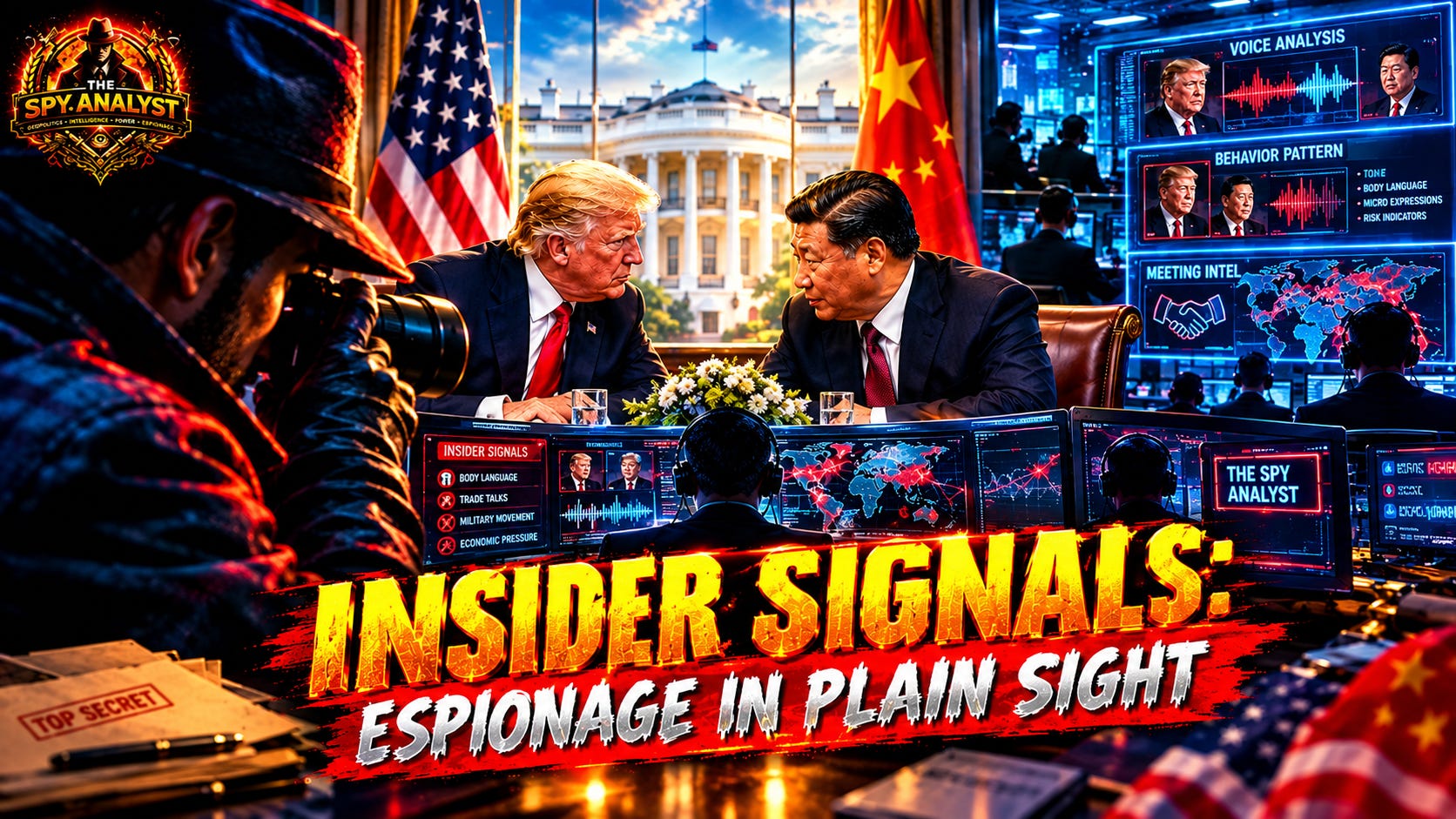
THE TRUMP–XI SUMMIT: THE ESPIONAGE GAME HIDDEN IN PLAIN SIGHT
Trump is buying a deal. Xi is buying time. And every intelligency agency on Earth is reading the receipt. What Trump is really playing for, what Xi quietly warned, and what every capital on Earth was reading between the lines One summit.
Trump is buying a deal. Xi is buying time. And every intelligency agency on Earth is reading the receipt.
What Trump is really playing for, what Xi quietly warned, and what every capital on Earth was reading between the lines
One summit. Two men. Two completely different games.
Most of the world watched the handshakes. This briefing is in two parts, because there are two men at the table and two hidden messages under the pageantry.
Section I decodes the man on the American side of the table:** his lens, his grudge, his admiration for strongmen, and the four-step loop he runs.**
Section II decodes the man on the Chinese side: the three lines Xi Jinping drew on American soil.
Read them in order. Each one only makes full sense with the other.
October 30, 2025, Busan. First meeting. Trump rates it a 12 on a scale of 10. US tariffs on Chinese goods fall from 57% to 47%.
May 2026, Beijing. Second meeting. The $14 billion Taiwan arms package is frozen. The friendship survives.
September 23-25, 2026, Washington. The state visit. The truce is extended by two months.
October 26-29, Beijing. The Communist Party’s fifth plenum, on the Party’s own governance and discipline.
November 3. US midterm elections.
November 18-19, Shenzhen. The APEC summit. Trump travels to China.
December 14-15, Miami. The G20 summit at Trump National Doral.
January 10, 2027. The truce expires unless renewed.
Three in-person meetings in eleven months, each a turn of the same wheel. If Shenzhen and Miami both happen, Trump and Xi will have met four times in a single year,** a frequency one Fudan University scholar called unprecedented.**
The four-step playbook Trump runs on Xi Jinping, and the three hidden signals every intelligence service on Earth was reading.
While cameras chased the handshakes, the world’s spy agencies were decoding something else: what Trump is really trying to buy, and what it costs every nation standing in the middle.
On Friday, September 25, Xi Jinping ended his first formal trip to Washington in 11 years, a state visit with Donald Trump.
The headlines gave you the tarmac greeting, the splashy state dinner and the pandas.
That was the wrapping paper. This is what was inside.
There were two layers of watching.
Layer one: Washington and Beijing studied each other, as they always do.
Layer two: intelligence agencies across the world studied both of them, like a live feed. Not only the two governments in the room. Every intelligence service, in every region, was watching this one meeting at the same moment.
Why? Because this was a high-profile summit between the two most powerful countries on Earth. When two giants sit at the same table, every gesture, pause and phrase becomes a signal: any gesture, pause or phrase that hints at what a player will do next. And those signals aren’t only about the two men in the room. Every other government was reading them to answer two questions:
What strategy might we soon be forced to adopt? And how will geopolitics unfold from here?
Think of it as a stress test. If the two biggest players quietly agree on something, every alliance, trade route and disputed border that depends on them feels the tremor.
Serious intelligence services knew one thing for certain about Trump’s mind. It shapes everything he does with China, and most commentators overlook it.
Once you see it, you cannot unsee it.
Let’s begin.
Before the psychology, the pressure. Because this summit did not happen in a vacuum. It happened inside a war and between two domestic clocks.
The war. The Iran war began in late February and is now about seven months old. The American naval blockade of Iranian ports around the Strait of Hormuz is estimated to cut off about 12% of China’s oil imports, and China is Iran’s largest oil customer. That changes who needs whom. Beijing, squeezed on energy, has every reason to keep Washington calm. Washington, fighting a war, has every reason not to open a second front.
Trump’s clock. The midterms are on November 3. He needs calm markets, happy farmers and headlines that say deal.
Xi’s clock. The Party’s fifth plenum convenes in Beijing from October 26 to 29, with the Party’s own governance and discipline on the agenda. Nothing is worth risking before it. Stability is the whole assignment.
Put the war and the clocks together and the shape of the summit was decided before anyone landed: both men wanted a calm, thin week. A thin summit is not an empty one. Thin was a choice, and the choice tells you what each side is protecting.
Keep this board in mind. It explains why a leader who opens with threats spent three days on flattery, and why another leader spent them on courtesy.
Every politician looks at the world through a filter. Change the filter, and the same country becomes an entirely different problem.
Trump is a politician who does not see China as a communist rival.
That matters far more than it sounds. Earlier U.S. administrations placed considerably greater emphasis on China's political system, human rights, Taiwan, and the strategic challenge posed by the Chinese Communist Party. In contrast, Trump's rhetoric has focused unusually heavily on trade, manufacturing, tariffs, and transactional economic outcomes
To the predecessors, China was first and foremost a communist country. It followed communism, and it was judged through that frame, the ideological lens. The contest was moral: a clash of systems, values and ways of life.
They measured Beijing on a scorecard with three lines:
Democracy. Does China let its people choose their leaders?
Human rights. How does it treat its own citizens?
Taiwan. How does it treat the self-governed island it claims as its own?
Every line was a question about what kind of country China is. Every line was a question of values.
Trump tore up that scorecard and wrote a new one:
Money. Who is getting rich from this relationship?
Manufacturing. Whose factories are running?
The trade deficit. The gap between what America buys from a country and what it sells back.
Look at the swap. Three lines out, three lines in.** Not one of the new lines is about values.**
A president fights for whatever he measures.
Change the scorecard, and you change the war. Earlier presidents asked, “Is China free?” Trump asks, “Who is winning the deal?”
He does not see a communist rival. He simply sees a giant, ruthless business competitor.
This tells intelligence services what Trump will demand, what he will trade away, and what he will simply ignore. If your opponent’s scorecard says “money,” then democracy and human rights are not on the table.
The takeaway: same country, new filter, entirely new problem.
But why does he see China this way? The answer is a grudge.
Every negotiator carries a story about how the other side got ahead. Trump’s story about China has three charges. Read them the way he tells them.
Charge 1: “China fooled us.” In Trump’s telling, China made a fool of America and threw dust in its eyes. While America wasn’t paying attention, China quietly strengthened its economic position. The insult matters as much as the injury: to Trump, America was outsmarted.
Charge 2: “China took our factories.” He believes China became wealthy and strong because it pulled American factories out of America and into its own territory. The production that once sat inside America now sits inside China. Its rise, in his eyes, was built on an American loss.
Charge 3: “China rigged the money.” He accuses China of manipulating its currency (steering the value of its money to gain an edge in trade), tilting the playing field in its favor.
And what is China’s one goal, according to this story?
To reverse the balance sheet (the simple ledger of gains and losses):** to make America the one showing losses and China the one showing gains.**
Now sit with that.
Fooled. Robbed. Rigged. Three charges, one direction: America losing, China gaining.
Earlier presidents fought China as an ideology. Trump fights China as a bad deal.
That is not foreign policy in the traditional sense. It is a grudge about a ledger.
And here is the twist. An ideology can never be settled. A ledger can be settled with a signature. That is exactly what makes the world’s capitals nervous.
To understand how the world reads Trump’s attitude toward Xi, you have to look beyond the trade grievances. Analysts don’t only listen to what Trump says about Xi. They study how he feels about him.
And what they find is admiration. Xi, to Trump, is a very big strongman with absolute control.
Across many speeches, Trump has praised Xi, and not in passing. He returns to the theme again and again, and the argument runs like this:
Look at the country Xi rules. Its population is enormous, among the largest in the world. And despite that, he holds it in an iron fist. He has absolute control.
Notice the tone. Trump says this with appreciation, not alarm. In Beijing in May, he said that if you went to Hollywood looking for someone to play the leader of China in a movie, you couldn’t find a guy like Xi. That is casting language. It is how a man talks about an actor who got the part exactly right.
The scale is the point. Governing a small country tightly is one thing. Keeping a population of that size under total control is what impresses him.
Most world leaders hear “absolute control” and see a warning. Trump hears it and sees a resume.
The takeaway: the same fact, “absolute control,” is a warning to most leaders and a** qualification to him.**
Why does this matter? Because the logic behind that admiration is the key to his entire approach.
This is where psychology becomes strategy.
Trump does not see Xi as a dictator.
That one difference changes everything. Follow the logic, step by step:
Earlier American presidents looked at Beijing’s leadership and saw a dictator. Joe Biden said the word out loud in 2023, after a four-hour summit with Xi, and stood by it.
Because they saw a dictator, they wanted regime change (replacing a country’s leadership and system from outside) inside China: a different system, a different leadership.
🕵️ CIA + GEORGE SOROS: THE 1980s REGIME-CHANGE ATTEMPT IN CHINA
A Chinese national is shadowed in New York.
Then another intelligence spy picks up the trail.
What emerges is a “China Fund,” a political influence agenda, and a far deeper story hiding behind it.
Then the intelligence takes an extraordinary turn:
A secret back channel to Beijing.
Why?What was uncovered?And what happened next—just before 1989?
🔥 CIA × SOROS × CHINA × REGIME CHANGE × ESPIONAGE
🔐 **The full investigation is coming **
The closest you can get to classified secrets without a clearance!
This one makes you want to know what was inside.
Trump sees Xi as a strong leader.
He wants Xi in place, because Xi is a strong leader with whom he wants to make a deal.
The proof point. On the flight home from Beijing in May, a reporter asked Trump directly whether Xi is a dictator. Trump first turned to attacking Biden. Pressed a second time, he said he doesn’t think about it, that Xi is the ruler and the president of China, that he respects him, that he is very smart and loves his country, and that whether he is a dictator is for the reporters to figure out. A man who saw a dictator would have said the word. A man protecting a deal did not.
The old playbook tried to replace the man across the table. Trump’s playbook needs him to stay.
The takeaway: one word,** “dictator” or “strong leader,” **decides whether Washington tries to replace the man across the table or make a deal with him.
But what exactly does “strong” mean to Trump? The answer is the most revealing part of this story.
In Trump’s mind, a strong leader is one who faces no day-to-day accountability:
No courts pulling him into legal battlesNo media demanding answersNo institution forcing him to explain himself
A leader free of all three is, in Trump’s view, very strong. That is the standard by which he rates people.
Now compare that with his own life.
America is a democracy, and democracy has a feature built into its bones: accountability that never switches off.
A president has to stand at a podium and take questions at press conferences. Reporters ask, and he has to answer, in public.
He has to justify his decisions to the U.S. Congress and show his reasoning.
Most people see that as a safeguard. Trump finds it irritating. These demands simply don’t suit a man like him.
You could see it in the week of the visit itself. On September 18, Trump banned CNN, MS NOW and Politico from the White House. The rest of the television pool suspended its coverage in protest. On the day of the state dinner, a federal judge ordered access restored, finding that the ban likely violated the outlets’ right to due process. Hours later, CNN and MS NOW journalists were still kept away from Xi’s arrival at the dinner, and Trump posted that the networks had refused to cover it. Read that as a small rehearsal of the thing he admires:** control over who gets to ask the questions, and who gets to watch the answers.**
Men like Trump want to operate in a space where nobody questions them, nobody asks them anything, and nobody holds them accountable.
That is the precise reason he is drawn to Xi. Inside China’s system, that space exists:
**No press conferences to survive. No podium, no questions.****No answerability to anyone outside. Nobody to explain a decision to.**No duty to share real information. Whatever is released can be manufactured to suit the leadership.
That is the freedom Trump admires.
He isn’t only negotiating with a rival. He is negotiating with someone whose life he envies.
The takeaway: in Trump’s mind, **“strong” **means “unquestioned,” and the deepest reason he likes Xi is that Xi lives the way he wishes he could.
And that envy explains one of his strangest habits.
Listen to how Trump speaks about Xi, in words to this effect:
“He’s a friend of mine. A brilliant man.”
Most people hear warmth.
Now connect it to everything you just read. Because he admires the kind of leader Xi is, his attacks on Xi never turn personal. Watch for this and you’ll notice it every time.
Look at the words themselves: friend and brilliant man. One word is about closeness, the other about respect. They are deliberate. They are chosen, not spontaneous.
Why? Because Trump wants to aim his attacks at business, not at the person. When the two men sit down, his objective is to sort out business-to-business deals, and you cannot close a deal with someone you have personally insulted.
Think of a negotiator who mocks the CEO in public, then wonders why the company won’t sign. Trump avoids that trap.
He attacks the company and flatters the CEO.
The takeaway: the friendliness is not softness. It is method.
And the method has a shape.
Now for the part intelligence services study most closely.
Trump’s dealings with Xi is a four-step process, a predictable behavioral loop. He doesn’t improvise. And here is the key: each stage is built to trigger the next.
Whenever talks or a meeting with Xi become possible, Trump opens with something extreme, a statement of maximum shock value, in words to this effect:
“I’ll stop your high-tech exports.”
“I’ll impose astronomical tariffs.”
(A tariff is simply a tax on imported goods.)
Notice the scale of the language. Not **“higher tariffs.” **Astronomical ones. Not “some limits.” A stop.
The tariff weapon has just been sharpened. **On September 18, five days before the state visit began, Trump signed the Lindsey O. Graham Sanctioning Russia and Iran Act into law. It authoriz…
Send this story to anyone — or drop the embed into a blog post, Substack, Notion page. Every play sends rev-share back to The Spy Analyst.
We’ve simplified responses to 👍 / 👎. Past comments are archived but no longer visible.