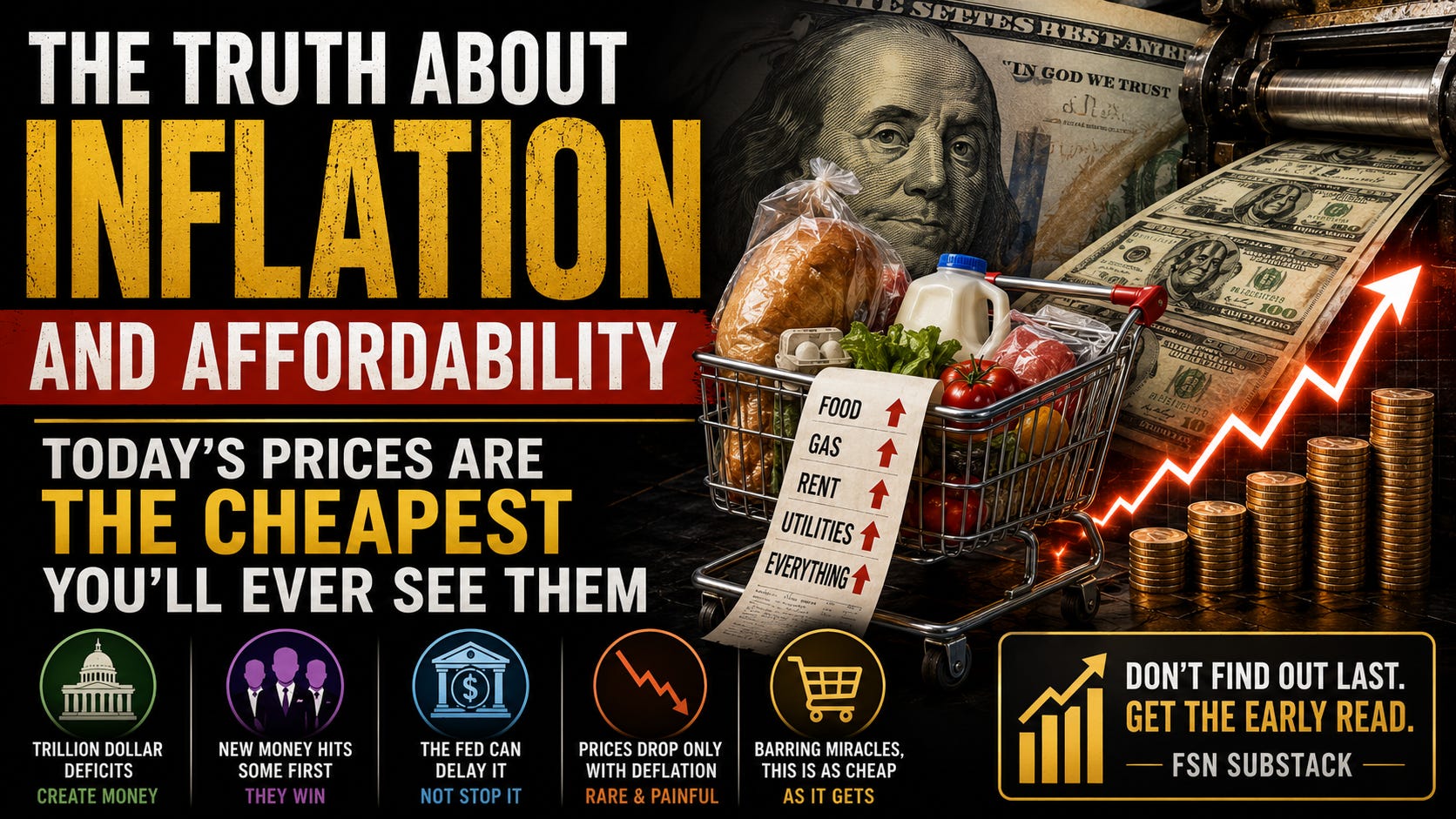
Today’s Prices Are the Cheapest You’ll Ever See Them
Here’s an experiment. Walk into a Walmart or a Costco and try to find someone — anyone — with the authority to personally mark down every price in the store. You won’t find them. Not Trump, not Bessent, not a single Democrat in Congress. Nobody has that power. And yet everybody talks about inflation like it’s a mystery, or a morality play about greedy corporations, instead of what it actually is.
So let’s define it. Properly, this time.
What Inflation Actually Is
Most people alive today weren’t around in the 1960s and 70s, the last time inflation really raged in this country. So the concept has gotten fuzzy. People think “inflation” just means “prices went up,” full stop, end of story, blame whoever’s convenient.
Milton Friedman said it better than anyone: “Inflation is first and foremost a monetary phenomenon.” Not a supermarket phenomenon. Not a landlord phenomenon. A monetary one.
Translation: when there’s more money chasing the same amount of goods, prices rise. That’s it. That’s the whole engine. Everything else — supply chains, corporate margins, weather, wars — are secondary effects layered on top of the real driver, which is how much money exists and how fast it’s moving.
Where the Money Actually Comes From 🏛️
Every year, Washington runs a deficit measured in the trillions. That gap between what the government spends and what it collects has to get filled somehow. When it’s filled in a way that expands the money supply — rather than genuinely borrowed from savers who wanted to hold that debt anyway — you’ve just created new money out of nothing. That new money didn’t come with new stuff to buy. It just came.
That is where higher prices come from. Not from a supermarket manager twirling his mustache. From the printing press, however dressed up and modern that press has become.
It Doesn’t Hit Everyone at the Same Time
Here’s the part most people miss, and it’s the sharpest insight the Austrian economists ever landed: new money doesn’t spread through the economy evenly or all at once. It has a sequence.
Whoever gets the new money first — banks, primary dealers, big institutions with direct access to the financial plumbing — gets to spend it while prices are still low. They buy assets, real estate, securities, at yesterday’s prices. By the time that money trickles down to regular paychecks and grocery bills, prices have already moved. The people who get the money last — wage earners, savers, retirees — are the ones who eat the higher prices without ever getting the early benefit.
This is called the Cantillon effect, named after an 18th century economist who noticed the exact same thing happening with gold and silver flowing into Europe from the New World. Nothing about it has changed in 300 years except the delivery mechanism.
The “Sterilization” Trick — And Why It Doesn’t Last 🏦
The Fed has a move it likes to make: pay banks interest just to sit on their reserves at the Fed instead of lending them out into the economy. It’s called interest on reserve balances. The idea is to bribe the new money into staying still so it doesn’t flood into circulation and spike prices.
It works — for a while. But the money hasn’t disappeared. It’s just parked, waiting for the incentives to change. The moment lending looks more profitable than sitting still, or the moment banks need liquidity for their own reasons, that money moves. And running this program isn’t free — the Fed has actually been paying out more in interest than it earns on its own bond holdings, running real operating losses to keep the lid on. That’s a bill that doesn’t vanish either.
Could Prices Ever Actually Go Down? 📉
Theoretically, yes — but not the way most people hope.
Most of the money supply isn’t cash in your wallet. It’s credit — money created the moment a bank issues a loan, and destroyed the moment that loan is paid off or defaults. If we saw mass defaults sweep through a major sector of the economy, all that credit-money would get extinguished fast, faster than the Fed could offset it. That’s genuinely deflationary. It happened in 2008.
But here’s the catch: every time that threatens to happen, the Fed and Treasury step in to stop it, because the political pain of a real deflationary bust is considered worse than the inflation created to prevent it. So realistically, there are only two paths to falling prices: a massive surge in productivity that outruns the money supply, or a real, sustained contraction in that money supply. Barring either one, this is as cheap as it gets from here.
The Bottom Line 👀
Ignore what they say. Watch what they do. Both parties — the left blaming corporate greed, the right cutting checks and running deficits of their own — are pursuing policies that, mechanically, can only produce one outcome: higher prices, permanently baked in, with the earliest recipients of the new money making out best and everyone else playing catch-up.
That’s not a conspiracy theory. That’s arithmetic. 📐
Want to see exactly how this plays out in real time — in silver, in oil, in the assets that move first when the money hits? That’s exactly what ** Insider Advantage** subscribers get: the early read before it shows up in your grocery bill. Upgrade to paid on FSN Substack and stop finding out last. 🚀