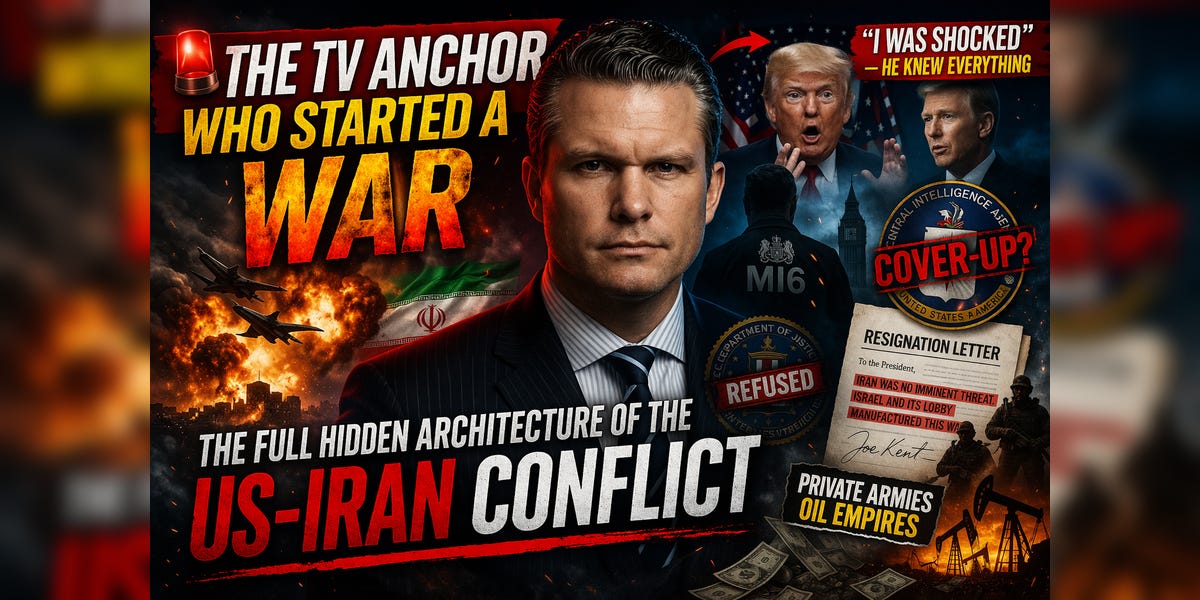
“The most dangerous wars are not started by generals. They are started by men who once sat in television studios telling other people to fight.”
Before we begin — what you are about to read has not been assembled like this anywhere in mainstream media. Every detail here is sourced, documented, and cross-referenced. If this gives you something rare and real, share it with one person who deserves to understand the world more clearly.
Subscribe to The Spy Analyst. Because behind every headline is a hidden game. 👇
On the night of March 19, at 12:30 AM — from 12,300 kilometers away from Washington D.C. — a former Indian intelligence operative sent out a quiet post on social media.
No breaking news chyron. No prime-time anchor. No official intelligence briefing. Just a post, from someone who had spent years inside the machinery of statecraft.
In it, he wrote something that no mainstream outlet was saying: the most important figure behind America’s war with Iran is not Donald Trump. It is Pete Hegseth — the United States Secretary of Defense.
Four days later, on March 23, Donald Trump confirmed it himself — publicly, at a roundtable in Mar-a-Lago — pointing directly at Hegseth, who was seated beside him, and saying:
“Pete, I think you were the first one to speak up. You said, ‘Let’s do it’ — because you can’t let them have a nuclear weapon.”
The moment Trump said those words. The conclusion is simple: Indian intelligence agencies knew who was really behind this war long before it reached the American President.
Let that sit for a moment.
A former Indian intelligence analyst, sitting 12,300 kilometers from Washington, identified the true architect of this war four days before the President of the United States did.
Either the CIA was slow.
Or the CIA was hiding something.
And that question — * why did it take so long for this information to reach Trump, if it ever truly did* — is the thread that unravels everything.
Before Pete Hegseth became America’s Secretary of Defense, he was something very different.
He was a Fox News television anchor.
To be fair, his biography is not entirely without military substance. He served in the United States Army, completing tours in both Iran and Afghanistan. He held rank. He knew what a rifle sounded like in a real firefight.
But after leaving the military, he built his identity in a television studio — and in that studio, he played one character, over and over, for years:
The man who wanted to bomb Iran.
On air, Hegseth was relentless. He told viewers, repeatedly, that America must show Iran absolute strength. No softness. No concessions. No diplomatic cover for a regime that, in his framing, only understood force.
“You can’t let them have a nuclear weapon.”
That line — that exact framing — became the justification for a war.
When Trump returned to power in 2025, he appointed Hegseth as Secretary of Defense. The moment Hegseth walked into the Pentagon, he began executing the worldview he had spent years broadcasting from a television studio.
And on March 23, at the Mar-a-Lago roundtable, Trump described the night the war decision was made. He told the room that he had called Hegseth. Then General Cain. Then several others. The conversation circled around Iran’s nuclear program.
In that room, on that night, Pete Hegseth — the former TV anchor — was the first and loudest voice to say: “Let’s do it.”
Trump confirmed even more on March 24: Hegseth was not interested in any settlement, any negotiation, any diplomatic off-ramp. He wanted to fight. He wanted to win. He wanted Iran defeated — fully, finally, permanently.
A catchphrase from a television set became the operational logic of a war.
Here is a detail that has received almost no attention in mainstream coverage-
The FBI was actively trying to distance itself from this war.
Internal signals indicated the Bureau had serious reservations about the legal, strategic, and intelligence basis for a military confrontation with Iran.
And yet — America went in anyway.
This matters enormously. When even the FBI, an institution not known for dovish foreign policy positions, is quietly backing away from a war rationale — and the administration charges forward regardless — the question of who is actually driving the decision becomes impossible to ignore.
The answer, as we now know, was Hegseth. But Hegseth did not operate in a vacuum.
There is another layer beneath the television anchor’s hawkishness — a layer that almost no one is discussing publicly.
Hegseth is not merely the war’s architect.
Multiple converging reports pointed toward something deeply troubling: that Pete Hegseth — America’s Secretary of Defense, the man in charge of the world’s largest military — was substantially controlled by MI6, the British intelligence agency.
Read that again.
Not influenced. Not briefed by. Not friendly toward.
Controlled.
If accurate — based on several converging intelligence reports, not confirmed fact — this reframes the entire war.
It would mean that the man who told Trump “Let’s do it” was not operating purely from American strategic interest. It would mean that a foreign intelligence service had, through its asset inside the Pentagon, helped push the United States into a war with Iran.
And it would raise a question that goes far beyond this conflict:
Who, exactly, is America’s Secretary of Defense working for?
Mainstream media has not touched this claim. That silence is itself worth noting.
In February 2026, indirect diplomatic talks between Iran and the United States were quietly underway. The subject was Iran’s nuclear program.
Iran had reportedly agreed to American terms. The back-channel was working.
Then, on February 28, something happened that terminated those talks in the most violent way imaginable.
The United States and Israel launched a massive coordinated aerial assault on Iran. The operation was code-named “Operation Epic Fury.”
In a single night, the strikes destroyed:
🏭 Iran’s nuclear enrichment facilities — reduced to rubble
🪖 Key military installations across the country
🎯 And then came the strike that shocked the entire world
Iran’s Supreme Leader, Ayatollah Ali Khamenei — who had ruled Iran for decades since the 1979 Islamic Revolution — was assassinated.
Along with him, all 40 of his top officials were killed simultaneously in a targeted operation of unprecedented scale.
Since 1979, no external force had struck this deep into Iran’s power structure. In one night, the entire architecture of Iranian governance was decapitated.
Also on that night — and this detail has been buried — American and Israeli strikes hit a girls’ elementary school in Iran. At least 168 children were killed.
That number. That image. That fact. It has done profound and lasting damage to America’s standing in the international community.
Trump and Hegseth operated on a clean, confident theory:
Kill Khamenei. The regime collapses. The Iranian people celebrate in the streets. Iran surrenders its nuclear program. America wins a quick, clean victory and goes home.
Hegseth specifically promised this would be a “quick, decisive action.” One week. Maximum. Clean outcome.
It was not one week.
It was not clean.
And Iran’s response proved the theory was built entirely on wishful thinking.
Iran’s retaliation was immediate, massive, and multi-directional.
🚀 Massive missile barrages and drone swarms hit
Israel💥 American military bases across the Gulf were struck — in
UAE, Qatar, and Bahrain🎯
Saudi Arabia, Kuwait, and Jordanwere also targeted⚓ And then — the move that paralyzed the global economy
Iran closed the Strait of Hormuz.
Most people have heard the name. Few truly understand what it means when those waters close.
The Strait of Hormuz is a narrow waterway — just 34 kilometers wide — sitting between Iran and Oman, connecting the Persian Gulf to the Indian Ocean.
On one side: the Persian Gulf, home to Saudi Arabia, UAE, Iran, Qatar, and Kuwait. On the other side: the Indian Ocean, and through it, the arteries of global trade.
Every single day, 20 million barrels of oil pass through this 34-kilometer corridor.
That is 20% of the entire world’s oil supply, moving through a passage barely wider than some city limits.
🇨🇳
Chinagets 30% of its total oil supply through this route🇪🇺
Europeimports its LNG through here🇮🇳
Indiadepends heavily on this route for its energy needs
When Iran’s naval forces positioned themselves to block all commercial traffic:
⛽
150+ oil tankerswere immediately stranded👨✈️
20,000+ sailorswere trapped at sea with no safe passage📈 Crude oil prices
exploded past $100 per barrel— spiking from the $65-70 range📉
Indian marketsjoined global markets in sharp decline🌍 The
International Energy Agencydeclared it the worst energy supply shock since1970
And here is the detail that truly exposes the depth of American miscalculation:
Trump publicly admitted he did not know whether Iran had already laid underwater mines in the Strait.
US officials later told CBS News that at least a dozen mines may be present beneath those waters.
No commercial shipping company — operating vessels worth billions of dollars, carrying crews of dozens — will risk sailing through a potentially mined waterway.
The Strait remains closed.
On March 18, 2026 — three weeks after the war began — America’s top intelligence officials were summoned before the Senate Intelligence Committee.
What followed was extraordinary.
Director of National Intelligence Tulsi Gabbard submitted a written statement containing a single, devastating admission:
After Operation Midnight Hammer in June 2025 — the previous joint US-Israel strike on Iran — Iran’s nuclear enrichment program had been completely destroyed.
And since that destruction, Iran had made absolutely no attempt to rebuild it.
Not a single centrifuge. Not a single enrichment facility. Nothing.
Yet Trump and Hegseth had been telling the world — repeatedly, loudly, publicly — that Iran was on the verge of a nuclear weapon and represented an imminent threat to the United States and its allies.
The intelligence community’s own written record said the opposite.
CIA Director John Ratcliffe and Tulsi Gabbard both confirmed to Congress something even more damning:
Trump had been fully briefed on Iran’s likely responses before the war began. Specifically, he was told:
✅ Iran would launch retaliatory strikes on Gulf neighbors ✅ Iran would close the Strait of Hormuz ✅ Global commercial shipping would face severe disruption ✅ Regional allies — UAE, Qatar, Saudi Arabia — would be targeted
After the war began and all of this happened exactly as briefed, Trump went before cameras and said:
“Nobody expected this. We were shocked.”
Two possibilities. Both are serious.
Possibility One: Trump was never actually told — meaning the CIA selectively withheld or softened intelligence to allow the war to proceed. A repeat of 2003, when “Weapons of Mass Destruction” in Iraq were presented as certain fact.
Possibility Two: Trump was told — and chose to lie to the American public about being shocked.
Neither possibility reflects well on the state of American governance.
On March 17, 2026, a man named Joe Kent did something that almost never happens inside America’s national security apparatus.
He resigned publicly. And loudly.
Kent was no ordinary official. His biography reads like the template for a loyal American patriot:
Director of the
National Counterterrorism Center****Army Special Forces veteranwith11 combat toursFormer
CIA operativeA declared, loyal supporter of Donald Trump
His job — his entire professional purpose — was to assess threats from countries like Iran.
He addressed his resignation letter directly to Trump and posted it publicly on X.
The letter contained claims that rocked Washington:
📌 Iran did not represent an imminent threat to the United States. Full stop. 📌 The war was launched under pressure from Israel and its powerful American lobbying apparatus.
📌 High-ranking Israeli officials AND influential American media figures had jointly run a coordinated disinformation campaign — convincing Trump that Iran was an imminent threat and that a quick victory was achievable.
📌 He reminded Trump that in his first term, Trump had used American military power effectively without starting a full-scale war: he killed Qasem Soleimani, he defeated ISIS — but he never destroyed a sovereign nation.
📌 Trump’s first-term legacy was strength without occupation. This war was the opposite.
The next day, Kent appeared on Tucker Carlson’s podcast and went further:
“Israel drove this deception.”
America’s own top counterterrorism official — the man whose entire career was built around identifying real threats — was publicly telling the world that this war’s intelligence foundation was manufactured.
And Washington’s mainstream media largely moved on.
Now we reach the question that every serious analyst must ask — and that most mainstream coverage never gets to.
Who profits from this war?
Wars of this scale do not happen by accident. Someone needed this to happen. Multiple someones. Let us name them clearly.
Before this war began, something happened that most people missed entirely.
Trump’s administration effectively seized control of Venezuela.
Venezuela is not a small prize. It sits on 17-18% of the world’s proven oil reserves — some of the largest deposits ever discovered. To give you a sense of scale: if India, which consumes approximately 50 million barrels of oil per day, were to run entirely on Venezuelan reserves, those reserves would last over 160 years without running dry.
Now connect the dots with surgical precision:
Iran closes the Strait of Hormuz ➡️ 20% of global oil supply vanishes overnight
Global oil prices surge past $100 per barrel
Venezuela — now under American control — becomes extraordinarily, historically valuable
The
private American oil companiesthat control this supply — the same corporations thatheavily funded Trump’s election campaign— generate historic profitsBrent crude, which traded around $65-70 before the war, pushes past $100 and climbing
And these are not government-owned oil companies. This is the crucial difference between America and countries like India, where HPCL and IOC are government entities.
American oil giants — private corporations — own this supply. Their profits flow to shareholders and to the political networks surrounding power.
When Trump ran for election, these corporations backed him. Now, with Venezuela controlled and Hormuz closed, their assets have become the most valuable energy reserves on earth.
War created that value. Venezuela was seized before the war to capture that value.
This is not conspiracy. This is the architecture of incentive, documented in plain sight.
Beyond oil, there is the second great engine of war profit: weapons.
Every nation watching this conflict — whether in the Middle East, Europe, or Asia — is now accelerating its military procurement. The global arms race that this war has triggered will generate hundreds of billions in contracts.
And who manufactures those weapons?
American private corporations — Lockheed Martin, Raytheon Technologies, Northrop Grumman, Boeing Defense. Every one of them is privately owned. Every contract enriches shareholders and the political networks they fund.
Trump’s political allies benefit when weapons spending increases. And war is the most reliable stimulus for weapons spending ever invented.
When the Pentagon asks Congress for **$200 billio…