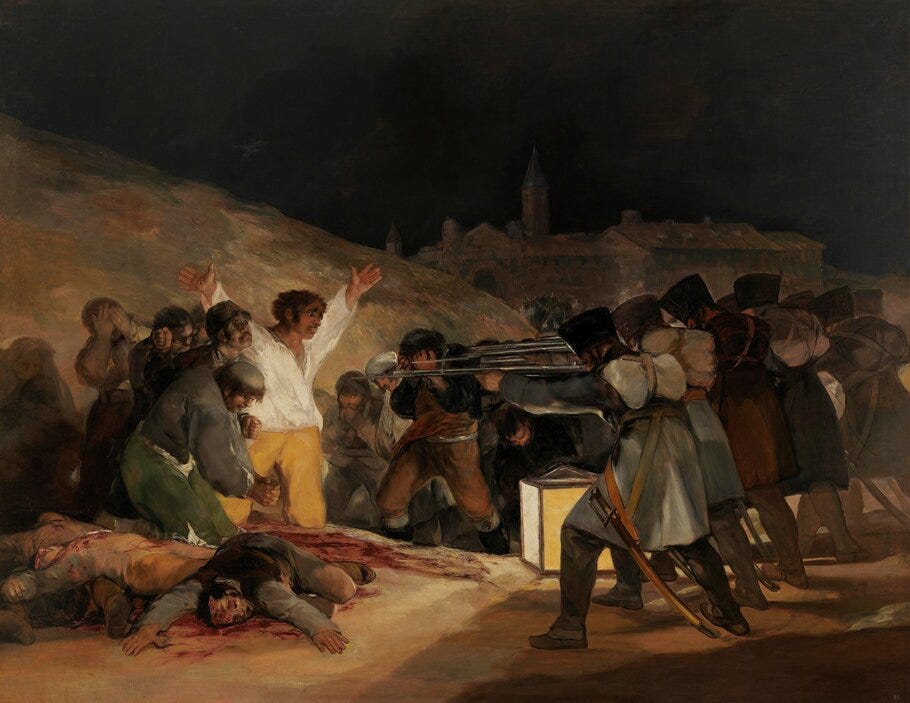
The list of nations that have public executions is a who’s who of dictatorial control and human rights violations. Pete Hegseth’s decision to televise the death by firing squad of Nidal Hasan as a deterrent against Islamic terrorists and a show of the force of Christofascism highlights how the US has fallen into the darkest of timelines, one that is truly dumber than any film and one that is crueler than a nation nicknamed the land of the free should be.
This is the weekly paid post. Read the full text online.
Public Execution as Christian Power
Christianity is rooted in violence from another era. Jesus’ crucifixion really comes out of the eye-for-an-eye mentality of the ancient world. Hammurabi’s legal code was rooted in the idea that society needs an iron fist to maintain order for the ruler. For millennia, law served the state, not all people, because most legal systems recognized only some humans as people. In a system built on inequity, cruelty maintained order. Think of a pit bull beaten and forced to fight; it often lacks the will to fight its masters. They’re tired, and the system's cruelty has become naturalized.
In his ministry, Jesus spoke out against the world's cruelty and preached peace instead. His crucifixion is not the lesson of his death, but his resurrection and his ability to forgive. Many of the earliest Christian thinkers focused on the nonviolence in Jesus’ message. The early Christians worked against the backdrop of the Roman Empire and hoped to create a countermovement. Clement of Alexandria (c. 150–215 CE), for example, held fast to teachings like "You shall love your neighbor as yourself" as the central principles for Christians. He wanted to spread peace rather than war. He was particularly pointed about how violence was generative. Violent correction added more evil in the world, and as such, violence was fundamentally incompatible with Christianity. Instead, he believed, “As simple and quiet sisters, peace and love require no arms. For it is not in war, but in peace, that we are trained.” Jesus did not extol violence.
Governance inextricably transformed Christian culture. When Constantine made Christianity the state religion, empire and faith became intertwined. Christianity became a tool to validate a legal system that did not treat all people equally. In essence, the Christian state treated many people as the Romans had treated Jesus.