Content warning: discussion of severe atrocities.
American foreign policy has, over the years, often been profoundly malevolent. That shining city on the hill bombed Laos so thoroughly that it killed 10% of their population, provided weapons for the Saudis as they caused half a million deaths in their failed war in Yemen, trained Mujahideen terrorists who destroyed Afghanistan and spread terror, and razed Vietnam and Cambodia. But perhaps topping the list is our policy towards Indonesian dictator Suharto.
Our malfeasance in Indonesia almost defies belief. One of the worst criminals of the last century slaughtered innocents on a massive scale, with U.S. support, and was lauded by a senior White House official as “our kind of guy.” We supported one of the most brutal thugs of the last century as he carried out some of the worst atrocities seen since World War two—tortures, killing on a mass scale, and the like.
The first stage of the atrocities took place between 1965 and 1966 in the aftermath of a failed coup attempt tied to left-wing political parties. Suharto, the man who carried out the atrocities, was one of the few remaining high-ranking military officials who wasn’t killed by the attempted coup.
Suharto’s response was to indiscriminately murder lots of people with loose communist connections. Between half a million and a million people were killed. More than half a million people were confined in labor camps. Leftist publications were shut down. Torture was routine as a means of extracting information.
Eyewitnesses to Suharto’s reign of terror describe routinely seeing corpses drifting down the river, heads and genitals hung outside brothels, beheadings, and screaming as those with vague communist associations were murdered. People were thrown in jail without due process. Civilians were lined up and shot. Perpetrators report beating people to death with sledgehammers, decapitating people, and hanging heads in the town square. One account from a perpetrator reads:
Over the whole kabupaten, there were around 700 people killed. During the first phase, when the order came from Jakarta, there were no interrogations at all. People who had been imprisoned for all kinds of reasons like theft, fighting and murder were all ‘cleansed’. Anyone held in police jails was killed. And none of them had any connection whatsoever to the Communist Party. The army that had come in from Kupang gave the orders to kill all the prisoners in SoE prisons without exception. When their wives or families came to visit the next day, those people just weren’t there anymore. We told them that their husbands had been moved to Sukabumi. When they heard this they passed out, because they knew their husbands had been killed.
Similarly, eyewitnesses describe that gunshots could be heard ringing out every night. Terror was ubiquitous, with everyone fearing they might be targeted next. Prisoners were compelled to dig their own graves, before being shot to death. Beny, the perpetrator who provides the account above, admits to killing 17 people. The killings were so widespread that after them the killers would often hear from the relatives of the people they’d murdered.
Torture was carried out with no due process. Ketut Samarta, who had no genuine communist connections, was jailed and tortured for multiple years. He describes:
a friend had his foot broken when stomped on with a table leg. Some had their bottom jaws moved around a bit. As for me, one of my vertebrae was broken.
…
Undergoing seemingly endless torture day after day had become a sort of routine to the other detainees and me. I could not get into a sleeping position that was comfortable for even a moment. The other prisoners and I, who had escaped the late night ‘call’, had to concentrate on getting well. We had to recuperate from the last torture in preparation for the torture bound to come tomorrow. We tended to our own bruises and the pains wracking our bodies with herbal medicine (beras kencur) we made ourselves.
Samarta described that prisoners were only fed stinking red cracked wheat that was usually reserved for pigs. They were so hungry that they’d eat cockroaches, rats, or anything else vaguely edible. Serious illness was extremely common.
The atrocities as they were carried out were not secret—they were reported by the American press, who called it a “staggering mass slaughter.” And yet despite full knowledge of Suharto’s crimes, America assisted Suharto. We provided lists of names for Suharto’s death-squads to assassinate and provided material assistance, military training, and institutional cover.
This was the first stage of Suharto’s crimes. The second of his most major crimes concerned his invasion of East Timor, in 1975, in response to the election (then victory in a civil war) of a popular left-wing political party. This invasion was carried out with the explicit approval of president Ford prior to its occurrence. 95% of weapons used in the invasion of East Timor came from the U.S..
The invasion is widely considered to constitute genocide.
The number of people killed has been estimated to be between 90,800 and 202,600, out of a pre-war population of about 700,000. This means means at the low end, around a seventh of the population was killed. At the high end, it was almost a third. Just imagine if this was done to your country: imagine almost one in three people in your whole nation dropping dead after a protracted, stifling, genocidal invasion.
A nearly 2,000 page report called Chega! (meaning Enough!) documents the extent of atrocities. It concluded the deaths were the result of a “systematic campaign orchestrated at the highest levels of the Indonesian government.” It found that U.S. political and military support was essential to Indonesia’s ability to invade and sustain the occupation.
The human rights violations were too numerous to concisely enumerate. To start with, there was the fact that the invasion itself was illegitimate—a foreign invasion to restrict the self-determination of a people. Murder and forced disappearances, including of non-combatants, occurred on a massive scale:
The killings committed by the Indonesian security forces had a particularly horrific character. The methods used ranged from death by severe deprivation in a prison cell to public executions committed using the most extreme brutality, in which villagers were sometimes forced to participate, to at supposedly secret sites, which in fact became widely notorious, to indiscriminate shooting of large numbers of persons in confined spaces.
Collective punishment of non-compliant communities was routine. Beheadings, shootings, fatal beatings, murder of journalists, immolation, burying alive, being tied to a moving vehicle, and torture were all documented methods of killing. Women were often raped before being murdered. Beheadings and cannibalism were both on public display. The body parts of those killed were often shown to their loved ones.
People were often arbitrarily detained and then killed. Thousands were tortured. Rape was routine, and in many cases “the rape victim was a substitute when the main target of violence could not be captured.” Over a hundred pages were written in Chega! detailing the widespread sexual violence.
Then there was the widespread famine caused by the invasion. Indonesian military strategy deliberately created famine conditions by destroying crops, killing livestock, forcing populations into areas where they couldn’t grow food, and restricting humanitarian access. The majority of deaths during the invasion were from famine and illness. Sometimes Indonesian forces would make civilians flee by setting grass fields on fire, burning to death those who couldn’t leave in time.
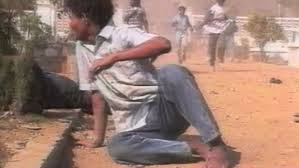
Huge numbers of people were displaced, often being forced into the mountains without adequate food. Other times, people were detained by Indonesian forces with inadequate provisions, leading them to starve to death. The report summarizes, “The overwhelming memory East Timorese people have of life just before and after their capture or surrender is of hunger.” Prisoners were often provided three meals’ worth of moldy corn for a week. The crimes in East Timor briefly entered the public consciousness after hundreds of funeral goers were shot to death, on video.
We should remember the lesson of Indonesia. Hideous atrocities are a tragically routine feature of our world. But in this case, it was done with U.S. knowledge and support, even though we knew about the tortures, forced displacement, starvations, butcherings, rapes, and beheadings. It was after all these crimes that we continued supporting Suharto for dubious strategic reasons. Worse: we backed the same dictator as he murdered and tortured and maimed two separate times, spaced a decade apart.
There is a special place in hell for those who committed the crimes in East Timor and Indonesia and to those who facilitated them. It is a disturbing reminder of the utter depravity that is all too common in high-stakes decision-making—that we live in a world where normal-seeming and educated men from Harvard and Yale make decisions from the confines of well-air-conditioned rooms that result in hundreds of thousands of people being murdered. To the extent that we mean it when we say “never again,” we’d do well to remember the lessons of Indonesia.