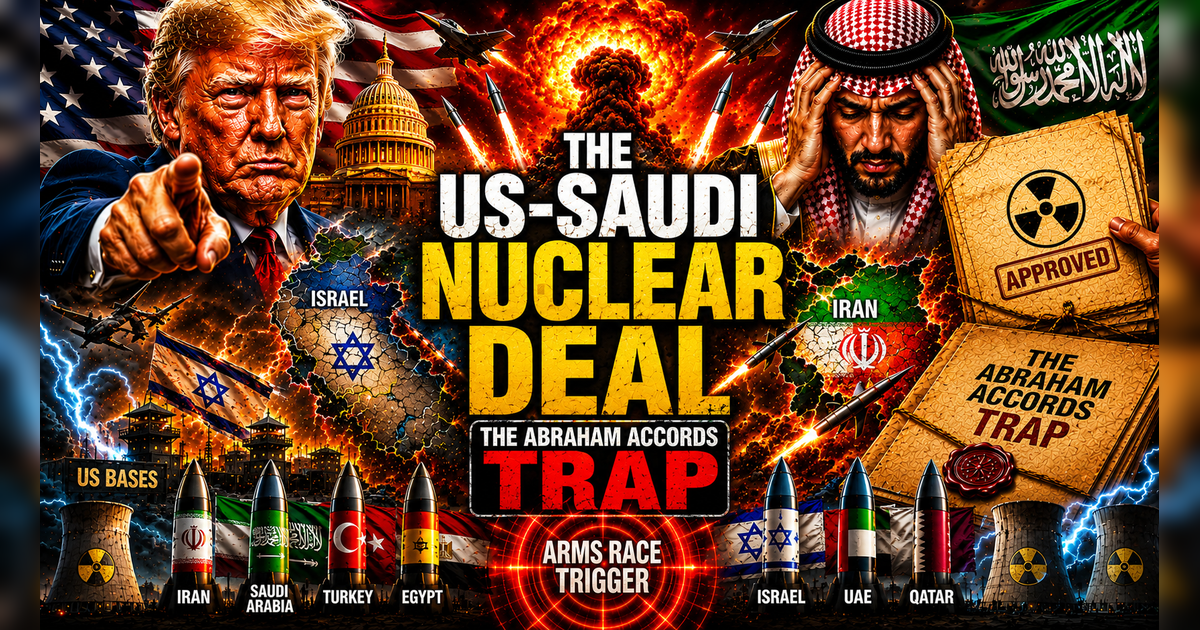
A single military strike was supposed to end a regime. Instead, it exposed the limits of American power, handed Russia and China a strategic opening, and set the Middle East on a path toward a new age of nuclear brinkmanship.
There are moments in geopolitics that look small on the surface but quietly rewrite the rules of the game underneath. Most people scroll past them. Few stop to ask what they actually mean.
This is one of those moments. And once you understand it, you won’t be able to un-see it.
To understand where the Middle East is heading — and why it matters to every economy watching from the outside, whether or not it borders the region — we have to go back to a single date**: February 28, 2026. That’s the day the United States, under President Donald Trump, launched a military strike on Iran,** an operation that would later become known as** Operation Epic Fury, coordinated with Israel’s Operation Roaring Lion.**
It wasn’t a random act of aggression. It was the opening move of a calculated strategy — one built on a theory that had worked before, at least on paper.
The doctrine behind the strike was simple, at least in theory.
Apply sustained military pressure on Iran. Let that pressure choke the economy from the inside. Once the economy starts collapsing, the regime — deprived of resources and public confidence — begins to crack under its own weight.
Then comes the final piece: combine that economic collapse with the removal or weakening of Iran’s top leadership. Do both together, and you get what strategists quietly call a** “regime change cascade”** — the same model that played out in Venezuela, where economic strangulation plus leadership decapitation eventually produced internal collapse and a change of power from within.
This wasn’t a guess dressed up as strategy. This was a model, built with real resources and real expertise. American intelligence agencies — the CIA in particular — and the broader U.S. strategic and defense-planning community had studied this scenario extensively before a single missile was fired. Analysts war-gamed it from multiple angles. Economists projected collapse timelines with real numbers attached. Regional experts mapped out precisely how leadership removal would interact with economic strangulation to produce the desired outcome.
This was, by every internal measure available to Washington, a well-resourced, thoroughly studied plan — not an improvised gamble fired off in anger.
It failed almost entirely.
And the way it failed tells us something far more important than the strike itself ever could.
Miscalculation One: The economy didn’t collapse the way they expected.
Even after Iran’s leadership took a direct hit — even after the shock of decapitation strikes specifically designed to destabilize command and control — the economic collapse that was supposed to follow simply didn’t materialize at the scale planners had projected. The first domino in the chain refused to fall the way the model insisted it would.
Miscalculation Two — and this is the one nobody in Washington saw coming: Iranian society didn’t fracture. It fused together.
Regime-change theory generally assumes a predictable sequence:** weaken the leader, and the population — resentful, exhausted, looking for someone to blame for their suffering — turns against the system that leader represents. **That’s the Venezuela model. That’s the assumption baked into decades of American foreign policy doctrine, tested and retested across multiple regions.
Iran broke that assumption completely, and it broke it in the opposite direction.
When leadership came under direct pressure, something closer to a siege mentality took hold instead. Rather than blaming the government for inviting the strike, the population rallied around the one institution capable of defending the country — the military. External pressure didn’t create internal blame. It created internal cohesion. And the military, now carrying the full weight of public backing behind it, became the very institution that held the regime together and kept it standing upright.
The result? The United States couldn’t degrade the Iranian regime in any meaningful, measurable way — let alone destroy it. The strategic objective failed on both fronts it was designed to attack simultaneously.
This wasn’t an improvised strike that nobody thought through carefully. It was a heavily analyzed strategy executed by people whose entire professional existence is built around getting this right — and reality diverged from the model almost immediately. That divergence, more than the strike itself, is the story that should be making headlines.
Iran didn’t weather this storm alone. **Russia and China quietly stepped in with real, tangible operational support **— not just political statements of solidarity issued for the cameras, but actual material assistance, delivered continuously and in real time.
This came in two distinct forms:
Supply chain support— keeping Iran’s military-industrial capacity functioning under sustained pressure.Real-time satellite intelligence— delivered to Iran on a day-to-day, near minute-by-minute basis.
That second piece is the one that changed everything.
China provided its BeiDou technology, giving Iran access to an independent global satellite navigation system with all-weather, high-accuracy positioning and timing. Russia’s intelligence pipeline allowed Iran to locate U.S. and Israeli assets with a precision Tehran could not achieve alone. Russia also helped upgrade Iran’s Shahed drones with better navigation and communications systems.
Using this continuous stream of satellite intelligence, Iran deployed its Shahed drones to systematically target and destroy American military installations scattered across the Middle East. The Shahed-136 drone, described as a low-cost but highly effective weapon, can fly long distances and strike specific targets.
Military bases are invisible on any public map — not by accident, but by deliberate operational secrecy. That secrecy protects a base from ordinary citizens. It does nothing to protect it from another government with a satellite and a reason to share what it sees.
The United States currently operates more than 800 military bases across the globe. Of those, at least 150 are concentrated in the Middle East alone — a staggering density of military infrastructure that the public will never see marked on any conventional map, but which exists in granular, precise detail inside intelligence databases in Moscow, Beijing, Washington, and beyond.
The real question was never whether Iran could locate these targets. It was whether anyone holding that information was willing to hand it over. Russia and China answered that question by doing exactly that — funneling positional intelligence into Iran through what amounts to an active, sustained intelligence pipeline. Armed with these coordinates, Iran’s Shahed drones didn’t strike randomly or symbolically. They struck with precision, taking out American military infrastructure across the region in a systematic campaign.
This is not a footnote. This is one state’s military infrastructure being methodically dismantled using intelligence supplied by two of its closest strategic partners — infrastructure the attacking nation didn’t even fully realize the target could see.
Iran escalated with a second strategic maneuver: **choking the Strait of Hormuz — one of the most critical energy chokepoints on the entire planet. **A massive share of the world’s oil and gas shipments pass through this single narrow waterway. Whoever controls the flow through it holds direct, immediate leverage over the global energy market itself.
Iran has used this chokepoint repeatedly and deliberately — not as a one-time disruption born of panic, but as a recurring strategic tool, manufacturing global energy crises whenever it serves Tehran’s broader interests. Hold that pattern in mind — later in this piece, at almost the exact moment Washington starts attaching new conditions to its diplomacy, Iran reaches for this same lever again. The two fronts are more connected than they first appear.
**Truth One: Military pressure alone cannot force regime change. **The entire strategic toolkit built around **“apply pressure, wait for collapse” **has now been tested against a real adversary with real, active backing — and it failed comprehensively.
**Truth Two: Geographic chokepoints are now active weapons. **The way Iran seized and weaponized the Strait of Hormuz is being studied right now, in real time, by every state with a similar chokepoint — and Russia and China sit at the very top of that list.
Since the military option failed to deliver regime change, the American position shifted noticeably. The public messaging — driven almost entirely by President Trump himself — became an unbroken drumbeat: I want a deal. I want a deal. I want a deal.
But this **“deal” **was never really about the Strait of Hormuz. It was never really about Iran’s broader economy either. It wasn’t even fundamentally about Iran’s conventional military capability.
The real prize behind this entire diplomatic push is something far more specific, and far more dangerous: nuclear-grade material.
Today, Iran holds an estimated 400 kilograms of highly enriched uranium — though Washington’s own assessment is that a significant portion of Iran’s broader nuclear infrastructure has already been degraded by the strikes. The stockpile itself, however, remains the sticking point that infrastructure damage alone cannot solve.
According to the latest comprehensive assessment from the International Atomic Energy Agency (IAEA), published in May 2025, Tehran possessed more than 400 kg of uranium enriched up to 60%, as well as nearly 300 kg enriched up to 20%. IAEA chief Rafael Grossi has stated that Iran possesses around 400 kilograms of uranium enriched to 60 percent, a level he described as close to weapons-grade enrichment. Western sources note that Iran is the only country in the world without nuclear bombs that possesses such highly enriched uranium.
With that stockpile, Iran possesses the material required to assemble a functioning atomic bomb whenever it chooses to do so. According to the IAEA, the 400 kg of 60% enriched uranium, if further enriched to around 90%, is enough for roughly ten nuclear weapons.
Iran understands that actually building a deployable weapon isn’t a simple exercise — it’s complex, resource-intensive, technically demanding. But Iran has internalized the deeper insight**: you don’t need a finished weapon to create deterrence. You just need the material sitting in your hands. Possession alone sends the signal — we have what we need, think twice before you push us.**
Iran has made its position unambiguous: **this material does not move. **Regardless of pressure, regardless of consequences threatened or applied, the stockpile stays exactly where it sits.
Facing this stalemate, the United States explored options beyond diplomacy. One option reportedly on the table: locate the material and extract it by force — a covert operation to physically seize the uranium and remove it from Iranian soil entirely.
Say it plainly: **a state forcibly entering another sovereign nation’s territory to remove its most sensitive strategic asset without consent is, functionally, an act of state-sanctioned theft **— a raid dressed up in the language of strategy. Critics have noted the irony: a nation that built much of its modern strength by drawing in the world’s best minds through genuine opportunity was, in this one moment, reduced to weighing whether to simply take by force what it couldn’t secure through diplomacy.
Whatever the merits of such a plan, here is the blunt operational reality:** the United States cannot move even a single gram of that 400 kilograms.** Why not? Because** Russia and China are actively, publicly backing Iran’s right to retain this material on its own soil. Any covert attempt to seize it risks triggering a direct confrontation with two nuclear-armed global powers standing firmly behind Tehran.**
The extraction option was dead on arrival. Washington was boxed in, with no clean way out.
With no viable path to neutralizing Iran’s nuclear leverage directly, the American strategy pivoted toward something else entirely: manufacture a counterbalancing power somewhere else in the region.
Enter Saudi Arabia.
This is no longer a hypothetical on the drawing board. Washington and Riyadh have already signed a nuclear deal — a formal agreement that, for the first time in Saudi history, puts the kingdom on a path to enrich its own uranium.
And the timing tells its own story. Yes, the paperwork traces back to a November 2025 joint declaration between Trump and Crown Prince Mohammed bin Salman — but paperwork sitting in a drawer is not the same as paperwork being signed, sealed, and publicly announced. What changed the moment Operation Epic Fury failed to deliver regime change was Washington’s willingness to activate what had been sitting dormant, and to lean on it harder, faster, and more visibly than it otherwise would have. A contingency plan that gets executed the moment Plan A collapses is not a coincidence of scheduling. It’s a doctrine revealing itself in real time.
The logic is almost mathematical in its apparent simplicity: Iran is a Shia power. Saudi Arabia is the leading Sunni power — home to Mecca and Medina, Islam’s two holiest cities, and a nation that has long seen itself as the natural leader of the Muslim world. If the Shia state already has highly enriched uranium, then — the thinking goes — give the Sunni state the same capability, and you create a natural, self-sustaining balance of power between the two.
Riyadh does not want to be seen as weak in front of a nuclear-capable Iran. Saudi Arabia has spent decades cultivating its identity as the Muslim world’s central power. Watching a historic rival hold a nuclear card that Riyadh itself doesn’t hold is, for Saudi leadership, close to intolerable.
Yes, Saudi Arabia has wanted this for over a decade — talks with France, Russia, South Korea, all predating this moment. But wanting something and being handed it by the world’s dominant military power, in the exact week your regional rival is being bombed, are two very different things. Riyadh supplied the motive.** Washington supplied the opportunity, the timing, and the cover. **That is not two independent ambitions arriving at the same door by coincidence. That is a client state’s long-standing wish list finally being signed off on by a patron that suddenly needed exactly this card played.
Clean, elegant logic on paper. Deeply, dangerously destabilizing the moment it touches reality — because logic this clean rarely survives contact with a region this combustible.
On the surface, arming Saudi Arabia to balance Iran looks like a genuinely smart, sensible strategy. Match power with power, the thinking goes, and stability follows. But turn that logic over once, and a much darker possibility appears underneath it.** Instead of slowing Iran down, a nuclear-capable Saudi Arabia might convince Tehran that its own program now needs to accelerate — not out of aggression, but out of the same insecurity Riyadh is currently acting on. What looks like a fire wall on paper can just as easily become the spark that makes the fire spread faster.**
Predictably, Israel is deeply unhappy about this arrangement — and has been from the very first moment it was floated publicly, long before ink ever touched paper.
**Israel has long treated Iran as its primary existential adversary, precisely because of Iran's nuclear ambitions and regional hegemony, which obstruct Israel's plans to establish a Greater Israel and construct The Third Temple. This is not speculation. T…