**This post is heavily indebted to a session Jake Nebel led, with a very helpful handout, in the ethics seminar he co-teaches with Liz Harman. *
After making Adam, God cast him from paradise. After making his monster, Frankenstein cast him aside. When Derek Parfit proved the repugnant conclusion, he quaked before his invention—and spurned and burned what he had birthed. And when Arrhenius proved the very repugnant conclusion, he declared it a horrendous paradox—perhaps even a reason for moral skepticism—rather than a proof.
The very repugnant conclusion is the idea that a world with 10 billion people with great lives is less good than a world with tons of people with terrible lives and an astronomical number of people with lives barely worth living.1 Totalism, the view that I think is right, says the value of the world is determined by summing together everyone’s welfare. Totalism implies the very repugnant conclusion—if there are enough people with lives barely worth living, they can bump up the total to be higher than the total in the world of 10 billion people with very happy lives.
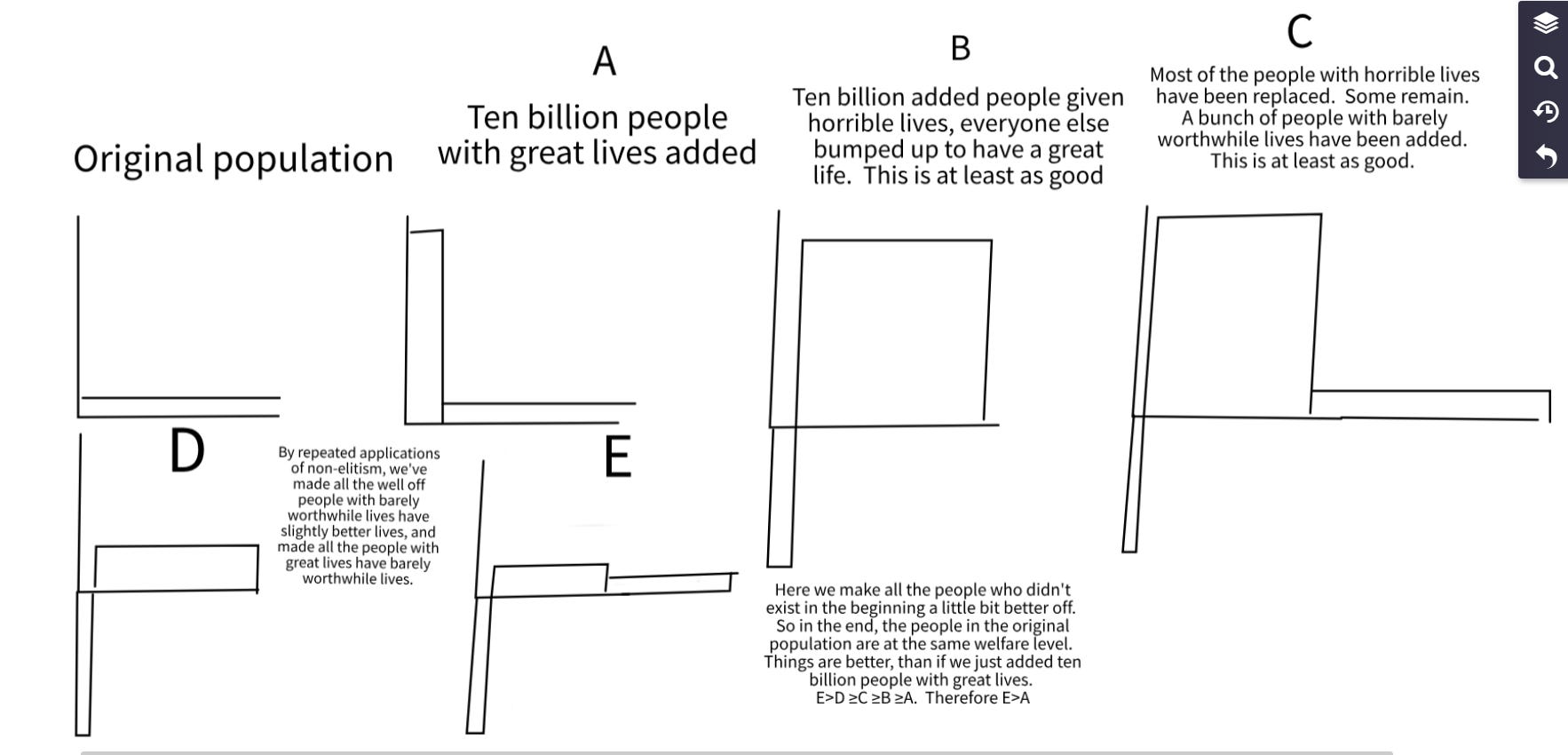
In the above graph, A depicts a population of a bunch of people with great lives. B depicts a population with a bunch of people with terrible lives and then an even more numerous bunch of people with barely worthwhile lives. The very repugnant conclusion is the idea that B>A.
The problem for those who don’t accept the VRC is that it’s extremely hard to avoid. Arrhenius proved it from a few very modest axioms, each of which seem extremely obvious when you think about them (read here for a great explainer, though I’m going to attempt to explain his most significant proof). Other strong arguments for accepting it abound.
People hate the VRC. They hate it so much that after Arrhenius produced some of his proofs, he wrote “the impossibility theorem cast doubts on the whole project of finding a normative theory that coheres with our considered moral beliefs.” Even Chat-GPT doesn’t like the very repugnant conclusion, so much so that it won’t draw me a graph of it. That’s why I had to draw the above graph by hand! Surely, whatever you think about it, it’s not *that *repugnant.
In this article, I’m not going to canvass every argument for accepting the very repugnant conclusion. The best one is probably the Arrhenius proof, which I’ll give a slightly simplified version of. This version has a tiny bit less force than the original, but still almost all of the force while being significantly simpler.
A brief note on names: I think it’s a bit unfair that the conclusions were given such charged names. The view that every totalist is straightforwardly committed to gets the name “the very repugnant conclusion.” Lance Bush voice: very repugnant to whom? Certainly it’s not very repugnant to me.
And one of the other results that views have is the “sadistic conclusion”—even though views that imply it aren’t sadistic. The views don’t like suffering. They just dislike suffering less than they dislike proliferating huge numbers of barely happy people. I think people would have less strong intuitions if the views in question weren’t given such charged names.
Trump voice: we’ve been treated so unfairly in terms of names, but that’s okay, right, we’re still winning by a lot—like nobody’s ever seen before!
This argument is Arrhenius-inspired but it’s not any of the Arrhenius proofs, I think, though I don’t know all of them off the top of my head—apologies if I’ve inadvertently plagiarized him. Also draws a bit from Huemer’s argument. Think of it as like if Arrhenius’s sixth proof and Huemer’s argument had a baby.
Start with a world with ten billion people with great lives. Now, imagine making one of those people a tiny bit worse off and creating a bunch of happy people. Seems like an improvement. Do that again. An improvement once more.
Keep doing that until all the original ten billion people have been made horribly badly off. At each step of the way things are getting better. So from this, we’ve learned that a world with ten billion people with great lives is less good than one with ten billion people with terrible lives and a huge number of people with great lives.
But now imagine raising everyone’s welfare level and flooding the world with a huge number of people with lives barely worth living. This seems like an improvement. So now we have the result that a world with a huge number of people with barely worthwhile lives, a bunch with great lives, and a bunch with horrible lives is better than one with a large number of great lives.
Now, imagine lowering the welfare of one of the people with great lives by a tiny amount to double the welfare of a thousand people with barely worthwhile lives. That’s an improvement. Do that again and again and again until all the people with great lives have been reduced to lives barely worth living. Once again, that’s an improvement. But once all the people with great lives are ground down to barely worthwhile lives, we’ve simply reproduced the very repugnant conclusion. And at each step of the way, things have gotten better.
Here’s a very fancy graph representing this, made by yours truly. The Y axis represents the amount of well-being of the people and the X axis represents the number of people.
W2>W1 because you get W2 by repeatedly slightly lowering the welfare of one person in the original group in W1 and creating a bunch of people with great lives. W3>W2 because everyone who exists in W2 is better off in W3 than W2—plus there are extra people with good lives.2 W3 is what you get when you raise everyone’s welfare in W2 and create a bunch of new people with lives barely worth living. W4>W3 because it’s what you get by repeatedly slightly lowering the welfare of one of the well-off people in W3 and doubling the welfare of a hundred people with lives barely worth living. W4>W1 just is the very repugnant conclusion.
W1, W2, W3, W4—you’re done, so figure out why you were wrong.
Here’s a simple argument. Start with a group of ten billion people with great lives. Let’s say their welfare is all 100. Now, imagine raising their welfare all to 110 and creating 10 billion new people with welfare of 80. It seems that things have gotten better. Now, imagine a third world where all twenty billion people have a welfare level of 99. Things are better still. You can keep doing analogous things until you bring people down to having just barely worthwhile lives (more details in a footnote).3 From this we can derive that a world with a bunch of people with barely worthwhile lives is better than one with 10 billion people with great lives.
A similar argument shows that a world with a bunch of people with slightly bad lives is worse than one with 10 billion people with horrible lives. 10 billion people with welfare level -100 is less bad than 100 billion with welfare level -99 which is less bad than 1 trillion with welfare level -98…which is less bad than some huge number of people with welfare level -.1.
Now, imagine starting with a world with 10 billion people with great lives. Imagine then adding a huge number of people with great lives and one person with a slightly bad life. It seems that things have gotten better. Do that again and again and again, until there are a bunch of people with great lives and a bunch of people with slightly bad lives. Now, replace the set of people with great lives with a bunch of people with barely worthwhile lives—things have gotten better. Then replace the set of people with barely bad lives with a much smaller group with horrible lives. That is better, per the above argument. So, in the end, a bunch of people with miserable lives and a gargantuan number with lives barely worth living is better than one with a huge number with great lives.
Technically what’s proved is the additive very repugnant conclusion: adding a population of a bunch of people with great lives is less good than adding a population of a bunch of people with horrible lives and a gargantuan number with lives barely worth living. I’m also going to simplify the proof a tiny bit, and modify things slightly—this only weakens the argument by a small amount but vastly increases ease of explanation. If you want to read the more complete version with its full force, see here. Think of what I’m presenting not as my own argument but as Arrhenius’s with a few shortcuts taken.
Here’s the basic idea of the proof. Start with a population of a bunch of people with barely worthwhile lives. Assume that the population size is really big. First, imagine adding 10 billion people with great lives to that world. The way the proof works is we’ll argue that the situation could be improved again and again and again, until it simply consists of adding a bunch of miserable people and a gargantuan number with barely worthwhile lives.
Now, imagine making one of the 10 billion people you’ve added slightly worse off to bring up a hundred other preexisting people to having great lives. Seems like it’s an improvement (or, at minimum, things aren’t worse). This follows from non-extreme priority which says that a world where one person has a slightly lower welfare level and a bunch of others have great lives is better than or equal to one where the one has a slightly higher welfare and the others have lives barely worth living. In other words, bringing up a bunch of people to high welfare is worth one person having a slightly lower welfare.
Now, make them worse off again and again and again, until they’re all horribly badly off. At each step, one of the ten billion is just slightly worse off and many others are brought up to a high welfare level. So, from this, we get the result that bumping up a bunch of people to have great lives is worth creating a bunch of people with horrible lives (negative utilitarianism BTFOd).
Now, weak non-sadism says that having a huge population with barely worthwhile lives is better than or equal to a smaller population of people with negative lives. More precisely, some number of lives at some sufficiently negative welfare are so bad that adding them is worse than adding any number of people at slightly positive welfare level.
So now imagine swapping out many of the people with horrible lives with a very large population of people with barely worthwhile lives. Once again, things are better. Though make sure to keep around some people with terrible lives.
Slightly stronger non-elitism4 says the following: suppose there are two welfare levels, x and y. x is more than y. If there’s a big enough group, it’s at least as good for all of the people to be at welfare level x as for one to be at welfare level x+1 and the rest to be at welfare level y. So, in other words, if x is more than y, in a large enough group, everyone at x is better than or equal to one person at x+1 and everyone else at y.
So now imagine lowering the welfare level of one person who currently has a great life to bump up a bunch of the people with barely worthwhile lives to be almost as good. That’s an improvement—or at the very least, not a worsening. Do that again and again and again until all the people with great lives have a slightly lower welfare level. Many with barely worthwhile lives have a much better life now, but there are still tons with barely worthwhile lives.
Repeat the process. Keep lowering one person’s welfare level to bump up a bunch of people to slightly lower welfare levels. At each step of the way, things are either as good or better. In the end, if you apply that enough times, you’re left with a population where everyone with a good life has a barely good life.
Now, imagine raising the welfare of everyone who didn’t originally exist—so everyone who wasn’t part of the original population has slightly better barely worth living lives. And we still had some left over people with terrible lives. So in the end, it’s better to add a population of people with barely worthwhile lives and many with terrible lives than a smaller population with great lives.
The reason we needed this last step was that the other steps are all consistent with each process leaving things equally good. This establishes that things are better, so that the world is better at the end, not just equally good.
I found the proof a bit hard to get a handle on at first, so here’s the basic idea. Basically, there are four substantive steps, starting from the population where 10 billion people with great lives were added:
Make the super well off people miserable to bump up the people with barely worthwhile lives. This leaves things at least as good, per repeated applications of non-extreme priority.
Replace most of the miserable people with a shit ton of people with barely worthwhile lives, but keep some miserable people left over. This leaves things at least as good, per weak non-sadism.
Now, level everyone down to have just barely worthwhile lives. This is at least as good by non-elitism. Make sure to return the people who originally had barely worthwhile lives to their original level.
Lastly, make the people who were created better off, so things are better in the end. This is better obviously.
We need one last premise which is that you can convert great lives to just barely worthwhile lives by repeatedly making them a bit worse (plus transitivity, but that’s not super needed, for reasons we’ll see later). More precisely “This assumption states that there exists a finite sequence of slight welfare differences between any two welfare levels.” Why think this?
The reason you might be tempted to deny this is if you think that the good life depends on organic unities. For example, maybe having a good life depends on valuable relationships and knowledge. But these properties are either had or lacked. So maybe the step where one loses a valuable relationship incurs a major loss in welfare. Perhaps there aren’t a series of small lowerings, but instead one giant fall.
This is a very interesting suggestion, but I don’t think it works for seven reasons.
First, goods like relationships can be reduced to goods of barely any value by a process of slow degradation. Imagine the person you have a relationship slowly being disposed to do fewer and fewer nicer things, until they barely care about you at all—until they’re just a bit more than an acquaintance.
Second, there’s a more straightforward way to lower the value of whichever goods are in a great life. Just lower the person’s degree of conscious experience, until it dwindles to almost non-existence—until they’re on the edge of zombiehood—and they’ll have a life barely worth living.
Third, for the proof we don’t quite need the assumption that any good life can be gradually degraded to a life that’s barely worth living. All we need is the assumption that there can be arbitrarily good lives that can be gradually degraded to a life that’s barely worth living. Here’s how that proof would work.
Suppose you think that the standard great human life can’t be degraded gradually in this way. Call degradable lives ones that can. If degradable lives can be arbitrarily good, then there’s a world full of degradable lives better than any one with 10 billion people with great lives. But then…