Democrats had a pretty good night!
Historically good, in fact. There was a +14.5 point swing relative to 2024 in the Senate. As of the time I’m writing this, there is, amazingly, uncertainty about who is going to win * Mississippi*. And Democrats are the favorites! We also won Kansas! Not only have Democrats won Texas and North Carolina, they’ve done so by huge margins. Talarico beat Paxton by around 11 points.
Now, part of the explanation of Talarico’s victory was that Paxton was some kind of swamp creature dredged up from the local morgue. But even Abbott was defeated by more than seven points in a race that was thought to be an easy lock for Republicans.
A very common phenomenon in politics is when political commentators suggest that their preferred candidate isn’t just better on the issues but would be electorally better. There is a suspicious convergence between how people think the country ought to be run and what policies are best for electoral victories. I like to think I don’t do that—for example, though I share Hillary Clinton’s political views a lot more than Bernie Sanders’, I think Bernie would have done better against Trump in 2016.
So I hope I’ve built up some credibility when I say that this election is good evidence that my preferred candidates are the ones that the parties should run.
I’m a moderate liberal (well, I have some extreme views, as you may know, but they’re not within the political Overton window). I prefer candidates who are moderate and hinged. I think the 2012-era Republican party is vastly preferable to the current one. Similarly, I like when Democrats run fairly moderate candidates. Politics was peak in the Obama vs. Romney years and has gone disastrously downhill since then.
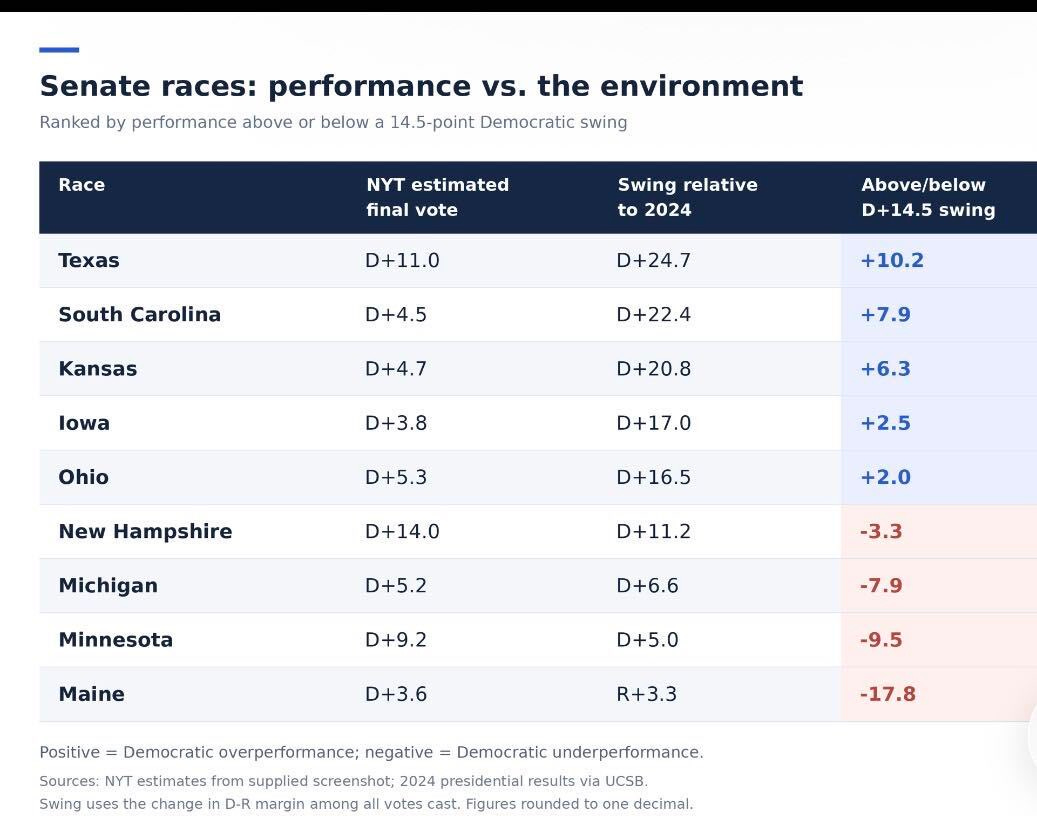
So which candidates did best? This chart, courtesy of , is a good indicator of the candidates who performed best relative to the average D+14.5 swing.
The candidates who did best are mostly moderates. Democrats in red states tended to be more moderate on average, and they hugely overperformed. For example, in North Carolina, Roy Cooper sailed to an easy victory by nearly 20 points, running on the slogan “make stuff cost less.” Progressives like Abdul El-Sayed and Peggy Flanagan underperformed. As Yglesias notes:
The real ideological fuckup was in ME-2, the only House seat that flipped from blue to red, where Democrats replaced Jared Golden with Bernie-endorsed Matt Dunlap, who lost despite a huge blue wave.
The Trumpian Republican party is very unpopular right now. So in races that were a referendum on Trump, Democrats won easily. In races that were a referendum on a more controversial progressive agenda—well, Democrats still won, because they basically won everywhere by a million points, but it was a lot closer. They won by only 52 points, rather than 85. The model of the future is: be a normal kind of chill moderate who runs on a slogan like “make stuff cost less.”
This election is also about as strong a rebuke of Trumpism as you can get. The Republican who most overperformed in the senate is Susan Collins. In fact, she did better than Republicans did in 2024! She still lost, but did extremely well. Collins is one of the most moderate Republicans—and the ones least friendly to Trump. Collins is, in many respects, a faint echo of the pre-Trump Republican party.
There is a perfectly sensible explanation of this. Trump is a deeply unpopular president because he tanked the global economy through unpopular and voluntary actions—both tariffs and the war in Iran—and then ran the presidency as some kind of demented and corrupt clown show. For example, in the run-up to the midterms, he decided to talk extensively about the Lincoln Memorial’s reflecting pool**. **This was…a choice.
It is bad for your political fortunes to go from a House, Senate, presidency trifecta into the midterms. It is especially bad if the economy is doing badly and gas prices are up. It is especially especially bad if the economic woes are the straightforward result of unpopular policies enacted by the president. And if on top of this, the president seems to be treating the reflecting pool and White House Ballroom as the central issue of the election, then that is a recipe for a historic shellacking.
Matt Yglesias’s blog is titled Slow Boring, a reference to the Max Weber quote “Politics is a strong and slow boring of hard boards.” Last night was a good night for slow boring politics. Voters aren’t happy with reckless unilateralism, and while very progressive Democrats still won by a considerable margin, they won by a lot less than their more moderate compatriots. The fact that the tariffs played a role in the humongous midterms defeat is further vindication of the Slow Boring worldview—according to which you shouldn’t ignore what one learns in Econ 101!
The model of the future for the Democrats is to run candidates like Jon Ossoff, Roy Cooper, and Josh Shapiro. The model of the future, if we want to win elections, is slow and boring. The insanity and the clown show has been decisively repudiated. Slow Boring has been vindicated!