While cable news commentators scramble to decode the latest Iranian missile salvos, the foreign-policy establishment has reached for its favorite analytical tool: a historical comparison that sounds impressive until you examine it.
The comparison du jour is the Tet Offensive. The theory is that Iran is repeating North Vietnam’s 1968 strategy—launching a dramatic wave of attacks designed less to achieve a military victory than to break America’s political will.
It is an interesting comparison. It is also wrong. Tet worked because North Vietnam was a unified country backed by two superpowers and fighting an America that had placed hundreds of thousands of its own troops directly in the line of fire.
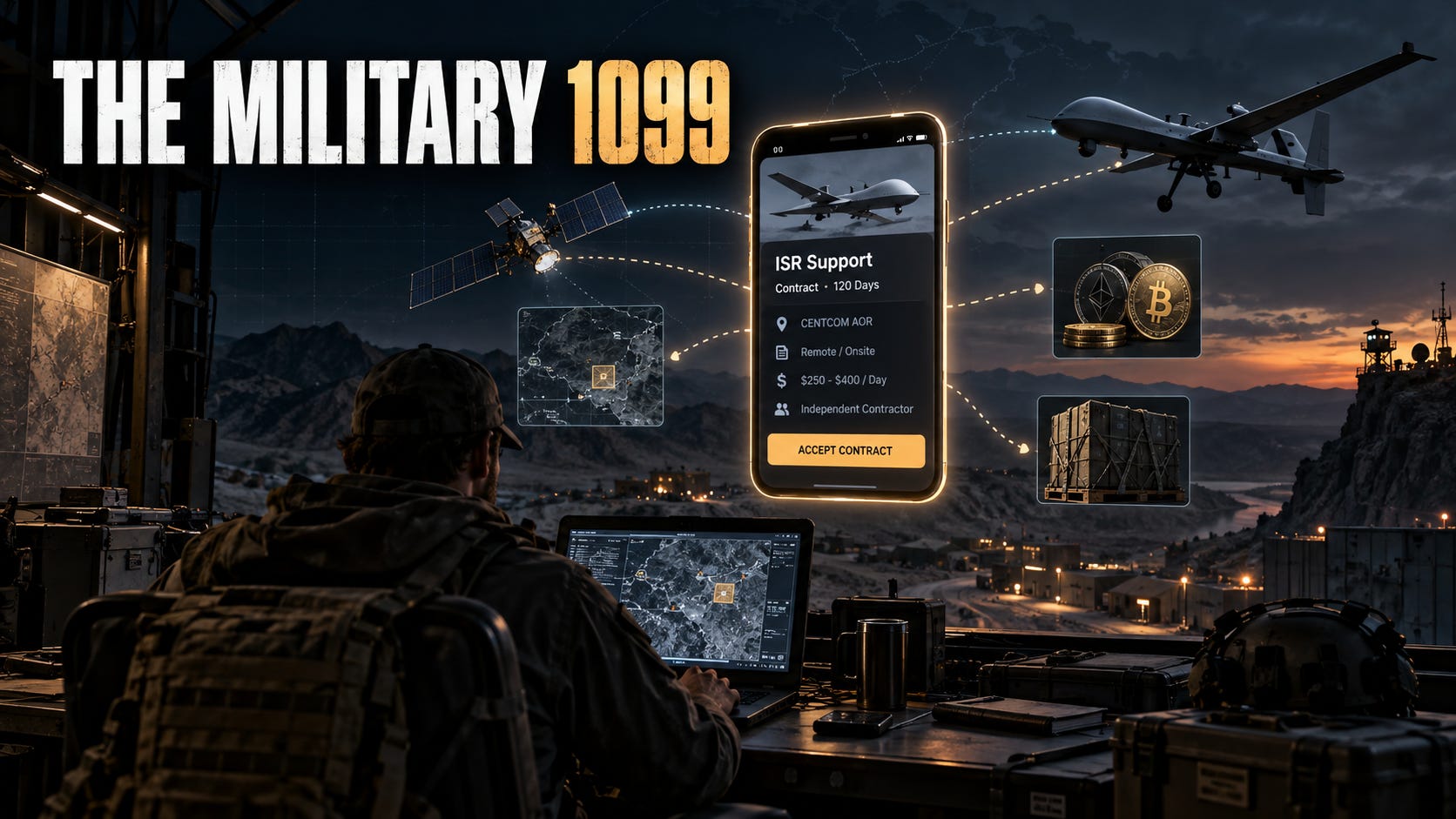
Iran faces a very different opponent operating under a very different model of warfare. The easiest way to understand it is to forget military jargon for a moment and think about the difference between a W-2 employee and a 1099 contractor.
I have met a number of them here in Florida and in my travels. I can almost pick them out of a crowd now. He’s a guy in his late 30’s, early 40’s who spent a career in the military and reluctantly left the military because his career advancement was over or he was attracted by a much larger paycheck. Often, he calls Norther Virginia home. And he’s smarter and more experienced than green troops and much more potentially lethal.
The W-2 Soldier
An active-duty soldier is a government employee. The government recruits him, trains him, deploys him and remains responsible for him and his family. If he is killed in combat, his death is publicly recorded. His body may return through Dover Air Force Base. The press reports it. Members of Congress demand answers. The public sees the human cost of the war.
That creates political pressure. Americans may support a military operation when it begins. But as casualties mount and flag-draped coffins come home, public support can evaporate very quickly.
We saw it in Vietnam. We saw it in Iraq. We saw it in Afghanistan. Every W-2 casualty becomes part of a highly visible national accounting. The dead have names, hometowns, families and photographs. Their stories appear on television and in newspapers. Eventually the public starts asking the question every administration dreads:
What exactly are we accomplishing over there? Tet was designed to force Americans to ask that question. Militarily, Tet was enormously costly for North Vietnam and the Viet Cong. Politically, however, it helped convince millions of Americans that the war they had been told was nearly won was nowhere close to being over.
That was the real target—not Saigon, not Hue and not the American embassy. The target was American public opinion.
The 1099 Battlefield
Modern military contractors operate differently. I am using “1099” as shorthand here. Many contractors are technically employees of private defense companies rather than self-employed freelancers filling out Schedule C between drone missions.
But the economic distinction is the same. These people are not active-duty members of the United States Armed Forces. They are hired through private companies to perform specific jobs involving logistics, security, intelligence, communications, equipment maintenance, drone operations and technical support.
Many are former military personnel with highly specialized skills. Some may work right beside American troops. But politically, they exist at least one step removed from Washington.
If a contractor is killed or injured, it generally does not produce the same public reaction as the death of an American service member. There may be an insurance claim under the Defense Base Act. There may be compensation for the family. The company may hire a replacement and continue performing the contract.
What there usually isn’t is a nationally televised arrival at Dover, a Pentagon casualty announcement and a photograph leading the evening news. That doesn’t make the contractor’s life worth any less. It means his death carries far less political weight in Washington.
That is the difference between the W-2 soldier and the 1099 contractor. The W-2 soldier is plainly part of the government. The contractor is part of a private supply chain operating just far enough away from the government to make the cost less visible. The work may be similar. The political consequences are not.
War Has Been Outsourced
Over the past several decades, America has outsourced enormous portions of the machinery required to fight a war. That doesn’t mean the Pentagon has secretly hired Uber to deliver missiles, although at this point I wouldn’t rule out a surge-pricing model.
It means more of the work once performed exclusively by uniformed personnel can now be handled by private companies, regional allies, intelligence networks and highly specialized technical contractors. Washington still supplies the money, intelligence, weapons and strategic direction. But it no longer needs to supply every person performing every task.
That changes the political calculation. An enemy can no longer assume that killing a relatively small number of Americans will automatically turn the public against an operation. When logistics, surveillance and technical functions are spread across contractors and regional partners, much of the human cost becomes harder for the American public to see.
Washington has not eliminated the cost of war. It has moved part of that cost off the front page and off the balance sheet.
Why Iran Is Not North Vietnam
North Vietnam entered the Tet Offensive with several advantages Iran does not today possess. Hanoi had an organized military, an ideologically committed leadership and substantial support from the Soviet Union and Communist China. It also had a clear political objective: survive long enough to convince the United States that the war was no longer worth fighting.
Iran is economically isolated, internally divided and under tremendous financial pressure. Its currency has been battered, inflation has savaged the population, and oil revenues have been severely disrupted by the war and blockade.
That does not make Iran harmless. A wounded regime with missiles, drones and regional proxies can still inflict tremendous damage. In fact, desperation can make it more dangerous. But launching missiles is not the same thing as possessing an unlimited supply of them.
Every ballistic missile Iran fires is expensive, difficult to replace and unavailable for the next confrontation. Tehran can create dramatic television footage, disrupt shipping and drive up the price of oil.
What it has not demonstrated is a realistic path to military victory. Iran is attempting to use disruption as leverage. It wants higher oil prices, frightened Gulf governments and nervous American voters to accomplish what its military cannot. That is certainly a strategy. But it is not a Tet Offensive.
The Political Risk Hasn’t Disappeared
There is one major limitation to the 1099 model: contractors cannot make every consequence disappear. American service members have already been killed, American bases have been damaged, advanced weapons have been consumed and the financial cost has climbed into the tens, if not hundreds of billions.
Then there is the price of oil. Americans may not see contractor casualties on the evening news, but they see the price of gasoline every time they pass a station. Iran understands that perfectly well.
If Tehran cannot recreate Tet through body bags, it can try to create the economic equivalent through energy prices, shipping disruptions and inflation. That is the regime’s strongest remaining card.
Closing or threatening the Strait of Hormuz immediately pushes the cost of the war into every American household. Iran-backed attacks near the Bab el-Mandeb add pressure from the other end of the region.
The modern political casualty counter may not be displayed at Dover. It may be displayed at the neighborhood gas station.
The Temptation to Arm Iran’s Periphery
Iran’s greatest vulnerability may not be an American invasion. It may be its own deeply divided population. The country contains Kurds, Azeris, Arabs, Baluchis and other groups with longstanding grievances against Tehran. The regime has survived through a combination of repression, patronage and the ability to concentrate force wherever opposition begins to organize.
If its military and Revolutionary Guard units are stretched across multiple fronts, that calculation changes. The obvious temptation for Iran’s enemies is to arm, finance and connect opposition groups along the country’s periphery. Modern communications, commercial drones and satellite internet make that far easier than it was even ten years ago.
It also carries enormous risks. Once weapons are distributed and regional groups develop their own military capability, nobody can be certain where the process ends. Today’s useful local partner can become tomorrow’s separatist army, criminal syndicate or revolutionary government.
We have watched that movie before. The title is usually something like *Our Former Ally Has Seized the Airport. *But from the standpoint of weakening Tehran without deploying large numbers of American troops, the attraction is obvious. Local resistance forces the regime to spread its most loyal units across an enormous country while economic pressure makes those units harder to pay, supply and control. That is how a government can begin collapsing from the outside in.
The Real Endgame
Iran’s leadership appears to believe that it can create enough noise, disruption and economic pain to force Washington and its allies back to the negotiating table. Perhaps it can. But Tehran’s pseudo-Tet strategy rests on an outdated assumption: that modern war still requires America to expose enormous numbers of its own troops to enemy fire. It doesn’t.
The United States can now project power through aircraft, naval forces, intelligence systems, regional partners, commercial technology and private contractors. That does not make war clean, cheap or risk-free. It does make the cost far less visible than it was in 1968.
Iran can launch missiles. It can attack shipping. It can activate proxies and try to drive oil back above $100 a barrel. What it cannot easily produce is the steady procession of American casualties that made Tet such a political turning point.
That is why this is not Vietnam. Iran is trying to fight a twentieth-century political war against a twenty-first-century military supply chain. Cable news is anxiouslywaiting for another Tet Offensive.
The Pentagon may be running something closer to Amazon Prime—with missiles, drones and somewhat less reliable two-day delivery. And until the commentators understand the difference between the W-2 soldier and the 1099 battlefield, they will continue analyzing the wrong war. But is that exactly what we’ve come to expect from them anyway?
We’ll keep following the war that is actually taking place—the money, the contractors, the energy routes and the political pressure points the mainstream media usually discovers six months late.
If you want the intelligence and analysis they can’t or won’t give you, join The Insider Advantage now.
And do me a personal favor, hermano: hit the like button, restack this post and tell me what you think in the comments.
Let’s keep the conversation going.