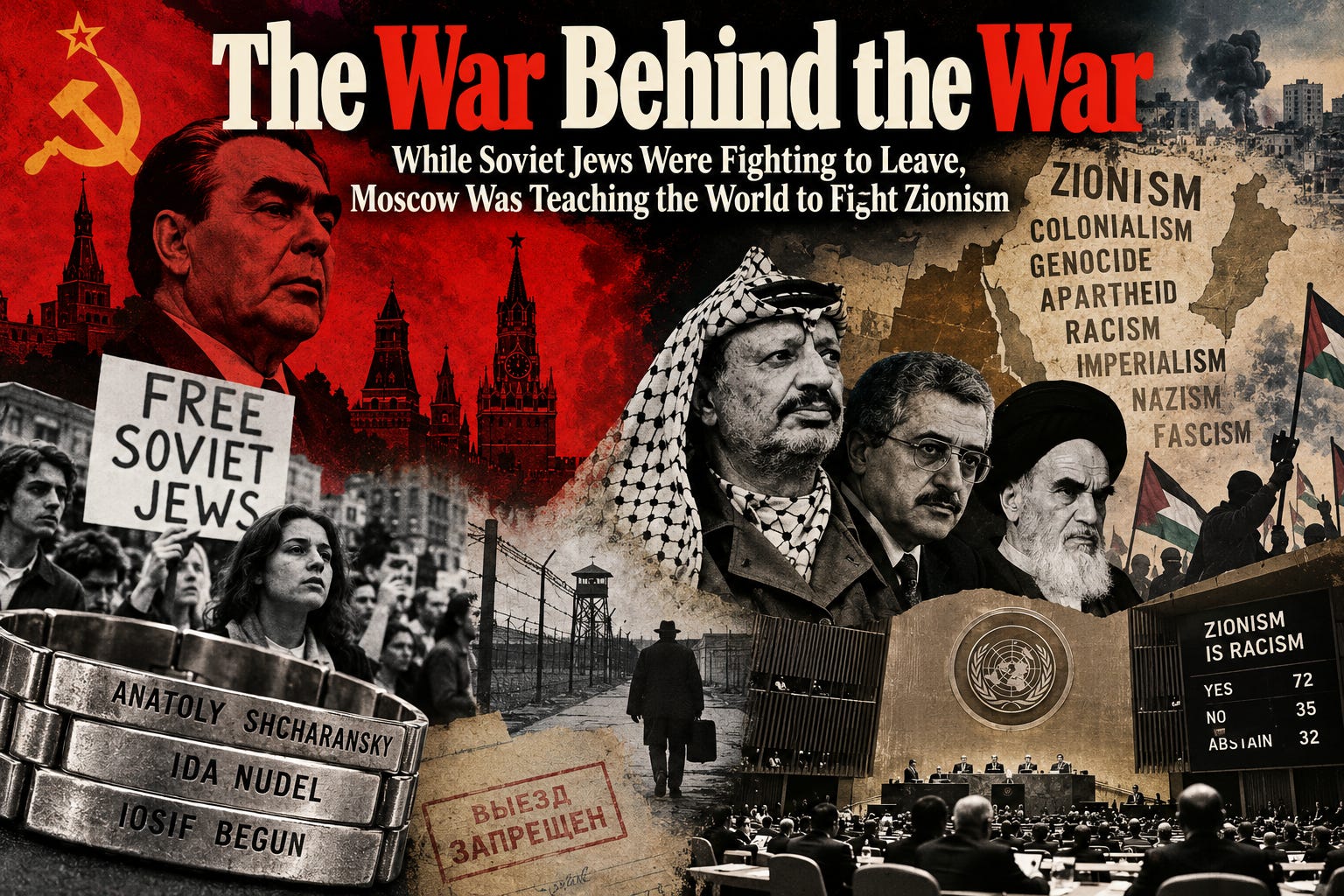
An American Jew in the 1970s could wear the name of a Soviet Jew she had never met around her wrist. The bracelets were plain…simple, usually stainless steel. Each one was stamped with the name of a refusenik…someone being denied permission to leave the Soviet Union. Some refuseniks lost their jobs after applying for exit visas while others were watched, harassed, arrested, or imprisoned. Many just wanted to get to Israel. American Jews wore their names because the Soviet government wouldn’t let them leave even though some had spent years asking for permission. Meanwhile, that same government was pumping out propaganda telling the world that Zionism was racist, colonialist, imperialist, and dangerous. And if that sounds familiar, there’s a reason for it.
This article began with a couple of questions from a subscriber. She wanted to know about the Soviet relationships with Yasser Arafat and Mahmoud Abbas, when the refusenik bracelets began, where HIAS entered the story, and how Soviet anti-Zionism eventually connected with the propaganda coming out of Iran. Arafat and Abbas weren’t selected together by Moscow in the 1960s, as the question may assume. Their Soviet relationships developed differently and years apart. And as seems to always happen when I start digging into information, following both men opened up a WAY bigger story.
The Soviet Union hadn’t always been Israel’s enemy. Moscow had actually supported the creation of Israel in 1947 and 1948, and weapons from communist Czechoslovakia helped the fledgling state survive its War of Independence. Stalin, of course, had his reasons. Britain remained a major power in the Middle East, and a Jewish state offered another way to weaken the British position there.
Israel moved closer to the West over the next several years while Moscow found opportunities in Egypt, Syria, and other Arab countries. The 1955 Czech-Egyptian arms deal delivered Egypt a huge shipment of Soviet-bloc weapons. Gamal Abdel Nasser nationalized the Suez Canal the following year, stood up to Britain and France, and became one of the most popular leaders in the Arab world. He wasn’t a communist, but he didn’t need to be. He opposed Western influence and was willing to buy Soviet weapons. Good enough for the Russians.
The Middle East had loads of oil, shipping routes, military positions, and governments Washington and Moscow were both trying very hard to influence. A 1970 American intelligence assessment said the Soviets had spent fifteen years exploiting “postcolonial resentments” and the Arab-Israeli conflict to push Western influence out of the region. As Israel grew closer to the US, it also became much more useful to Moscow as…the ultimate big bad villain.
After the Six-Day War in 1967, Moscow broke diplomatic relations with Israel and pumped weapons back into the Arab states Israel had just defeated. Moscow increasingly talked about Israel the same way it talked about Western colonial powers. The Palestinians, meanwhile, were cast as another people fighting for “national liberation.” By 1970, the Soviet propaganda machine was describing the “Palestinian cause” as an “anti-imperialist national liberation struggle” and blaming Israeli strength on imperialist powers, “above all the United States.”
Arab hostility toward Zionism had existed long before the Cold War, and Palestinian nationalism wasn’t invented in a Soviet office. What Moscow had was reach…newspapers, universities, intelligence services, diplomatic missions, publishing houses, international organizations, money, weapons, and decades of experience getting its ideas into places where they no longer looked like they had started in Moscow.
The PLO was founded in 1964 after an Arab League summit backed the creation of a Palestinian organization. Ahmad Shuqayri became its very first chairman and organized the initial Palestinian National Council. Arafat wasn’t running it yet. His Fatah movement had developed separately, and he wouldn’t take control of the PLO until 1969.