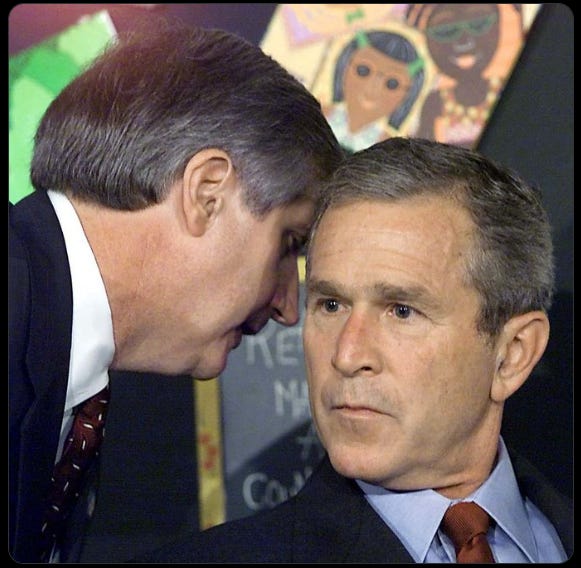
"The crisis takes a much longer time coming than you think, and then it happens much faster than you would have thought." Rudi Dornbusch
There’s the classic picture of President George W. Bush, reading a book to kindergarten children the morning of September 11, 2001, being informed by Andy Card of the attacks on the Twin Towers. The state of play in this country and the world was within acceptable parameters; and then, in one sentence, it wasn’t. The ongoing dismissal of the myriad of concerning, confusing, and potentially disastrous events by the equities markets continues to baffle and worry me, and sadly, I can’t help but wonder if — on a markets level — a similar moment isn’t inevitable.
I understand that the continued belief in AI and the companies driving it are masking some underlying negative divergences, but still…the Middle East remains a significant problem, now exacerbated by ongoing Houthi attacks on Saudi Arabia; the smart money is on a re-emergence of the hot war with Iran—the question is when, not if; and the upcoming elections promise to cause massive disarray. But yet, the market persists.
It’s the classic vicious cycle. The US economy has inflation and affordability problems; the debt markets are dealing with higher rates in a Treasury portfolio with low, low, low duration, yet the rally endures. Passive chases the high performers (read: AI), which keeps the indices high, and Investment pools, measured by performance versus the indices, need to go along for fear of AUM drops if they don’t. And so, the masters continue to run on the wheel and the mice follow the Pied Piper. Remember, the band kept playing on the deck of the Titanic.
Ok, so I have to say something about this recent Scott Bessent- Liz Warren kerfuffle. Please understand, as context, that I have an ‘allergy’ to intellectual arrogance and bullying; this might influence my reaction. But the coarsening of political and governmental dialogue is, to me, nauseating. Elizabeth Warren, whatever you think of her, is a United States Senator, one of only 50 members of the senior house of the U.S. Congress. In no world is it acceptable for the Secretary of the Treasury to address a Senator in the way that he did, including a childish ‘poke’ at her heritage. Period, full stop. I do not know him, and people I know who do tell me he is a friendly, engaging fellow. Whatever the case, insulting and bullying are disqualifying to me. Sorry, but it is
And, on a slight tangent; I uderstand that Sec. Bessent i very intelligent; e went to Yale and currently teaches there. He famously worked in London at Soros when George and Druck ‘broke the pound’. But when he left Soros and started his own hedge fund, that intelligence and trading acumen did not translate into outperformance; $5b turned into $500m in short order. That’s a 90% drop in AUM, which looks like my P.A.!! Just saying.
This will probably infuriate some readers, and I apologize, but I felt I needed to say something
**SURPRISES LAND WHERE THE CROWD IS THICKEST, AND THAT IS AI.**Seoul showed the exit. I like memory from the short side. I’M WRONG IF SK Hynix recovers Monday’s loss by October 20.**THE BOND SCARE MADE THE COVER, SO THE NEAR-TERM SURPRISE IS A RALLY.**My book needs rates high; a soft core print hurts. I’M WRONG IF core CPI prints 0.3 percent m/m or more.**THE STRAIT PAYS THROUGH FREIGHT, NOT THE BARREL.**Six ships struck and Brent fell. I like tankers from the long side. I’M WRONG IF Brent settles under $95.**THE BANK PRINTS ARE A SORT, NOT A VERDICT.**I want the funding franchise over the deposit-heavy book. I’M WRONG IF US Bancorp discloses a post-hike deposit beta under 30 percent Thursday.
I think the market spent the weekend bracing for the wrong surprise.
**THE SETUP.**Everything I read Monday was about the long end: a 30-year at 5.60, a $10.7 trillion rollover, and the Economist asking on its cover whether bonds will blow up. Then the surprises came from Seoul, from a bank income statement and from a tanker lane where oil fell anyway.**THE COVER.**Economist covers have a habit of arriving near the turn (the magazine prints the consensus, and the consensus is usually late).
The 10-year at 5.24 sits well above its long-run average near 4.5, and the two prior pushes through that line, around 1920 and 1966, ended very differently.
I hold the structural view; the case for higher long-end yields has not changed.
A third of the $32.0 trillion of marketable debt, $10.7 trillion, reprices inside 12 months into a bill curve above 4 percent, and 54 percent reprices inside three years.
The 10-year now yields more than a single-family rental, 5.1 against a 4.8 cap rate in September, the first time in more than 20 years. That is a valuation fact for every real asset priced off it.
THE SURPRISE I RESPECT. December hike odds fell to about 72 percent from the low 80s in one session with no data behind it. Gold is up, the yen is up, the dollar is off and the 10-year is 4 to 5bp lower. That reads like the front end coming out. A core print under 0.2 percent m/m on Wednesday (consensus 0.2, headline 3.7 percent y/y) is the state my book is thinnest against, and I’d rather say it now. Would a magazine cover asking whether bonds blow up land the week the 10-year rallies? It has before; that is the whole joke about covers.
THE CASE AGAINST. The rally may simply be a haven bid on a chip scare with crude down $2, and that carries no information about term premium. The other read of the hike odds is noise in a thin holiday market.
THE WAR. Iran struck six commercial vessels Sunday, the highest daily count of the war, and Houthi missiles shut Riyadh’s King Khalid International Airport through at least October 17. Brent fell 1.4 percent.
Dated Brent, the price of a physical cargo, trades near $150 against futures near $105. JPMorgan wrote last week that October looks a lot like April, when the same gap opened.
Drones hit two merchant ships off Bulgaria overnight, the second Black Sea strike in a week, and Bulgaria’s prime minister summoned the Russian ambassador (Reuters).
Diesel averages $6.28 a gallon against a record $6.53 on September 22; two wars have taken about 5 million barrels a day of refining off the market, and the Strategic Petroleum Reserve sits at 284 million barrels, its lowest since 1982 (The Dispatch).
The IMF says global oil stocks are drawing about 2.7 million barrels a day, and it kept 2026 growth at 3.1 percent (annual) while warning of the ‘limits of resilience’ (
Axios).
THE AI LEG. AI-related stocks are 49 percent of the S&P, above every bubble peak except the railroads at 63 percent in 1881.
Hyperscaler free cash flow, as a share of net income, has gone negative. Earnings are fine; the cash is going into the build.
Compute is not getting cheaper even as tokens do: H100 rental holds near $2.70 an hour.
Oracle’s five-year CDS reached 264.97bp on October 8, against 24.70 in 2020.
The IMF puts an AI reversal at 1.1 percent off global GDP and 1.8 percent off US GDP by 2028.
**Before the open, Goldman and Citi.**Goldman’s estimate was cut about 20 percent in three weeks, so the bar is low; FICC is the line. UnitedHealth and J&J also report.**10:00 ET, existing home sales.**Sellers outnumber buyers by 57.9 percent, the widest gap since 2013. A 5.2 percent 10-year is doing that.**3:00 PM, the first official curve close since Friday.**A 30-year under 5.55 is the number that changes my mind fastest.**Fed speakers all day, and the IMF meetings in Bangkok.**Cleveland’s Hammack said Monday that neutral is likely higher than the committee assumes. Any second voice saying so puts the 72 percent back toward 80.**Overnight, China’s September trade, CPI and PPI.**The memory tape will read the export line first.**Wednesday 08:30, September CPI.**The week’s real event. NFIB small business optimism printed 98.7 this morning against 96 expected, which says the small-business mood is holding even at a 5 percent 10-year.
Two of these pull against each other, and I am on the short side of one and flat the other: the memory names sold on a cost curve while Meta rallied on its own models.
**SK HYNIX, SAMSUNG, MICRON.**Down 10.09, 7.39 and 3.88 percent. CXMT plans server DDR5 on a denser cell, and Samsung’s buyback ended. Micron fell before Seoul did, so part of the move is in, and I still like the group from the short side.**JPMORGAN AND WELLS FARGO.**JPMorgan missed on securities losses with FICC down 4 percent to $5.4 billion and IB fees up 14 percent. Wells beat with net interest income up 5 percent and traded down 1.5 percent. A sort, not a verdict on banks.**META.**Up about 3.4 percent Monday after unveiling Muse Wonder, which it says beats rival frontier models. Ten stocks drove 70 percent of the rally since March 30, so one launch moves the index.
Behind the wall this morning:
THE BOOK: 13 live lines, 2 new today, each with the factor it monetizes, its size and the condition that kills it.
FINANCIALS: what the two prints mean for the bank pair, and why private credit sits at red.
FLOWS AND POSITIONING: the sentiment gauge that says buy against the breadth that says do not.
The free note is my read of the morning. Below the line is where I put my own capital around it. Subscribe at marketmusing.com.
Talk about grade inflation!