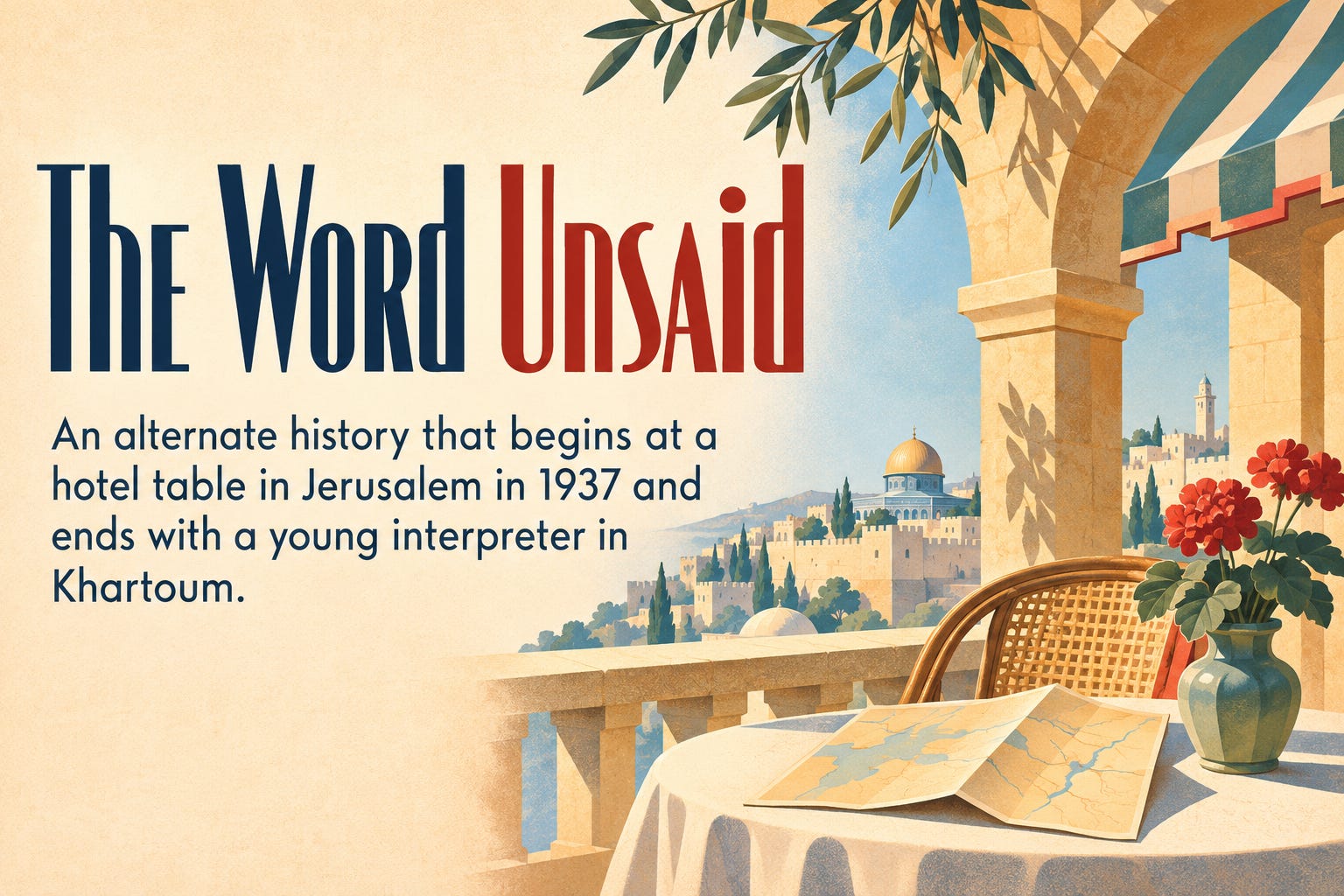
I woke up this morning with a question. What if, in 1937, Arab leaders had looked at the British plan to divide the land and said yes? I started playing it out in my head. Somewhere between a hotel room in Jerusalem and a summit in Khartoum, the thought experiment turned into a very short story about what that one word could have changed.
Raghib al-Nashashibi was sweating heavily through his wool suit when he pounded his hand flat on the map.
It was July of 1937. The room at the King David Hotel was stifling, and the ceiling fans did little to cool the air. Lord Peel’s plan lay across the table in blocks of color. The Jews would get a strip of coast and much of the Galilee. Most of the rest would join Transjordan. The British would keep Jerusalem, Bethlehem, and a corridor to the sea. Nobody in the room loved it. Haj Amin al-Husseini, the Grand Mufti, had opened his mouth, lips curling into a “no.”
“We take the land,” Nashashibi said loudly.
The room erupted, the shouting lasted for hours. Husseini called it treason. Nashashibi had the moderate mayors and the landowners behind him, men who’d done the math on a war they knew they couldn’t win. By nightfall they had sent a cable to London over the Mufti’s head. One word: Accepted.
Layla Nashashibi heard that story so many times as a girl that she could have recited it. Her grandfather always ended it the same way. “We all wanted something. I just happened to have my hand on the paper.”
She grew up on what came after. Ships landed in Haifa all through the war, and no British officer turned one around, because the Jewish state decided who came ashore. The Mufti went to Berlin and came back with nothing. Her grandfather sold wheat and olive oil to the Allied armies in North Africa and spent the postwar grants paving the road to Nablus.
Every Saturday, Layla piled in her father’s truck to the crossing at Qalqilya, where Arab and Jewish customs men stamped the paperwork under one canvas awning and split cigarettes and opinions in the shade. Buses painted blue and red-and-white sat nose to tail at the transfer station. The women selling produce switched reflexively between Arabic, Hebrew, and English mid-sentence without skipping a beat. Layla picked up all three before she was ten. She later learned that was quite an unusual way to grow up. At the time, it was just… a regular day.
In September of 1967, she sat in a glass booth in Khartoum with a headset around her neck and the Arab League’s final text laid out in front of her. Delegates from Egypt, Jordan, Syria, and Israel filled the press room below. Some of the men at the front had spent twenty years sharing aquifer charts across a kitchen table, and they looked exhausted in the way people look when a long argument is finally over.
The chairman nodded at her.
She read it aloud into the microphone. Hebrew first, then English. The declaration said yes to open borders, yes to mutual defense, and yes to an economy built across all of them.
When she finished, she realized her palm was flat against the page.