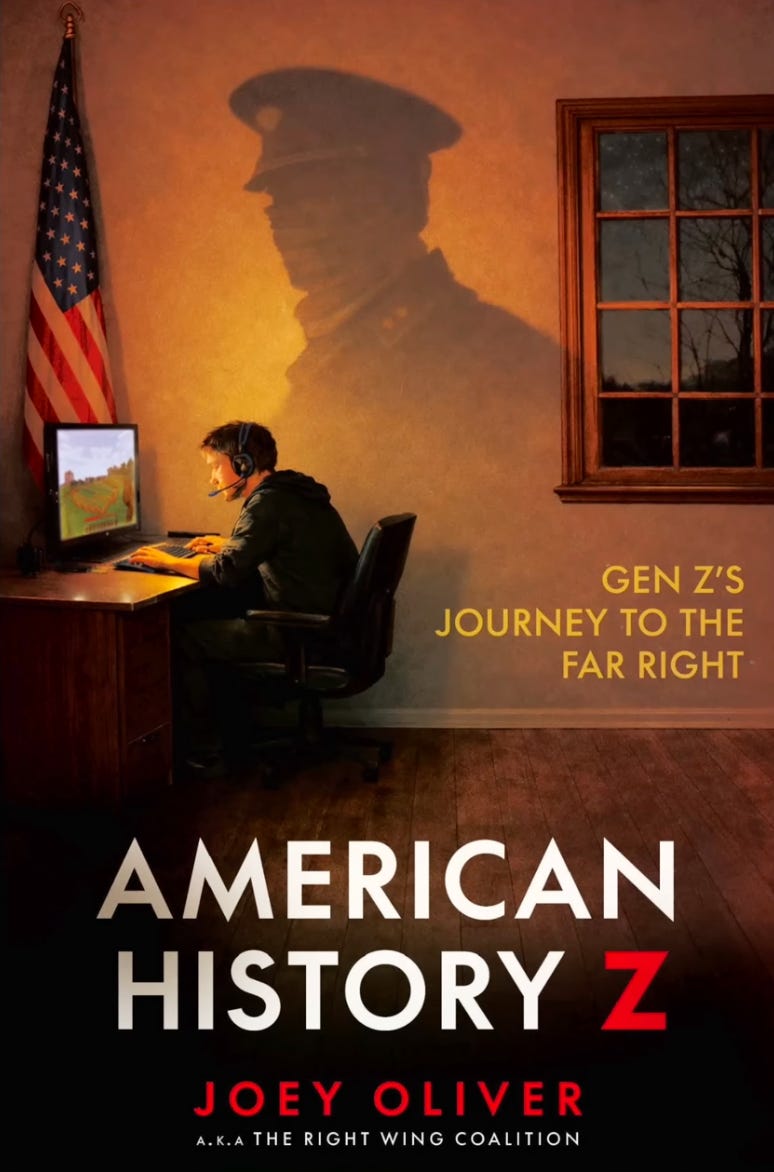
Yesterday on the flight from Birmingham to Chicago, I read a book I think is important. I don’t think it’s a good book in any sense (more on which below), but if you want to know what Generation Z white male radical right guys think, and why they think it, it’s a very accessible introduction. You are probably tired of hearing me say that people of my generation (Gen X), the Boomers, and maybe even some older Millennials are really out of touch with what this cohort thinks — you know, the “tear it all down” Zoomerwaffen. That’s why I recommend the book to you, even though I believe that this way of thinking is ultimately poisonous. Sometimes you really need to read books that are morally offensive to be aware of significant currents in our culture. That’s why you should read the book. I’m serious.
The title is * American History Z: Gen Z’s Journey to the Far Right;* the author is a Zoomer named Joey Oliver. I can’t remember where I heard about the book, but when I mentioned it to a conservative Christian friend who shares my Weimar America concerns, he told me that his son, who has become a right-wing radical and an anti-Semite, he told me this book is on his son’s shelf.
Joey Oliver currently writes from Miami. After completing his undergraduate degree at the turn of the last decade, he moved away from the Pacific Northwest to escape his liberal home state. Though he has primarily worked in real estate development since completing college, he also did a short stint at Tesla and even published a novel. In addition to his career, he is earning a Master’s degree while also writing and recording political commentary for his YouTube channel, The Right Wing Coalition.
So, the book. One line on the very first page jumped out at me. Oliver says that very few of his generation know any political theory, or can articulate what’s wrong with liberalism. He says:
All we have is feeling. But the feeling is all we need.
That line is the key to this book. It’s a deceptively powerful insight. By the end of the book, you understand one thing: these young men are full of rage, and, as I was told by a DC Zoomer last November, want to “tear it all down.” *American History Z *(henceforth, “AHZ”) is in no way an intellectual account of far-right theories that inform the political convictions of white males of Oliver’s generation. Rather, it’s a story of how and why they got radicalized.
And the thing is, they’re not wrong to be angry. Let me be clear about that: it’s not hard at all to get why they are so mad. This is something that all of us older conservatives (and moderates and liberals too) should understand. It’s important if we want to stop this radicalism, and rescue these angry young men from it.
Before I get into the substance of this book, a word about this feeling business. This is exactly the problem with most progressive activists: they too valorize feeling over thought. Sure, many of them have theories that justify their anger, but they have built an entire political movement based on their feelings. Yesterday I posted the Christian writer Brandon Showalter’s account of his frustrating conversation with a religious black woman, and how it was impossible to reason with her, because she was so full of anger that she deflected any reasonable thing he said. Similarly, Chris Rufo wrote not long about about “The Cluster B Society,” and how psychological debility has conquered our institutions. Rufo wrote:
Today, we are witnessing the emergence of something new: the “
[Cluster B society].” Like the culture of narcissism, our digital age has distinct psychological traits, heavily influenced by the[rise]of personal pathologies and the power of social media. For this generation, the cameras are always on. The audience is always watching. And the old narcissism has transformed into frenzy, moral theatrics, emotional volatility, self-indulgence, and outbursts of violence.Psychologists have captured the spirit of our modern culture in four specific psychopathologies that, together, make up the
[Cluster B]personality disorders: the narcissist, the borderline, the histrionic, and the antisocial. (They also identify Cluster A and Cluster C[groupings of personality disorders].)Narcissistic personality disorder is characterized by a sense of entitlement, obsession with one’s own importance, and deep feelings of resentment, often expressed through moral self-righteousness. Borderline personality disorder is marked by an unstable sense of identity, black-and-white thinking, feelings of emptiness, and recurring self-harm and suicide attempts. Histrionic personality disorder exhibits excessive emotionality, sexual provocation, and attention-seeking, often to serve a pathological need for sympathy. Antisocial personality disorder is typified by impulsivity, manipulation, disregard for others, and a penchant for violence and aggression that violates social norms.
This cluster of psychopathologies is no longer an individual matter, however, to be dealt with in the privacy of the analyst’s office. On the contrary, Cluster B psychological traits have begun to shape the patterns and structures of our culture. The scenes of American public life increasingly resemble a Cluster B psychodrama: victimhood replaces accomplishment as the standard of merit; accusation replaces disagreement as the means of settling disputes; false compassion becomes the primary method of manipulating citizens into compliance; and the whole scheme is enforced with the threat of violence: obey, or suffer the consequences.
AHZ is more or less what happens when Cluster B takes over the minds of young far-right white males. Remember that old Ben Shapiro line “facts don’t care about your feelings”? AHZ is a complete repudiation of that. This justification (it’s not even an argument) for white nationalism and racial consciousness is as intellectually thin as any Social Justice Warrior screed of the Left.
But see, that is why it is so powerful. It taps right into the lizard brains of anxious, hurting, furious young men, and seeks to weaponize their (often justified) feelings of betrayal. As I point out in Weimar America (which you can pre-order here), this was what Adolf Hitler understood early on about the audience he was trying to reach and recruit into a movement. Hitler’s political theories were half-baked at best, but he also knew that didn’t really matter. He was trying to capture and focus the diffuse rage and confusion of Germans of the 1920s and early 1930s, in particular their fury at the disorder and injustice that had overwhelmed their culture and society.
A digression: one thing that became clearer to me about Donald Trump after reading Regime Change was how little his movement depends on intellectual thought. No, Trump is not Hitler, but as authors Maggie Haberman and Jonathan Swan write:
But the whole episode once again demonstrated the way Trump could confound those who wanted to put him in ideological boxes or fit his actions into a coherent worldview. For all his “America First” rhetoric, contempt for Bush-era interventionism, personal irritation with Netanyahu, and the considerable risks involved, he had decided to bomb Iran anyway, and he had gotten away with it. As always, those searching for geopolitical or strategic motivations came away empty-handed.
In a 2025 interview with The Atlantic, Trump was asked about criticism from Tucker Carlson and other MAGA supporters who were then arguing that his bellicosity towards Iran was a betrayal of his “America First” ideology. Trump responded:
When I caught Donald Trump by phone this morning, the president wanted to make one thing clear: “America First” means whatever he says it does. “Well, considering that I’m the one that developed ‘America First,’ and considering that the term wasn’t used until I came along, I think I’m the one that decides that,” Trump told me.
You see? It’s all built on Trump’s feelings. This is all over Regime Change — how Trump, in this term, justifies his erratic policymaking by relying on what his gut tells him. It has now gotten him into a world of trouble with his own base — this sense of total betrayal of Gen Z white males by Trump comes at the end of AHZ — but really, the lines that begin AHZ (“All we have is feeling. But the feeling is all we need.”) is a pure distillation of Trump’s governing style.
Anyway, back to *AHZ, *which, to be fair, really does provide a mostly coherent narrative explaining the sources of the rage of the white male Zoomers who call themselves the “New Right”. Oliver begins by admitting up front that his generation loves “slaughtering sacred cows.” Why? Because, he says:
[W]e’ve discovered exactly what’s been stolen from us: our communities, our culture, our opportunities, our money, our peace, our God, our nation. Everything has been ripped away. The men of Gen Z are now rebelling against this plundering and betrayal.
(When I tell you that these exact words could have been spoken by a German man in his twenties circa 1929, please believe me. Ten years into the Weimar Republic, the sense that “everything has been ripped away” was intense for these guys — because in a very real sense, everything *had been *ripped away. That’s a story I tell in the forthcoming book, so I won’t go into it here. I only bring it up here to point out that what hit all Germans, but especially young men, hard enough to crack them open to Nazism has also struck many young American men today. It’s a softer version of it, for sure, but the feelings of disjointedness, of vulnerability, of having been robbed of a future — it’s all quite parallel.)
I’m not going to take on Oliver’s claims point by point. Again, the way to read this book is not as an intellectually deep diagnosis of his generation’s despair; as you see later in the book, some of it is so absurd as to be scarcely contestable. But that’s how it works with people (like Cluster B sufferers) who take their feelings as a sufficient and reliable guide to reality: to disagree with them is, as they see it, to attack their identity. There is no such thing as truth; there are only narratives and feelings, and an overwhelming sense of victimhood. (“The Zoomers have nothing to lose,” writes Oliver. “Everything’s already been stolen from us.”)
This is what many of us on the Right have said about the woke Left for years. Now this same pathology is blossoming on the New Right — and why not? Who said the Cluster B Society had to be only a left-wing phenomenon?
Here’s what Joey Oliver gets right, in my view. White males of his generation really did grow up in a world that told them that whites and men were to blame for pretty much all bad things in society, and certainly the suffering (real or perceived) of women and minorities. Oliver says the lie of liberalism is that individuals will be judged as individuals, and punished or rewarded according to neutral criteria, but in fact that was a scam.
He’s not wrong about that. The entire woke era testifies to the reality of what these young men see. Liberals and progressives either deny it, or say yeah, it’s real, but you privileged assholes had it coming. Many years ago, at the dawn of wokeness, I coined a phrase and concept to capture this doublespeak from the Left when they said people like me were alarmists when we warned that the policies and goals they were fighting for were going to lead to unjust and destructive outcomes. I called it “The Law of Merited Possibility: ‘It will never happen, and when it does, you bigots will deserve it.”
Joey Oliver correctly identifies the deep and real damage wokeness, in the broadest sense, did to the life prospects of white males of his generation. He accurately recalls the lies we had to all tell ourselves in order to conform to the utopianism of liberals (e.g., downplaying the wildly disproportionate black crime rates), and how conservatives failed to fight back against all this.
Here’s the thing, though: **you don’t need to become a “tear it all down” radical Rightist to fight these crackpot injustices. **I’ll come back to this point shortly.
Oliver points to a few key events that pushed his generation (of white males — this is a book for and about white males) into radicalism.
**Racial: **The Michael Brown shooting that led to the founding of Black Lives Matter, and the lies that the Left told about Brown (who, as an Obama Justice Department investigation found out, was shot trying to grab an officer’s gun). The George Floyd riots and the subsequent anti-white radicalization that pervaded institutions and popular culture. (“The Left had managed to beatify one of the most vile characters that had existed in our society. This was a man who had lived a life of crime, abuse, and chaos. He had no regard for order. For his whole life, he had served only himself, and his impulses.”) And, naturally, the perfidious Jooz.
Sexual: The triumph of transgenderism. The constant celebration of homosexuality. The feminization of everything, and the stigmatization of masculinity.
Institutional: Covid punished an entire nation, with special emphasis on the young and healthy (Oliver frames this as the Boomers saving their own lives at the expense of the Zoomers), and revealed what politicized frauds medical scientists (especially Tony Fauci) are.
Political: Trump, Our Only Hope, sold us out for Israel’s war.
The heroes of this book include: Andrew Tate, now sitting in a federal prison in Miami awaiting extradition to Britain to face rape and sex trafficking charges. Why him? Because in Oliver’s view, Tate gave his cucked generation their masculinity back. Another hero: the mental case Kanye West, for wising up to the evil of the Jews, and releasing a rap song titled “Nigga Heil Hitler.” Another: Donald Trump, until he proved to be just another Boomer sellout (he betrayed us on the Epstein Files, and with the Iran War to serve Israel. Another: Elon Musk, until he sold out for the sake of bringing more H1B workers into Our Country. Another: amateur historian Darryl Cooper, for pointing out that the lies of World War II (Churchill the Good, the truth claims of the Holocaust). And finally, the greatest hero of all: Nicholas J. Fuentes, an unstoppable Warrior for Truth.
I don’t suppose I have to tell you that this book’s treatment of these men has all the subtlety and critical nuance of a teenage girl gushing over the lead singer of a boy band. But hey, they have the feelings for the flavor of Tate, Trump (for a while), and Fuentes, and that’s all they need. Because the portrayal of these men is so gushingly propagandistic, you have to wonder what role they play in the psychology on display in AZH’s pages. One answer: they are all shameless transgressors of bourgeois liberal proprieties. And in the Tate and Fuentes cases, they became generational heroes via the Internet, which (see the book’s brilliant cover design) was the vector of radicalization.
The Internet is the key here, and not just because it allows Angry Young Men to bypass traditional gatekeepers. That’s obvious. It’s key for reasons I point out in Weimar America, and will mention tomorrow in my Touchstone conference address. From that speech (which you can watch onl…