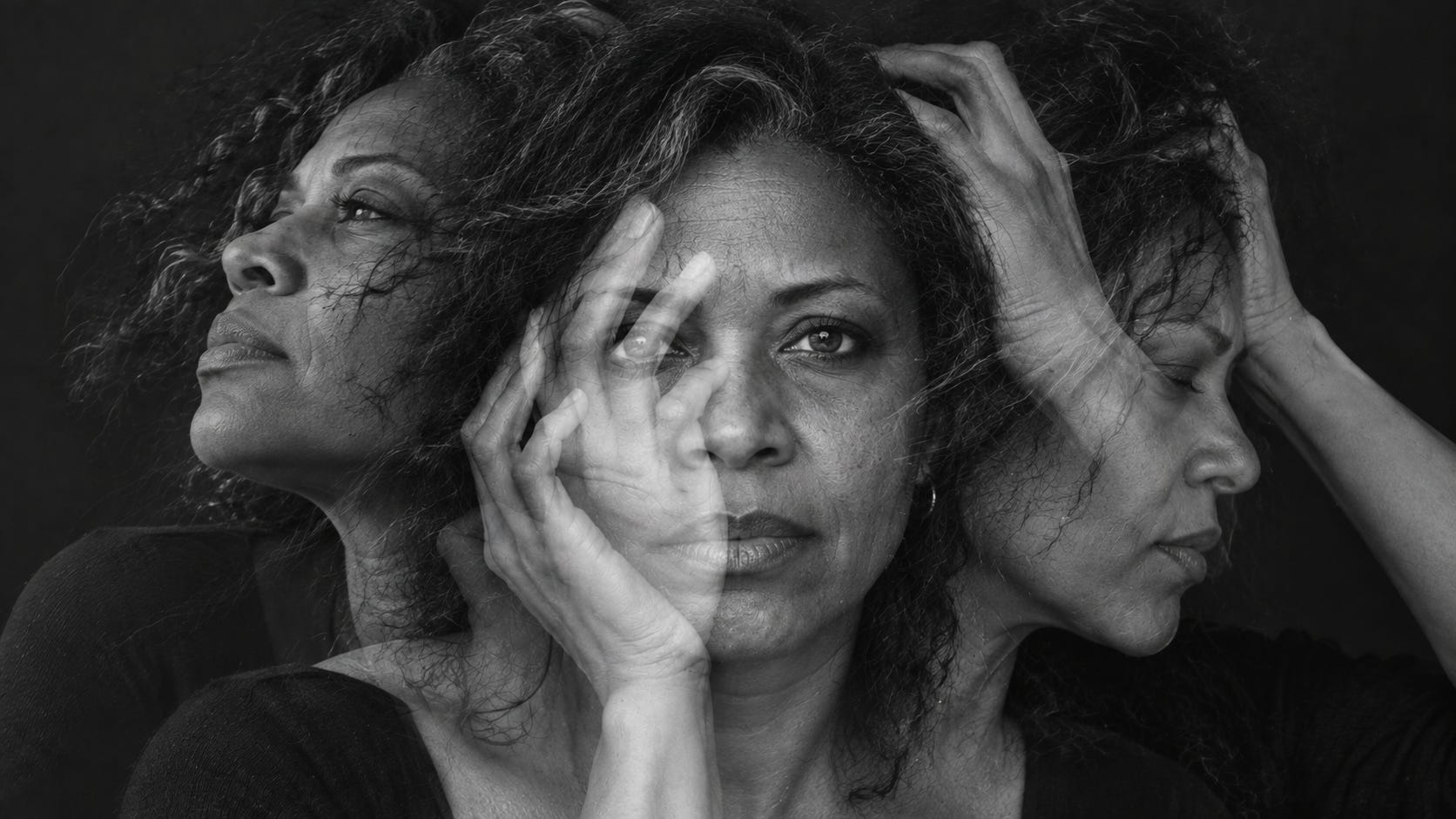
This is Part Two of The Life That Is Yours, a three-part exploration of authority, identity, and the difficult freedom of being human.
In Part One, ** Nobody Is Coming to Tell You Who You Are**, I explored what happens when inherited authorities lose their power to define us. Religion, family, culture, institutions, and the countless systems that interpret us before we learn to interpret ourselves do not simply disappear when we begin questioning them. Their voices often remain inside us, shaping what we trust, what we fear, and what we imagine we are permitted to become.
But reclaiming authority over your own life creates another problem. Once no one else has the final word about who you are, what exactly are you trying to find?
We often speak about identity as though somewhere beneath everything that has happened to us there is an authentic self waiting to be uncovered. If we could remove enough conditioning, heal enough wounds, understand our childhood, leave the wrong communities, find the right language, and become sufficiently self-aware, eventually we would arrive at the person we were always meant to be.
I no longer think a human life works that way.
There is no untouched self buried beneath history. There is no final layer of conditioning we peel away to reveal the permanent person underneath. We are formed through what happens to us and through what we do with what happens to us. We inherit identities, inhabit them, revise them, outgrow them, grieve them, and sometimes discover that the person we worked very hard to become no longer fits the life we are living.
This is where identity becomes an existential question rather than simply a psychological one. Existential health is not about achieving a perfected or permanently resolved self. It concerns our capacity to remain in relationship with reality while continuing to become someone within it.
The freedom to author your life therefore comes with an unsettling truth: the author is changing too. You will make choices that shape who you become, and the person who emerges from those choices will sometimes see the world differently from the person who made them. Life does not wait for identity to become settled before asking something of us.
There is no final version of you waiting somewhere ahead.
There is only the unfinished human being you are now, carrying everything that has brought you here and still capable of becoming otherwise.
There are versions of ourselves we once needed in order to survive. They learned the rules of the worlds into which we were born, discovered what earned approval and what threatened belonging, and figured out which questions were safe to ask. Long before we possessed the language to call any of this identity, we were already constructing one.
This is part of what it means to become human. We arrive unfinished, dependent upon other people not only for food and protection but for interpretation. Someone tells us what things mean. Families, religions, schools, communities, nations, and cultures provide categories through which we first learn to recognize ourselves.
We do not begin by authoring ourselves. We begin inside stories already underway, surrounded by people who have ideas about who we are and what our lives should become. Some of those stories give us belonging and orientation. Others place boundaries around us that we will spend years learning to see.
The difficulty comes later, when the person those worlds helped us become is no longer adequate to the life we are actually living. Sometimes the rupture is dramatic: a belief system collapses, a marriage ends, a career disappears, someone dies, or we encounter a truth about ourselves that no longer fits the story we have been telling.
At other times the disturbance is quieter. Nothing obvious has gone wrong, yet something inside us has begun withdrawing its consent. The old identity still functions in public, and we might even perform it convincingly, but privately we have begun to feel the distance between the person we have been and the life asking to be lived.
Much of adulthood happens inside this distance. We carry identities constructed under earlier conditions into realities those identities were never designed to inhabit. Eventually the familiar question, Who am I?, is joined by a more unsettling one: Who am I still trying to be because I once needed to be that person?
Modern culture gives us contradictory instructions about identity. We are told to “find ourselves,” as though somewhere beneath social conditioning there exists a finished person waiting to be uncovered. At the same time, we are encouraged to reinvent ourselves endlessly, as though identity were a lifestyle product available for redesign whenever the existing version becomes inconvenient.
Neither picture does justice to a human life. There is something in us that persists across time. Our histories matter, as do our bodies, temperaments, relationships, memories, commitments, cultures, injuries, loves, and choices. We do not awaken each morning as blank human beings with an unlimited range of possible selves.
But continuity is not completion. A human being is less like an object with discoverable specifications than a living relationship between inheritance, circumstance, choice, and time. We are shaped by what has happened to us, while also participating in what those events will mean.
This is why self-authorship should never be confused with self-invention. Self-invention imagines the autonomous individual standing outside history, constructing an identity according to preference. Self-authorship begins with greater humility because it acknowledges that none of us chose our starting conditions.
We did not select our bodies, families, languages, historical moment, early attachments, cultural categories, or most of the experiences that first taught us who we were. By the time we become capable of examining our lives, much of the first draft has already been written.
Our freedom lies neither in denying those pages nor in treating them as the entire book. It lies in developing the authority to participate consciously in what comes next, knowing that even what we write for ourselves will eventually have to answer to reality.
I understand something of this because I have lived through identities that once seemed permanent. There was a period of my life when Christianity did not merely describe something I believed. It organized reality itself.
I studied theology, went to seminary, became a pastor, preached sermons, led people, and inhabited a world in which certain answers seemed settled. That identity provided vocabulary, community, vocation, moral orientation, purpose, and a place from which to understand my own life. I was not pretending to inhabit that world. It was my world.
Leaving it was therefore never simply a matter of changing my mind about a collection of doctrines. Something more fundamental was happening. The person who had known how to exist inside that world had to learn how to inhabit a life for which many of the old coordinates no longer worked.
That experience taught me something I have encountered repeatedly in people I have worked with since. Identities are not merely ideas we hold about ourselves. They become structures of participation, shaping where we belong, whom we trust, what futures we imagine, which emotions make sense, and what explanations remain available when life becomes difficult.
This is why the familiar instruction to “just be yourself” is so inadequate. The self is entangled with entire systems of relationship and meaning. Changing our relationship to an identity sometimes changes our relationship to a family, a community, a history, a future we had imagined, and people we love.
Some identities have also protected us. The obedient child, the successful professional, the caretaker, the believer, the skeptic, the achiever, the wounded person, the strong one, or the person who never needs anyone might each have emerged as an intelligent response to particular circumstances.
There is no wisdom in despising an earlier version of ourselves merely because we have outgrown it. The problem begins when gratitude becomes obligation and we assume that because an identity once preserved our coherence, we must continue living inside it forever.
I have come to think of one form of existential distress as identity lag. It describes the distance that develops when the life we are actually living has moved beyond the identity through which we are still interpreting it.
Reality has changed. Experience has taught us something. Our relationships have shifted, our values have deepened, or our understanding has expanded, yet our internal account of who we are has not caught up. We continue interpreting the present through a version of ourselves formed under conditions that no longer exist.
A person might have stopped believing years ago but still experience doubt as moral failure. Someone who spent decades caring for everyone else might finally have the freedom to choose differently but feel guilty whenever their own life becomes visible. A childhood shaped by constant vigilance can leave someone living in relative safety while still organized around danger.
An identity built around achievement can carry a person all the way to the summit, only to reveal that the self who once wanted to arrive there no longer exists in quite the same way. The accomplishment is real, but the identity that gave it meaning has changed somewhere along the climb.
None of this means the previous identity was fraudulent. It means identities are historical. They arise within circumstances, relationships, necessities, and interpretations that belong to particular periods of our lives.
The difficulty is that identities often continue enforcing agreements made under conditions that have disappeared. What began as adaptation becomes allegiance. We remain faithful to earlier versions of ourselves long after the realities that produced them have changed.
This is one reason freedom sometimes arrives as anxiety rather than relief. Freedom removes more than constraints; it also removes explanations. The old identity told us who we were supposed to be, and when it weakens, possibility returns carrying the uncomfortable weight of responsibility.
After a major transformation, there is an understandable temptation to believe we have finally arrived. We escaped one inadequate identity, endured the uncertainty of leaving it, and found language that seems more faithful to our experience. It is natural to want the new ground to remain still beneath our feet.
People who leave religion sometimes replace the believer identity with the identity of the deconstructed person. Someone who has spent years recovering from trauma might eventually organize life around being a survivor. A person liberated from an oppressive social expectation might discover a community whose language initially feels like oxygen and later find that the same language has begun placing new boundaries around what is permissible to think.
This does not make those identities false or unimportant. Naming ourselves matters. Categories help us recognize experiences that were previously unintelligible, while shared identities make solidarity and belonging possible. People who have lived in isolation often discover through such language that their experience was neither private failure nor personal madness.
The danger appears when identity becomes so central that we begin protecting it from information. We notice what confirms it, interpret ambiguity through it, build relationships around it, and gradually become less available to experiences that complicate the story.
An identity that once helped us see something eventually becomes capable of preventing us from seeing anything else. The window through which we looked at the world becomes the world itself. I discuss this further in the article, ** When the Window Becomes the World**.
This is not primarily a religious problem. It is a human one. We need coherence, and identities provide it by gathering thousands of experiences into a manageable story about who we are and where we belong.
The trouble begins when preserving the story becomes more important than remaining in contact with reality. At that point we are no longer using identity to participate in life. We are asking life to protect our identity.
I see this tension increasingly in contemporary healing culture. Psychological language has been profoundly liberating for many people, giving names to experiences that were previously dismissed as weakness, sin, dysfunction, or personal failure. I address this further in the article, ** Healing is the New Religion: How Wounding Replaced Sin and Recovery Replaced Salvation**.
Concepts such as trauma, attachment, boundaries, nervous-system regulation, abuse, and relational patterns have given people ways to understand suffering that once remained confusing or invisible. There is genuine human value in finally having language for something that has shaped your life without your understanding.
Yet every emancipatory vocabulary eventually faces the same test. Will it remain a tool for encountering reality, or will it become another system for organizing reality in advance?
There is a meaningful difference between understanding what happened to us and constructing a permanent identity around what happened to us. There is also a difference between recognizing an adaptation that once protected us and assuming that adaptation defines the perimeter of who we will always be.
Healing itself sometimes acquires an imagined destination: a future self who has resolved the contradictions, processed the wounds, established the right boundaries, understood every trigger, regulated every emotion, and become secure enough to escape the ordinary instability of being human.
The pursuit of that final healed self easily becomes another form of self-rejection. The person we are today remains perpetually provisional, valued mainly as raw material for the improved person who is supposed to arrive after enough work has been done.
My work in existential health begins from a different premise. The question is not how we eliminate the unfinished character of human life, but how we develop the capacity to inhabit it without abandoning ourselves whenever life becomes uncertain.
A healthy identity is therefore neither rigid nor formless. It gives us somewhere to stand without convincing us that we have found the only place from which life is intelligible. It offers enough continuity for responsibility and commitment while remaining permeable enough for reality to teach us something new.
This brings us back to the question of authority. Identity asks who I understand myself to be, while authority concerns who gets to participate in deciding what my life will become.
For much of human history, identity was heavily assigned. Family, religion, gender, class, race, nationality, profession, and local community established powerful boundaries around the lives people were expected to inhabit. Those structures have not disappeared, but many have weakened, fragmented, or become open to challenge.
The result has been an extraordinary expansion of personal freedom, accompanied by a burden that modern discussions of liberation sometimes underestimate. When inherited structures lose their unquestioned authority, decisions that were once made elsewhere increasingly return to the individual.
We are left to decide what we believe, what constitutes a meaningful life, which relationships deserve our commitment, how we understand our bodies, where we belong, what success means, and what obligations we have to other people. Self-authorship is difficult precisely because these questions do not arrive with answer keys.
The danger is confusing reclaimed authority with certainty. Human aut…