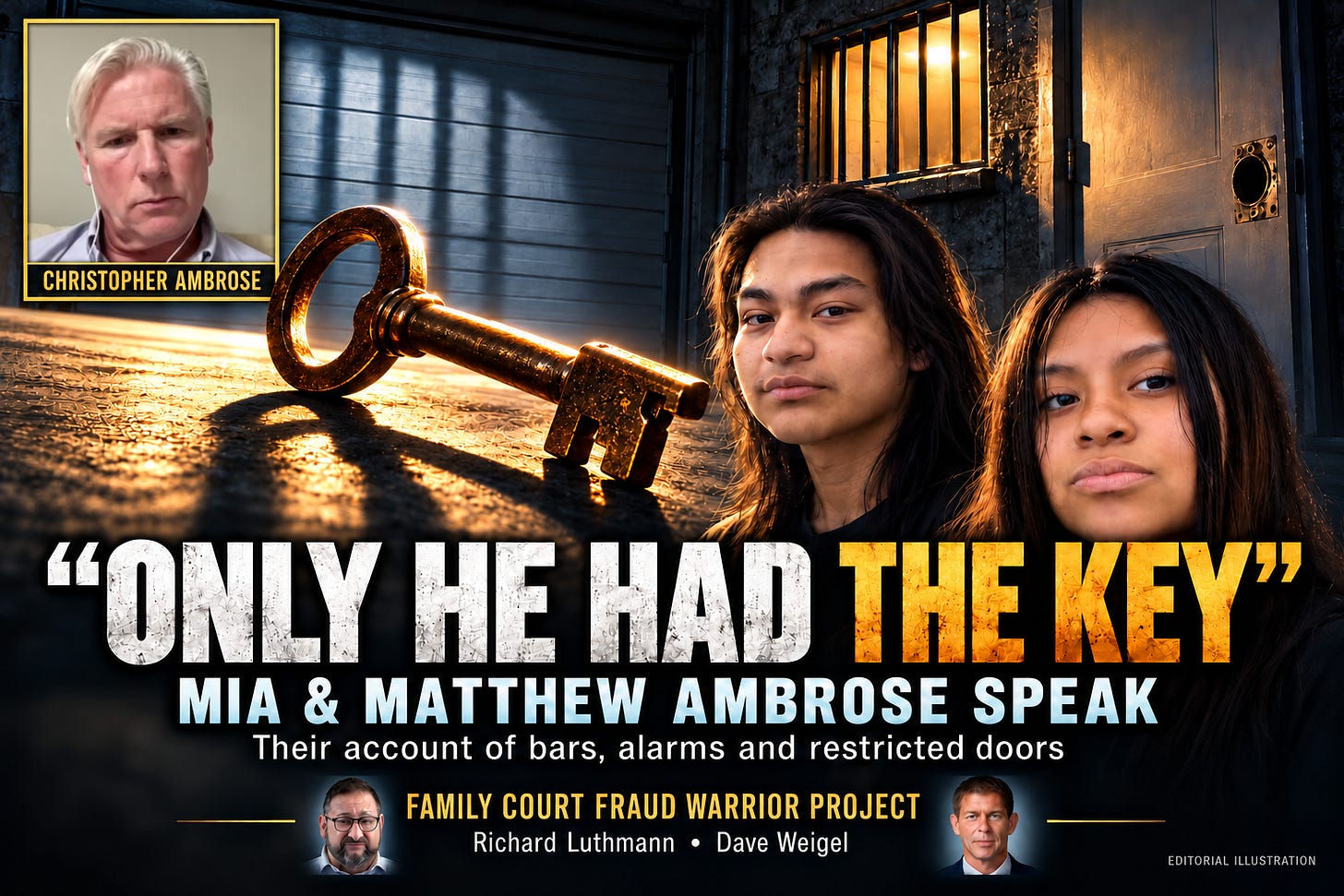
LUTHMANN NOTE: I have reported on this case for years, but Mia and Matthew’s presence gives this conversation a force another stack of filings can't match. They describe the experience of asking for protection while adults argued over whether their words belonged to them. Their allegations deserve scrutiny, and the decisions made around those allegations deserve scrutiny just as serious. Dave Weigel keeps pressing the question of accountability: who answers when a professional’s judgment shapes a child’s life? These young adults are explaining what those judgments meant to them. Their voices belong in the public record, where the people and institutions they describe can answer.
Mia and Matthew Ambrose say they repeatedly asked adults for help and were sent back to a home where they felt unsafe. Now 19, they are explaining those experiences themselves.
00:00:00 Opening theme00:01:33 Dave Weigel opens the program00:12:59 Richard Luthmann introduces the case00:22:42 Mia and Matthew join the conversation00:23:19 Denials and the 2022 custody findings00:26:12 The siblings introduce themselves00:28:07 Early experiences and concerns at home00:33:54 Guardian ad litem and professional fees00:41:00 DCF, hospitals, and requests for help00:50:32 Attorney Curley and the DCF correspondence00:52:16 Mia corrects the allegation being discussed00:54:12 Police encounters and retrieving belongings01:00:02 Leaving Connecticut and the police audio01:04:30 Dr. Bandy Lee01:07:13 Investigator Manuel Gomez01:09:54 Doorknobs, privacy, and restrictions01:16:48 Recovery and life after leaving01:18:13 Reporting and Frank Parlato01:23:57 Mia’s letter to Judge O’Neill01:29:40 Matthew’s published account01:34:20 Earlier Mia interview replay01:36:23 Benefits and financial allegations01:46:27 Responses to people who helped01:48:06 Washington advocacy01:49:08 A platform for other young adults01:50:48 Dave Weigel’s closing discussion02:00:29 Outro
In this extended Family Court Fraud Warrior Project conversation, host Dave Weigel and investigative journalist ** Richard Luthmann** examine the Riordan–Ambrose case through the siblings’ accounts of alleged abuse, isolation, custody proceedings, and attempts to obtain protection. Luthmann follows the chronology and questions the guests about specific events. Weigel brings his own family-court experience and financial background to a forceful discussion of professional accountability and the incentives surrounding prolonged litigation.
The interview moves beyond the familiar language of a “custody dispute.” Mia and Matthew describe what they say happened inside Christopher Ambrose’s home, what they reported to adults, and how those adults responded. They discuss restrictions on privacy and communication, encounters with police and Connecticut’s Department of Children and Families, and their frustration with decisions made without the meaningful participation they wanted.
Four accompanying clips capture different parts of that account:
**The Warning Signs at Home:**Mia describes unsettling comments about pets, missing doorknobs, monitoring, and the growing discomfort that she says preceded later abuse. Her account explains why she began feeling unsafe before she had the language or opportunity to describe everything that concerned her.
**The News That Made Them Freeze:**Matthew recalls hearing that Christopher was coming to Rhode Island after the siblings had left Connecticut. He describes becoming so nervous that he felt frozen, offering a brief but striking account of what that news meant to him.
**When Reporting Abuse Means Losing Custody:**Weigel challenges how institutions respond when children and parents report abuse. The excerpt captures his argument that the response itself can become another source of fear, alongside the interview’s discussion of how difficult it was for the siblings to seek help.
**“We Weren’t Allowed to Have Phones”:**An earlier interview with Mia, replayed during this program, addresses alleged abuse and restrictions on communication. The archival exchange includes Luthmann and Michael Volpe and provides context for the siblings’ continuing public advocacy.
The full conversation also examines the guardian-ad-litem representation the siblings remember, a substantial bill discussed on screen, Mia’s efforts to retrieve her identity documents after leaving, and her allegation that benefits continued to be claimed using a household description that included her.
Mia and Matthew identify people they believe tried to help, including attorney Michael Curley, Dr. Bandy Lee, investigator Manuel Gomez, and journalists covering the case. They discuss the importance of that attention and the pressure they say followed assistance or public criticism.
Their accounts form part of a longer public record, including Mia’s published 2023 request for protection and Matthew’s account following the return from New York.
Christopher Ambrose denies the abuse allegations. A 2022 Connecticut custody decision awarded him sole custody and stated that abuse allegations had not been substantiated, while noting determinations of coaching. That history is discussed at the beginning of the interview and summarized in the September 30, 2026 federal ruling in * Ambrose v. Parlato*. Mia and Matthew challenge the account that their statements resulted from coaching.
The program closes with independence and advocacy. Mia discusses speaking in Washington and finding a purpose beyond her own case. Matthew explains why young adults need a place where they can tell their stories safely and decide what they want shared.
Watch the full conversation, examine the linked reporting, and share the siblings’ accounts with their context intact.
Follow: FCFWP · Richard Luthmann · The Family Court Circus
Contains discussion of alleged child abuse, past mental-health distress, substance use, and strong language.
Thank you to everyone who tuned into my live video! Join me for my next live video in the app.