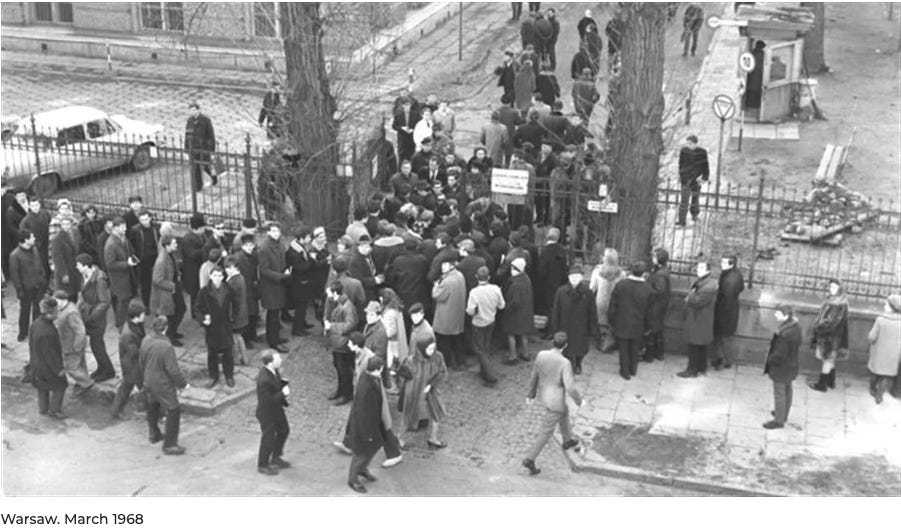
Twenty-three years after Auschwitz was liberated, Polish Jews were packing their suitcases again. They were professors, doctors, journalists, military officers, actors, students, engineers, civil servants, and families whose roots in Poland went back generations. Some had survived the Holocaust. Some had fought in the Polish army. Some had returned after the war, rebuilt careers, raised children, and tried to make lives in a country where entire Jewish neighborhoods had disappeared.
Poland had been home to one of the largest Jewish civilizations in the world, built over nearly a thousand years. I wrote about that history in:
By 1968 the Polish communist government had found a word that could cover almost any of them. It could describe someone who supported Israel or had relatives there. It could be attached to a professor who criticized the government, a journalist who had fallen out of favor, or a party official someone wanted pushed aside. A person didn’t even have to consider himself one. The word was Zionist.
In June 1967 Israel fought the Six-Day War against Egypt, Syria, and Jordan. The Soviet Union had armed and backed the Arab states, and Moscow’s allies across Eastern Europe followed its political lead after Israel’s victory. Poland broke diplomatic relations with Israel. Some Polish Jews were happy Israel had survived.
On June 19 Władysław Gomułka, the leader of communist Poland, stood before a trade union congress in Warsaw and spoke about Jews who had celebrated Israel’s victory. He warned of a “fifth column” inside Poland and suggested that people who felt greater loyalty to Israel should leave.
About three million Polish Jews had been murdered during the Holocaust. The people now being questioned about their loyalty included survivors and their children. They had Polish birth certificates, Polish educations, Polish jobs, Polish military records, and Polish addresses. Still, the government began looking more closely at their ancestry.
Jewish officers and others suspected of sympathy for Israel were removed or demoted in the military. Party officials came under scrutiny. Security services gathered information about citizens of Jewish origin, including people who had been detached from organized Jewish life for years. Whether someone actually belonged to a Zionist organization was becoming less important than what the government could find in a family tree or personnel file.
There was another fight happening inside Poland’s Communist Party. Interior Minister Mieczysław Moczar had built a nationalist faction known as the “Partisans,” many of them men with wartime resistance credentials who wanted greater influence inside the government. Removing officials branded as Jewish or Zionist created vacancies for other people to fill. Antisemitism and political ambition worked quite well together.
Even some communist leaders thought Gomułka had gone too far with “fifth column.” The phrase was removed from the published version of his speech. Everyone who had listened to the speech had already heard it.