Armed men descended on Safed. This is 1834; Jews had been living in this city for centuries. The armed men didn’t care. They broke into homes, destroyed synagogues, stole property, and obliterated Israel Bak’s Hebrew printing press. This wave of violence went on for weeks, leaving families hiding wherever they could and a community struggling to recover from the aftershock.
The region was in the throes of a revolt against Egyptian rule. The Jews of Safed had nothing to do with the rebellion, but they were the targets anyway. At that point, nothing could be blamed on Zionism; there wasn’t yet a Zionist movement. There was no Jewish army fighting for control of the country, and certainly no Jewish state yet.
Safed’s Jews were attacked yet again just four years later, in another uprising against Egypt.
Israel Bak was still rebuilding his life. An injury to his foot had left him with a permanent limp, and the printing business he’d established to supply Jewish communities with Hebrew books had been absolutely destroyed.
In 1838, Druze rebels fighting Egyptian rule entered Safed and decimated its Jewish quarter. The Jewish traveler Louis Loewe, who later worked for British philanthropist Moses Montefiore, described terrified residents and Arab attackers demanding money. Families hid while rioters entered their homes and carried off their belongings. Some local Muslims sheltered Jewish neighbors, but there was no organized force capable of stopping the raiders.
Safed had also been devastated by the earthquake of January 1837, which killed thousands and destroyed much of the city. After the second assault, Bak moved to Jerusalem and established another printing business.
Hebron’s Jews were attacked during the 1834 rebellion, too. This time the attackers were Egyptian soldiers. They had been sent to stop the uprising, and instead of leaving the Jewish community alone, they broke into homes and looted Jewish property. These families had taken no part in the rebellion, yet they were robbed by the very soldiers sent to restore order.
Hebron, Safed, Jerusalem, and Tiberias were known as Judaism’s Four Holy Cities. Jewish life in Jerusalem and Hebron stretched back thousands of years, while Safed and Tiberias had been important centers of Jewish religious life for centuries. Wars, massacres, earthquakes, and expulsions had driven Jews from their homes time and again, but they kept returning and rebuilding. By 1834, all four cities had established Jewish communities, with families maintaining synagogues, schools, shops, and cemeteries, just as generations before them had done under earlier rulers. They lived alongside Muslim and Christian neighbors, trading and working together, and sometimes relying on one another for protection.
When armed men entered a Jewish neighborhood, a family might survive because a neighbor opened a door or an official intervened. Others hid until the attackers left. Government troops often arrived way after the damage had been done.
By the 1880s, Jews fleeing the Russian Empire were arriving in Ottoman Palestine to establish farms. They had escaped pogroms in Europe, where mobs invaded Jewish homes, wrecked businesses, and assaulted residents following the assassination of Tsar Alexander II in 1881. Most emigrants went to America and other countries. Fewer chose their ancestral homeland.
Some believed agriculture would give Jews greater control over their livelihoods. Others were drawn by religious attachment or the growing movement for Jewish national renewal. Many arrived with savings and tools but little experience farming in the Middle East.
Petah Tikva had been founded in 1878 by Jews from Jerusalem. Rishon LeZion, Rosh Pina, and Zikhron Ya’akov followed in 1882, with Gedera established two years later. Land was purchased under Ottoman law, although some transactions led to disputes with tenants and herders who had previously used the property.
The farmers had to dig wells, clear fields, and plant crops in unfamiliar soil. Malaria killed settlers, while drought and failed harvests emptied family savings. Baron Edmond de Rothschild financed vineyards, equipment, and agricultural training, keeping several settlements afloat.
Livestock wandered into cultivated fields, animals were stolen, and crops were destroyed. A stolen horse could leave a farmer without the animal needed to plow or haul supplies. Some settlements hired Arab and Circassian watchmen who knew the countryside and had experience dealing with neighboring villages.
Others employed Jewish guards familiar with local customs. At Petah Tikva, Daud abu Yusuf, a Jew from Baghdad, and Ya’qub bin Maymun Zirmati, a North African Jew living in Jaffa, were among the early watchmen. Both spoke Arabic and had experience trading with Bedouin communities.
A watchman might spend the night patrolling fields, searching for stolen animals, or confronting intruders. Some disputes ended through negotiation. Others left farmers beaten and property destroyed.
In March 1886, a confrontation between Jewish farmers from Petah Tikva and Arabs from the neighboring village of Yahudiya turned into an assault. The dispute concerned grazing rights on cultivated land. Several Jews were injured, and an older Jewish woman died afterward.
Legal ownership sometimes conflicted with longstanding grazing practices. The Jewish writer Ahad Ha’am criticized settlers who mistreated Arab residents after visiting Palestine in 1891. Jewish farmers also faced theft, threats, and assaults that could destroy their livelihoods.
Ottoman police couldn’t guard every settlement. Younger Jewish immigrants began arguing that the farms needed trained, armed guards answerable to the people they protected.
Israel Shochat arrived from the Russian Empire in 1904. He had grown up while Jews were organizing self-defense against pogroms and believed the agricultural settlements needed the same approach.
In September 1907, Shochat met with Yitzhak Ben-Zvi, Alexander Zaïd, and several companions in Jaffa. They founded Bar-Giora, named for Simon bar Giora, a Jewish commander who fought against Rome during the revolt in Judea. Their goal was to replace hired guards with Jews trained to protect the settlements.
At Sejera, a farm in the Lower Galilee, Bar-Giora secured a contract to provide security. Its members spent their nights patrolling fields, watching livestock, and learning to handle rifles and horses. The work was dangerous and poorly paid, but it gave them experience.
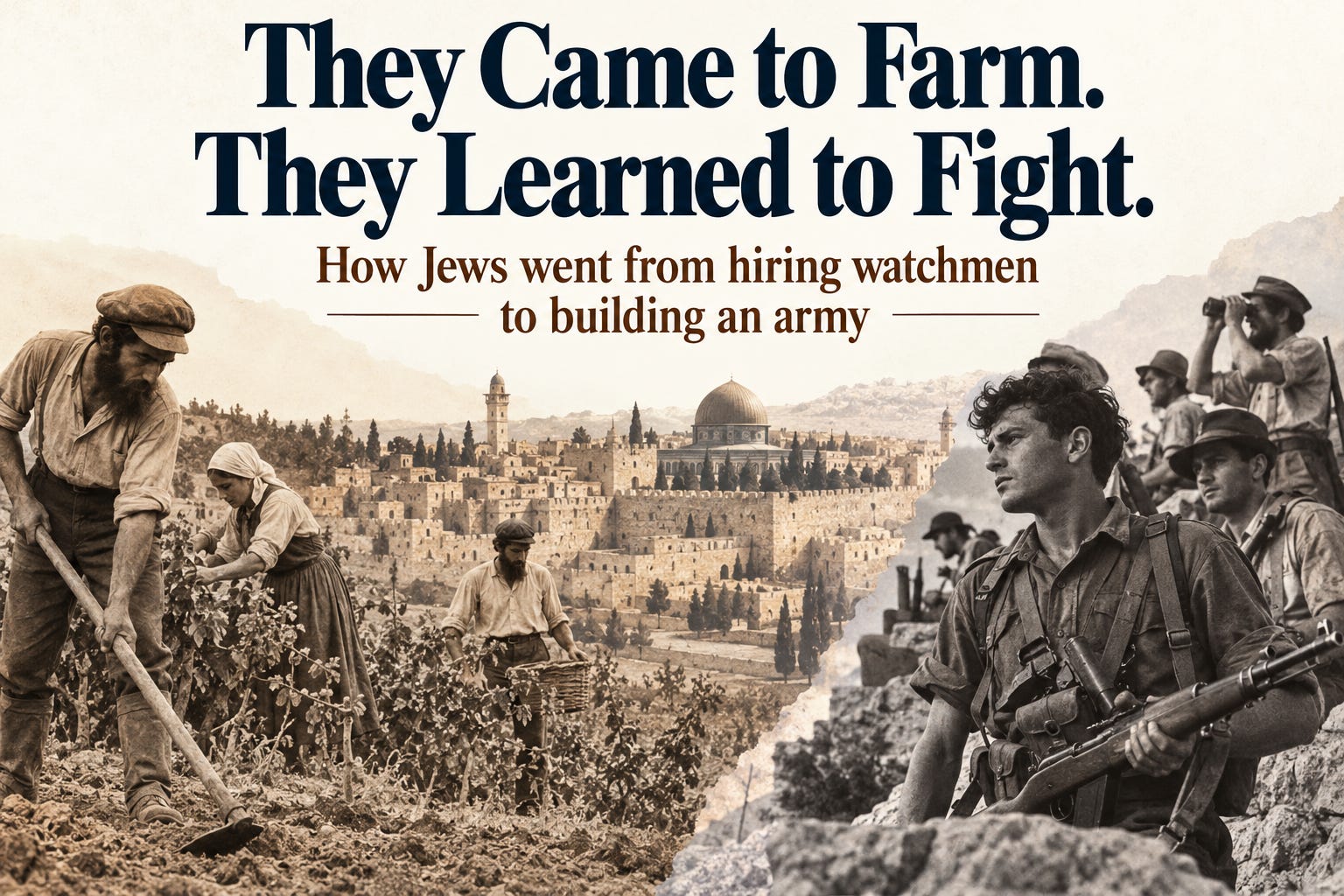
On April 12, 1909, Bar-Giora’s members founded Hashomer, The Watchman, at Kfar Tavor. The organization recruited guards, negotiated contracts, and helped members obtain horses and weapons. Some farmed during the day and patrolled at night.
That same day, two Jews were killed near Sejera. Israel Korngold had come from the Bialystok region, while Shimon Malmud was a carpenter from Minsk who had brought his wife and child to Palestine. Their deaths followed an earlier confrontation where an Arab man had been wounded and later died. Malmud left behind a widow and child.
By 1914, Hashomer had about forty full members and fifty candidates. Its guards protected farms across the Galilee, but they couldn’t defend the Jewish neighborhoods of Jerusalem, Jaffa, or Hebron.
The First World War ended Ottoman rule in Palestine. British forces conquered the country, and the Balfour Declaration of 1917 committed Britain to supporting a Jewish national home while protecting the civil and religious rights of the non-Jewish population.
Arab political leaders opposed Jewish immigration, land purchases, and the prospect of Jewish sovereignty. Some organized petitions and demonstrations, while others encouraged hostility that erupted into attacks on Jewish residents.
In April 1920, Jerusalem filled with pilgrims for Nebi Musa, an annual Muslim festival. Arab nationalist leaders used the gathering to campaign against the Balfour Declaration and demand that Palestine become part of an independent Arab Syria under Emir Faisal.
Among the speakers were Musa Kazim al-Husseini, Jerusalem’s mayor, and Aref al-Aref, a journalist and Arab nationalist. Haj Amin al-Husseini, a young member of the same influential Jerusalem family, also participated in the agitation. British officials had received warnings before the festival, but the procession went ahead.
On April 4, Arab rioters attacked Jews in Jerusalem’s Old City. Men were beaten in the streets, homes invaded, and shops looted. The assaults continued for several days, leaving five Jews dead and 211 wounded. Four Arabs were also killed, and thirty-three were injured.
Ze’ev Jabotinsky had helped organize Jewish volunteers to protect Jerusalem, but they couldn’t reach many residents trapped inside the Jewish quarter. British authorities arrested him after the riots and sentenced him to prison before granting him an amnesty.
Haj Amin al-Husseini fled to Syria. A British military tribunal convicted him in absentia of incitement to revolt and sentenced him to ten years in prison. High Commissioner Herbert Samuel later pardoned him and appointed him Mufti of Jerusalem in May 1921. In 1922, al-Husseini became president of the Supreme Muslim Council, gaining control over influential religious institutions and funds.
In June 1920, Jewish leaders formed Haganah, The Defense. Hashomer dissolved, and some members joined the new organization. Haganah began organizing local units, collecting weapons, and training volunteers to protect settlements and neighborhoods.
Less than a year later, Arab rioters attacked Jews in Jaffa.
On May 1, 1921, rival Jewish political demonstrations clashed in the city. Arab crowds soon turned on Jewish residents, breaking into homes and shops, assaulting people in the streets, and looting businesses.
Among those murdered was Yosef Haim Brenner, a Hebrew writer who had arrived in Palestine in 1909. Brenner had spent years writing about Jewish life and the hardships facing immigrants. On May 2, he and five companions were killed at a house outside Jaffa.
The attackers also invaded a hostel housing newly arrived Jewish immigrants. An Arab crowd broke down the doors, and thirteen Jews were killed. British investigators later found credible evidence that police had fired at the building’s windows during the assault.
Arab groups raided agricultural settlements, including Hadera and Rehovot, although the farmers had played no part in the Jaffa demonstrations.
The British appointed Chief Justice Thomas Haycraft to investigate. His commission found that Arabs had begun the wider fighting and had been the aggressors. It also uncovered serious crimes committed by policemen, some of whom participated in attacks while others refused to intervene. Members of the Jaffa police were convicted of homicide, theft, attempted rape, and unlawful wounding.
Dr. Beadles, Jaffa’s principal medical officer, described Jewish victims whose bodies had been struck repeatedly. He had served during the war and treated terrible injuries, but the wounds he encountered in Jaffa shocked him.
False rumors that Jews had killed Arabs in Jaffa instigated raids on Jewish agricultural settlements. The attackers saw no difference between families who had lived in Palestine for generations and recent immigrants. Religious Jews, secular Jews, Russians, Algerians, and longtime residents were all targeted and attacked.
Nearly two months after the riots, two British commissioners encountered Arab children marching through Jaffa’s Ajami quarter, waving sticks and branches while shouting that they wanted to fight Jews. The children were little…only six or seven years old. Several policemen watched without intervening.
Haganah expanded its training, but its volunteers were scattered across towns and agricultural settlements. It still lacked the manpower and equipment to protect every Jewish neighborhood.
Hebron’s Jewish families had lived in the city for centuries, maintaining synagogues, schools, businesses, and homes near the Cave of the Patriarchs. Some had close relationships with Arab neighbors whose families they had known for generations.
In September 1928, British police removed a temporary prayer screen Jewish worshippers had placed at the Western Wall for Yom Kippur. Muslim authorities objected to the screen as a change in the arrangements governing the site. Jewish leaders protested, and the dispute became the center of a religious campaign.
Haj Amin al-Husseini was now Grand Mufti of Jerusalem and president of the Supreme Muslim Council. Under his leadership, the council accused Jews of planning to seize Al-Aqsa Mosque, beginning with the Western Wall.
On October 8, 1928, the council sent British authorities a memorandum claiming that Jewish demands at the Wall were the first stage of a plan to take possession of Al-Aqsa. It warned that Muslims would resist any change and suggested that Jews would bear responsibility for the reaction their demands provoked.
The accusation was, of course, completely fabricated. The Jewish National Council publicly denied any intention of interfering with Muslim holy places. In November 1928, it affirmed Muslim religious rights while insisting that Jews also had the right to worship at the Western Wall.
Al-Husseini’s campaign continued through newspapers, religious gatherings, and organizations formed to defend Muslim holy places. Jewish demands concerning prayer at the Wall were used as evidence of a plan to seize Al-Aqsa and the Dome of the Rock.
By August 1929, rumors about Jewish intentions toward Muslim holy places were circulating widely. Demonstrations at the Western Wall heightened the confrontation, and outrageous lies about Jewish attacks on Muslims spread through Arab communities.
On August 23, Arab rioters attacked Jews in Jerusalem. The following morning, mobs invaded Jewish homes in Hebron.
The attackers beat, stabbed, and murdered men, women, and children. Families whose ancestors had lived in the city for generations were killed over accusations concerning holy places in Jerusalem.
Eliezer Dan Slonim, a young Jewish banker and member of Hebron’s municipal council, had opened his home to people seeking shelter. The attackers broke in and murdered Slonim, his wife Chana, their young son Aharon, and many of those hiding with them. Their younger son Shlomo survived with a serious head injury.
By the time the massacre ended, 67 Jews were dead. Homes and synagogues had been looted, and children were left without parents.
Some Arab neighbors risked their lives to hide Jewish families, while others joined the killers. British police officer Raymond Cafferata intervened during the massacre, but the authorities had failed to stop the mobs before dozens were murdered.
The surviving Jews were evacuated from Hebron, leaving behind their homes, businesses, and synagogues.
The Shaw Commission investigated the killings and the religious campaign that preceded them. Its report held al-Husseini partly responsible for the agitation that had turned the Western Wall dispute into a confrontation over Muslim holy places.
Five days after the Hebron massacre, Arab mobs attacked Safed.
Captain Faraday, the British police officer responsible for the town, had heard false rumors circulating before the assault, including claims that Muslims were being slaughtered in Jerusalem. He testified that a local official identified as Nassouk had spread such stories and that he had threatened the man with imprisonment.
Subhi Khadra, an Arab political activist, had visited Safed before the massacre and was identified as an agitator. A Muslim procession moved through the city, with demonstrators declaring their readiness to defend their religion by force.
On August 29, Arab rioters invaded Safed’s Jewish quarter. They set houses and shops on fire, murdered residents, and wounded others. Rabbi Ishmael Cohen and members of the Afriat family were…