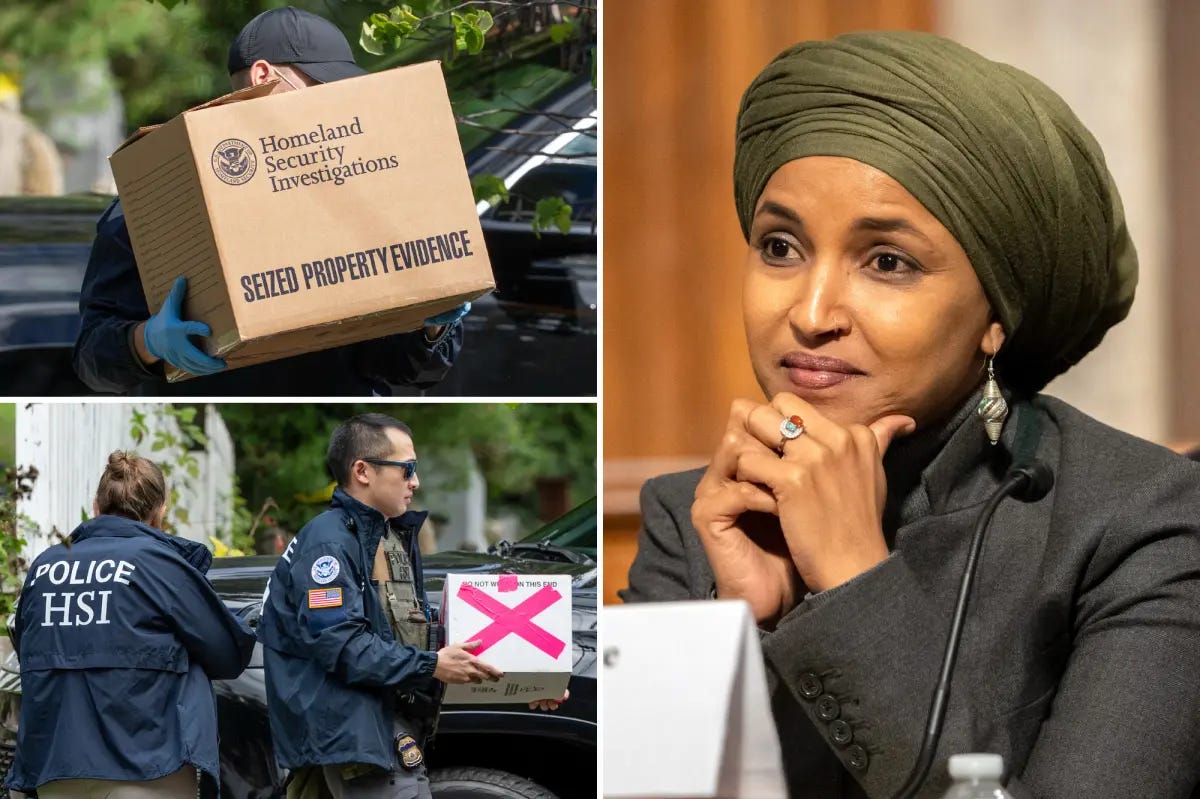
A raid can accomplish its political purpose before a prosecutor proves (or doesn’t prove) a damn thing.
That is what I see in the federal search of Ilhan Omar’s home over the weekend.
By the time agents leave, the images are circulating, the accusations have acquired the appearance of official confirmation, and the person whose home was searched is answering questions the government can leave unanswered.
The administration gets its spectacle immediately. Any reckoning with the evidence happens later.
For a president who has spent years attacking Omar, that is an awfully convenient arrangement.
Federal agents searched the Minnesota congresswoman’s Washington home on Monday, twenty-two days before Election Day. Omar called it political intimidation. I agree with her. The timing, the history and the administration’s public treatment of her make the purpose of this spectacle clear to me. Associated Press
You don’t have to like Omar’s politics to recognize what is happening. Your disagreements with a member of Congress don’t make this fucking acceptable.
In my experience in law enforcement, the government’s power begins affecting someone’s life long before a trial. A search reaches into a person’s home, their privacy and their family’s sense of security. It redirects their time and money toward dealing with investigators and lawyers. It creates an accusation that can follow them even when the public never learns enough to evaluate it.
That power comes with a responsibility to exercise judgment. Having authority to take an investigative step doesn’t answer every question about how, when or why you take it.
Here, the administration had already been telling the public what to think about Omar.
Last month, Homeland Security Secretary Markwayne Mullin publicly referred to an investigation concerning her family’s immigration paperwork and said, “Something’s going to happen.” Now something has happened, in the final weeks of her reelection campaign. Associated Press
That sequence matters. A Cabinet official’s public prediction gives the eventual enforcement action a political audience before agents ever arrive.
The paperwork itself deserves attention, too.
Reuters reports that part of the inquiry concerns immigration documents completed by Omar’s late father when she was a child. Reuters reporting
Think about the distance between that description and the image this administration wants people to carry around: Ilhan Omar, dangerous foreigner, finally exposed by federal agents.
Childhood paperwork. A deceased parent. A naturalized American citizen who now serves in Congress.
Those facts don’t resolve whatever evidence investigators may possess. They do make the administration’s years of portraying Omar as someone who doesn’t belong here especially relevant to the public meaning of this operation.
She can become a citizen. She can get elected. She can represent American constituents. And this president will still invoke where she came from when he wants to discredit her.
That is part of the intimidation. It tells people that citizenship and elected office offer no protection from having your belonging treated as conditional.
The Justice Department says the search was judicially authorized. That is an important fact. A warrant authorizes a defined investigative action; it does not establish the guilt of the person whose home is searched. It also does not give the public a complete account of the decisions that brought agents to the door. Reporting on DOJ’s statement
But the political value of the word “raid” doesn’t depend on those distinctions.
People see federal agents and assume the government must have something. The target is expected to explain herself. Investigators can invoke an ongoing case and say very little. The accusation moves through the news cycle with the authority of the badge attached to it.
I know how much weight that badge carries. An officer’s account can shape everything that follows: what gets investigated, what gets repeated and which person has to fight to correct the record.
That is precisely why the government’s account requires scrutiny.
The public can understand that a search is not a conviction and still absorb the suspicion created by it. A voter doesn’t need to declare someone guilty to become distracted by an allegation. A supporter doesn’t need to abandon a candidate to spend the next week defending her instead of discussing what she stands for.
Every hour spent responding to the government is an hour the government has taken from the campaign.
Election timing makes those consequences sharper.
The Justice Department’s own policy prohibits prosecutors and agents from choosing the timing of investigative actions or statements for the purpose of affecting an election or advantaging or disadvantaging a candidate. That policy recognizes the obvious: federal investigative power can alter political circumstances before a court decides anything. Justice Department policy
The prohibition concerns purpose. It does not mean every search near an election automatically violates a rule. But it makes the administration’s conduct and public messaging legitimate subjects of scrutiny, rather than details we are supposed to ignore once somebody says “warrant.”
Evidence has a chronology. So does a political campaign.
A person can eventually defeat an allegation and still lose the weeks when that allegation mattered most. A later clarification can establish the truth without recovering the opportunities consumed by the original accusation.
That is the advantage this administration gains from turning an investigation into a public event.
I survived an actual attack on our constitutional process on January sixth. I watched people use violence to try to overturn an election. So I take the misuse of power around elections personally, and I have little patience for politicians who celebrate law enforcement when it targets their enemies while excusing attacks on officers when their own supporters commit them.
A badge should not become another instrument of that double standard.
This raid also reaches an audience beyond Omar and her constituents.
Other people in public life see it. So do immigrants who have spent years establishing their lives here. So do families who recognize how little control a child has over documents a parent completes.
They can understand the warning without receiving a letter from a prosecutor.
Challenge this administration, and the machinery may turn toward your home. Your background may become a public accusation. Your family may become material for somebody else’s political performance.
That warning doesn’t require a conviction.
Nor does the immediate harm.
There may eventually be a public account of the evidence. There may be litigation over what the government did. Those developments will matter on their own terms.
But none of them can make Monday’s images arrive after the election. None can return the campaign time already consumed. None can erase the message delivered to everyone watching.
The government controls when it acts. The person it targets has to live on the timetable that action creates.
Trump’s administration doesn’t need to win a case against Ilhan Omar to benefit from putting her under suspicion.
The raid already gave it something a verdict may never deliver.
Punishment, on fucking schedule.